Table of Contents:
- Introduction – The Billing Problem Nobody Notices Until Cash Stops Flowing
- What Is an RA Bill in Construction?
- How the RA Billing Process Works
- RA Bill Format: Core Components
- The Biggest Challenges in Manual RA Billing
- Hidden Risks Most Contractors Ignore
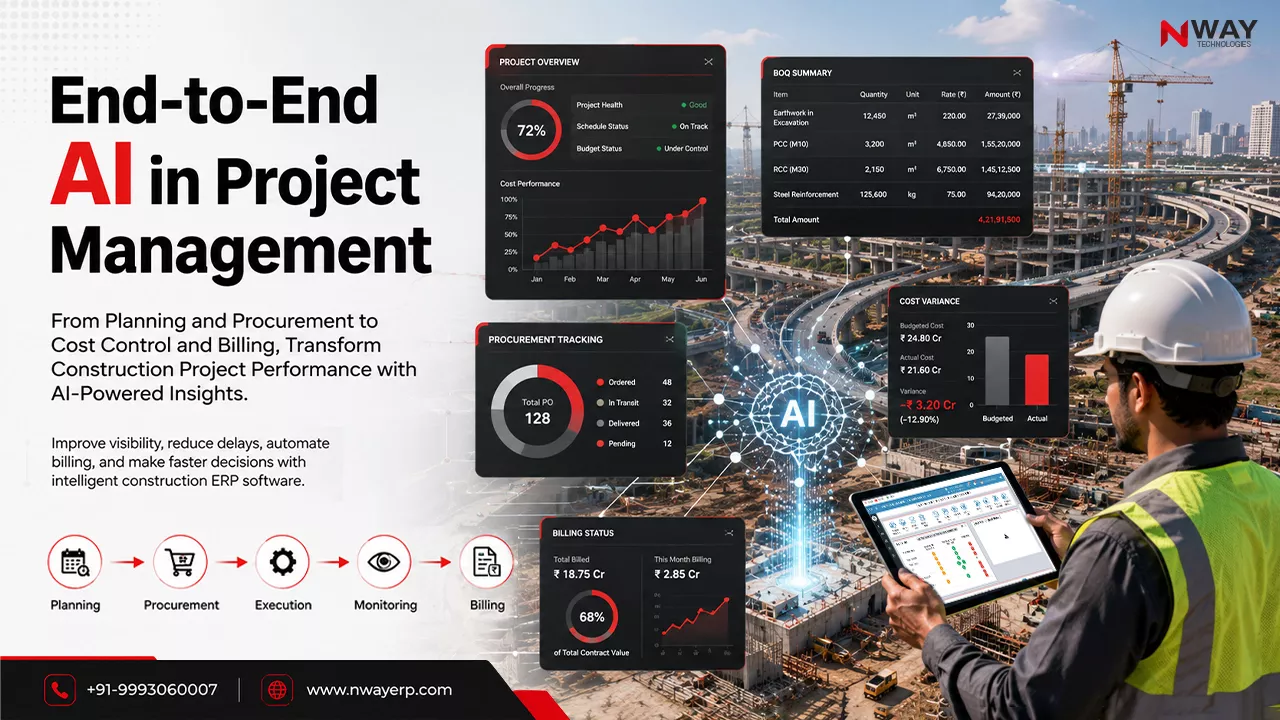
- How Automated RA Billing Transforms Construction Operations
- Key Features to Look for in RA Bill Tracking Software
- Why Construction ERP Delivers Better Billing Control
- Strategic Summary Table: RA Billing Cheat Sheet
- Conclusion
Introduction – The Billing Problem Nobody Notices Until Cash Stops Flowing
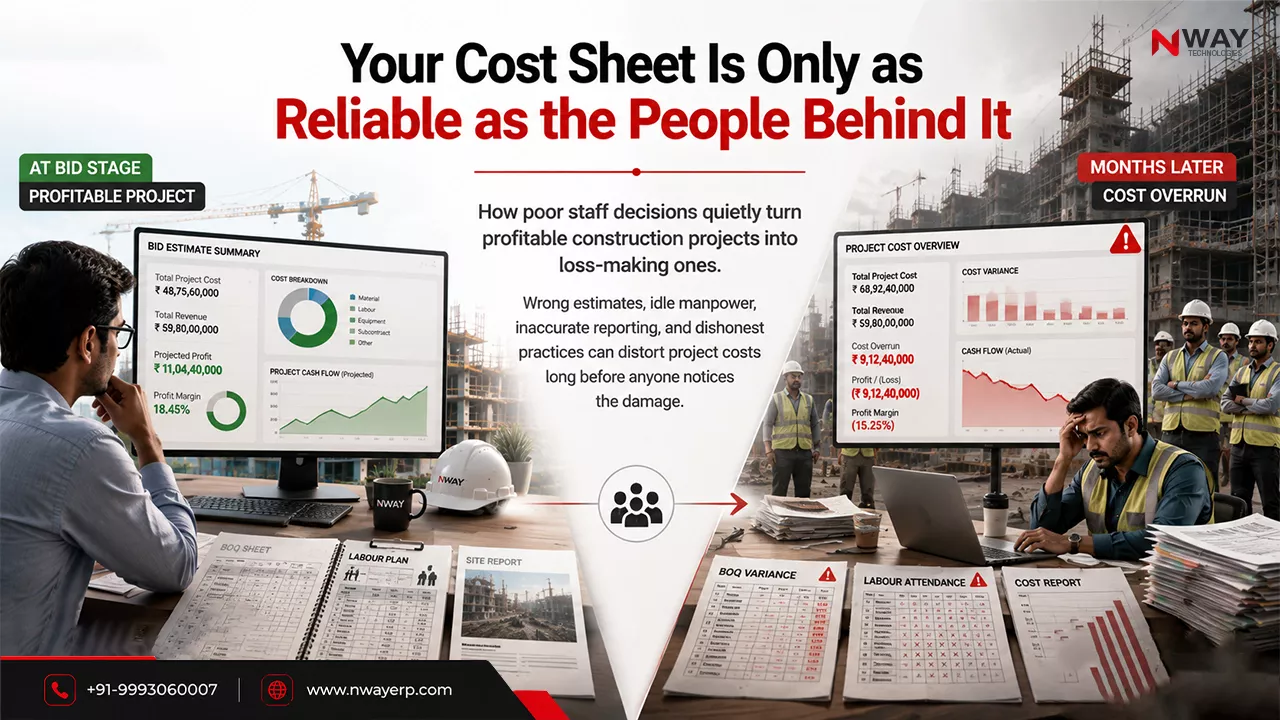
Consider a contractor executing a ₹50-crore infrastructure project.
The work is progressing. Labour is on-site. Machinery is active. Materials are arriving as planned.
Yet the finance team faces a serious problem.
The fourth RA bill has been submitted, but payment has not been released.
Project managers insist work is complete.
Accounts claim measurements are pending.
The client has raised quantity discrepancies.
Meanwhile, vendor payments are due and working capital is under pressure.
This scenario is extremely common across India’s construction industry.
While project teams often focus on execution, procurement, and scheduling, one operational process has a disproportionate influence on cash flow and profitability:
RA billing.
A well-managed RA bill process ensures steady revenue realization. A poorly managed process creates payment delays, billing disputes, project financing stress, and cost overruns.
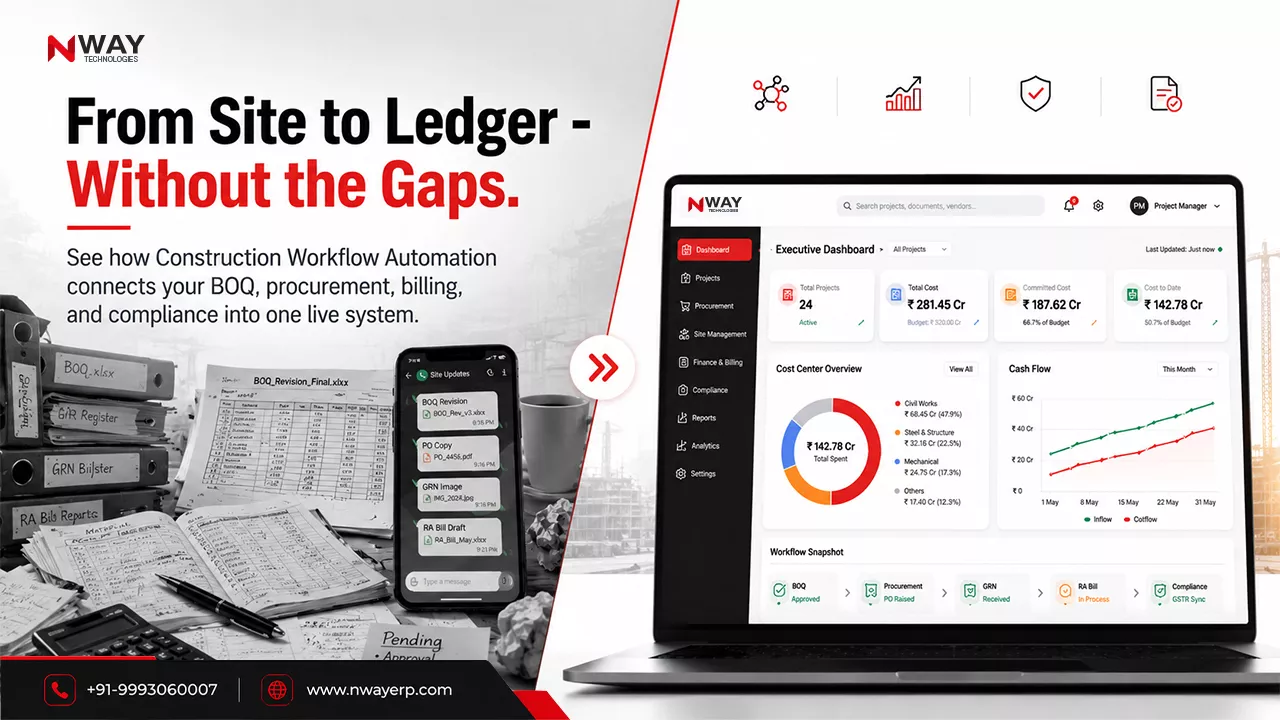
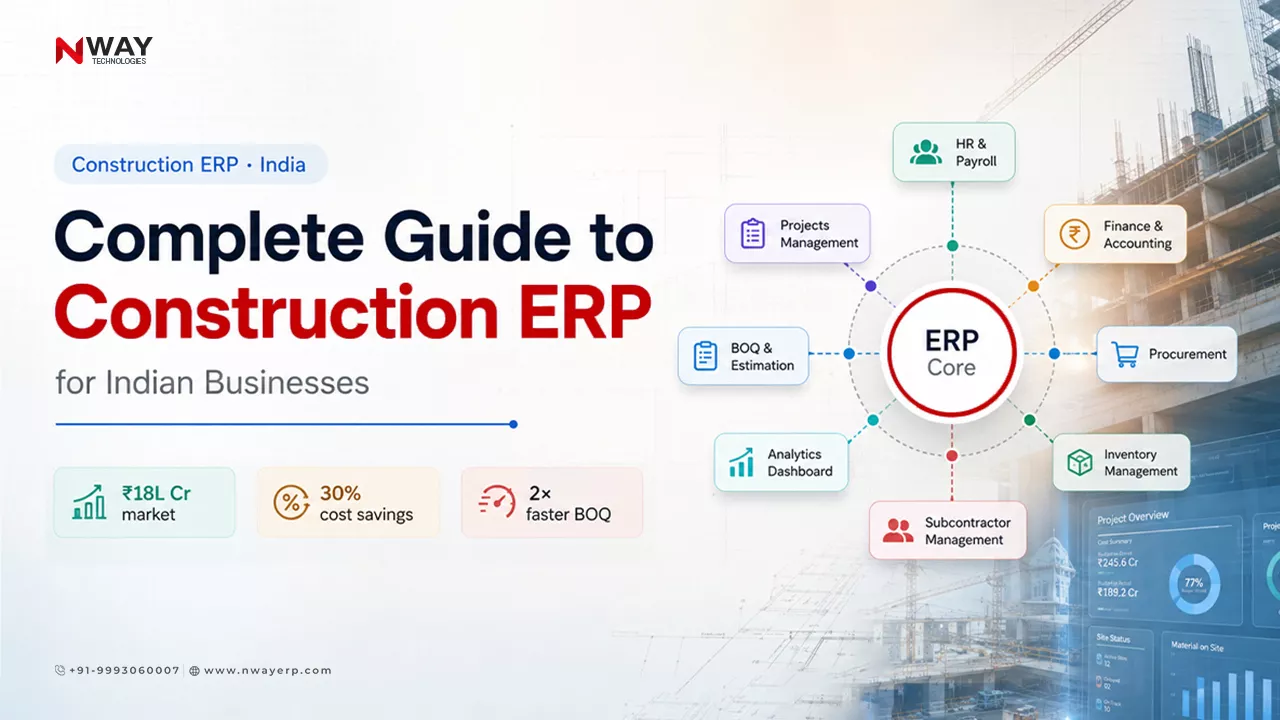
As projects become larger and more complex, contractors are increasingly replacing spreadsheets and manual registers with construction billing software, RA bill tracking software, and integrated construction ERP platforms to gain end-to-end visibility.
What Is an RA Bill in Construction?
An RA Bill in Construction (Running Account Bill) is an interim payment claim raised by a contractor for work completed during the execution phase of a project.
Instead of waiting until project completion for payment, contractors submit periodic bills, typically monthly or milestone-based, capturing the value of executed work.
The client verifies the quantities, deductions, and contractual terms before releasing payment.
Why It Matters
RA bills serve as the financial bridge between project execution and revenue realization.
Without them:
- Contractors face working capital shortages
- Vendor payments become difficult
- Labour payments get delayed
- Project progress slows down
- Profitability becomes unpredictable
Quick Insight
A construction project may contain dozens of RA bills before a final bill is raised. Even a small delay in each cycle can significantly impact annual cash flow.
How the RA Billing Process Works
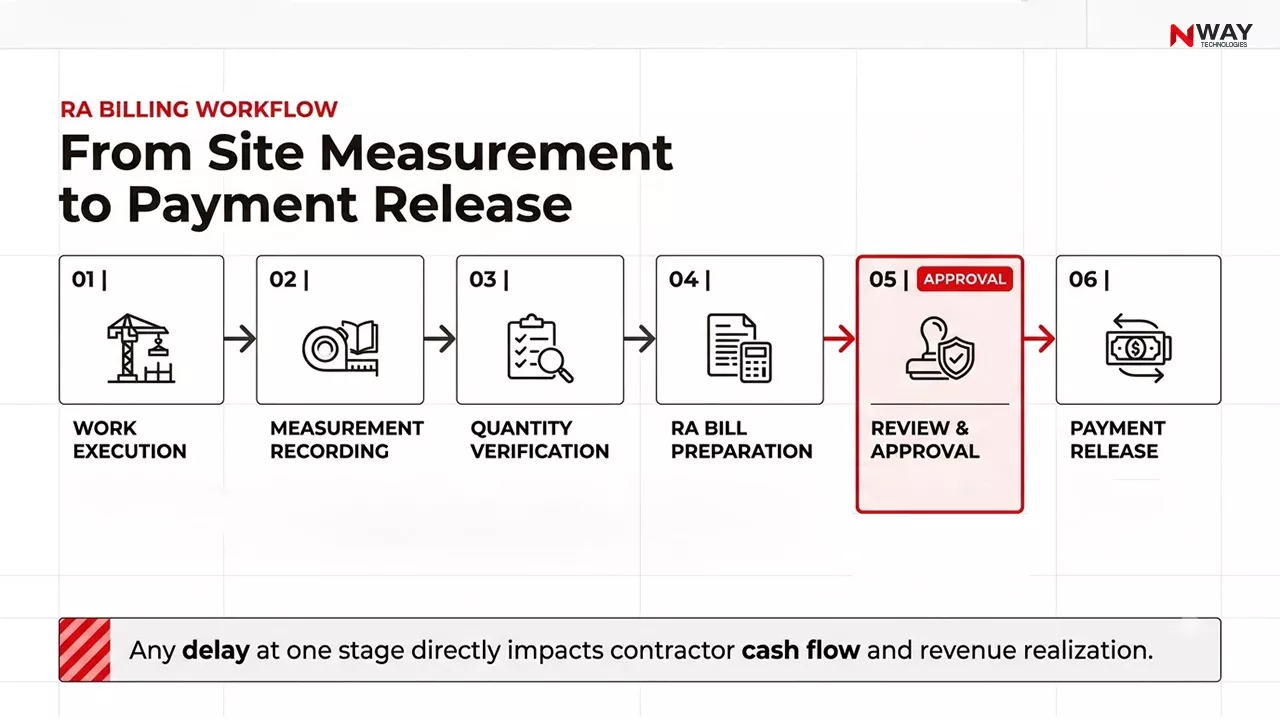
The Standard RA Billing Workflow
Step 1: Work Execution
Project activities are completed according to the approved BOQ and contract scope.
Examples:
- RCC work
- Earthwork
- Finishing activities
- Steel fabrication
- Road construction
Step 2: Measurement Recording
Executed quantities are measured and verified.
Typical measurement sources:
- Site records
- Joint measurement sheets
- Engineer certification
- Survey reports
Step 3: Quantity Verification
Client representatives verify completed quantities against:
- BOQ
- Contract rates
- Approved drawings
- Change orders
*Managing Extra Items, BOQ Deviations and Price Escalation
One of the leading causes of RA billing disputes is work executed beyond the original BOQ scope.
Common examples include:
- Additional client-requested work
- BOQ quantity deviations
- New non-BOQ items
- Material price escalation claims
Such items should be supported by approved variation orders, escalation clauses, or change requests before being included in the RA Bill. Proper documentation helps reduce disputes and speeds up certification.
Step 4: RA Bill Preparation
The contractor prepares the Running Account Bill using approved measurements.
The bill includes:
- Cumulative work executed
- Previous bill amount
- Current bill value
- Deductions
- Net payable amount
Step 5: Review & Approval
The bill passes through:
- Site Engineer
- Project Manager
- Client Engineer
- Quantity Surveyor
- Finance Team
Step 6: Payment Release
After approvals and deductions, payment is processed.
RA Bill Format: Core Components
Standard RA Bill Format Structure
| Section | Information Included |
|---|---|
| Project Details | Project Name, Contract No., Client Name |
| Contractor Details | Company Name, GST Details |
| RA Bill Information | Bill Number, Date, Billing Period |
| BOQ Progress | Item-wise Quantity & Rate |
| Previous Bill Details | Amount Already Paid |
| Current Bill Amount | Value of New Work |
| Deductions | Retention, TDS, Recoveries |
| Net Payable | Final Amount Due |
| Approval Section | Authorized Signatures |
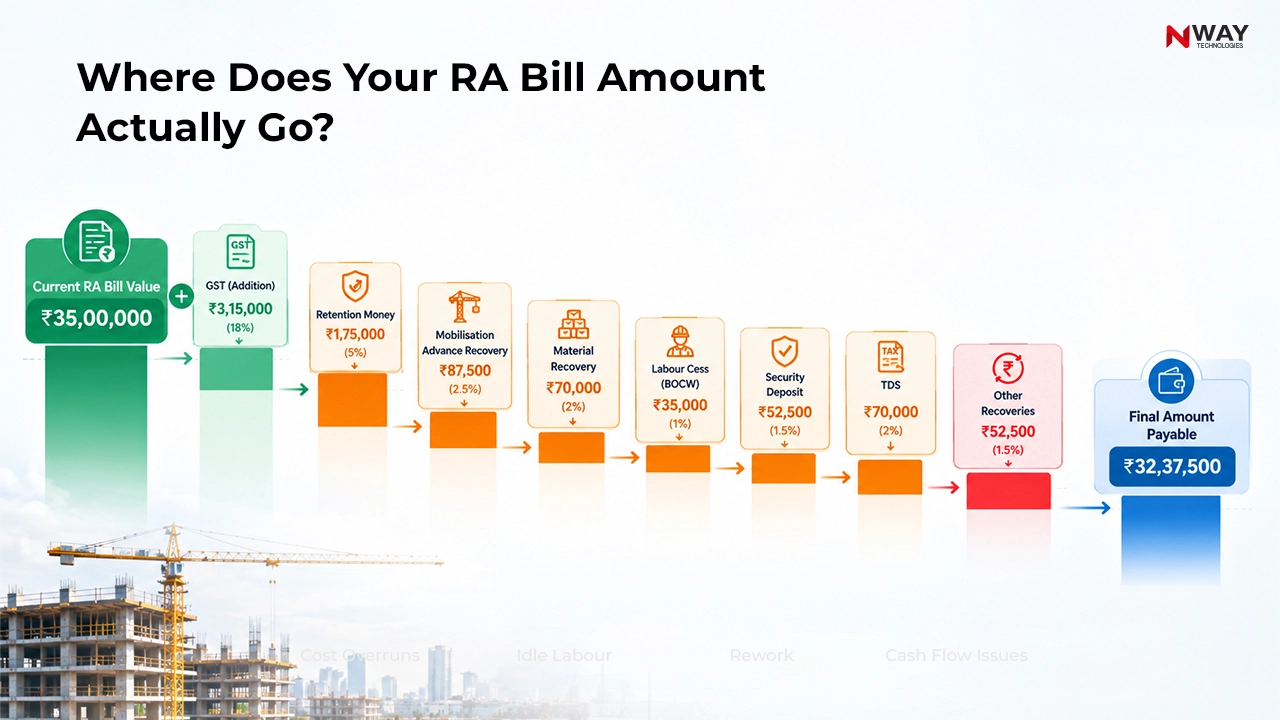
Sample RA Bill Calculation
| Particulars | Amount (₹) |
|---|---|
| Cumulative Work Value | 1,20,00,000 |
| Less Previous Payments | 85,00,000 |
| Current Bill Value | 35,00,000 |
| Add: GST @18% | 6,30,000 |
| Gross Invoice Value | 41,30,000 |
| Less Retention Money @5% | 1,75,000 |
| Less: Mobilisation Advance Recovery | 50,000 |
| Less: Material Recovery | 20,000 |
| Less: TDS @1% on Taxable Value* | 35,000 |
| Less TDS & Recoveries | 70,000 |
| Total Deductions | 2,80,000 |
| Net Amount Payable | 38,50,000 |
*TDS is generally calculated on the taxable value (excluding GST), subject to applicable regulations and contract terms.
Common Deductions in RA Bills
| Deduction Type | Purpose |
|---|---|
| Retention Money | Amount withheld until project milestones or defect liability obligations are fulfilled. |
| TDS (Tax Deducted at Source) | Statutory tax deduction applicable as per prevailing regulations. |
| Mobilisation Advance Recovery | Recovery of advance funds provided at project commencement. |
| Free-Issue Material Recovery | Recovery of client-supplied materials such as cement, steel, fuel, or aggregates. |
| Security Deposit | Contractual deduction maintained as financial security against performance obligations. |
| Labour Cess (BOCW) | Deduction towards Building and Other Construction Workers Welfare requirements. |
| Penalty / Liquidated Damages (LD) | Recovery applied for delays, quality issues, or contractual non-compliance. |
| Other Recoveries | Equipment hire charges, utility charges, insurance recoveries, or other contract-specific deductions. |
Retention Release Process
Retention amounts are generally not lost revenue. They are withheld temporarily and released upon completion of contractual obligations, successful project handover, or closure of the defect liability period. Contractors should actively track retained amounts to ensure timely recovery after eligibility conditions are met.
This addition will directly address the implementation team’s concern because it covers:
- Mobilisation Advance Recovery
- Free-Issue Material Recovery
- Security Deposit
- Labour Cess (BOCW)
- Penalty / LD
- Retention Release Process
Common Mistake
Many contractors focus only on bill preparation and ignore quantity reconciliation. This creates recurring disputes in later billing cycles.
The Biggest Challenges in Manual RA Billing
1. Measurement Disputes
When measurements are maintained in multiple files, project stakeholders often work with conflicting data.
Business Impact
- Delayed certifications
- Reduced trust
- Repeated revisions
2. Billing Errors
Manual formulas and spreadsheet calculations frequently create:
- Quantity errors
- Rate mismatches
- Duplicate entries
- Deduction mistakes
3. Lack of Approval Visibility
One of the most common questions finance teams ask:
“Where is the bill currently stuck?”
Unfortunately, manual systems rarely provide a clear answer.
4. Multiple Project Complexity
As contractors grow, they manage:
- Multiple clients
- Multiple locations
- Multiple billing cycles
Tracking all bills manually becomes difficult and risky.
5. Weak Construction Cost Tracking
Disconnected billing makes it difficult to understand:
- Actual revenue earned
- Project profitability
- Work completed versus invoiced
- Cost versus billing position
Hidden Risks Most Contractors Ignore
- Revenue Leakage – Incorrect quantities can directly reduce bill values.
- Cash Flow Disruptions – Delayed approvals lead to delayed collections.
- Audit Issues – Missing documentation creates compliance challenges.
- Project Margin Erosion – Untracked deductions often go unnoticed until project closure.
Did You Know?
Many construction businesses discover major billing discrepancies only during final bill reconciliation, when recovery becomes significantly more difficult.
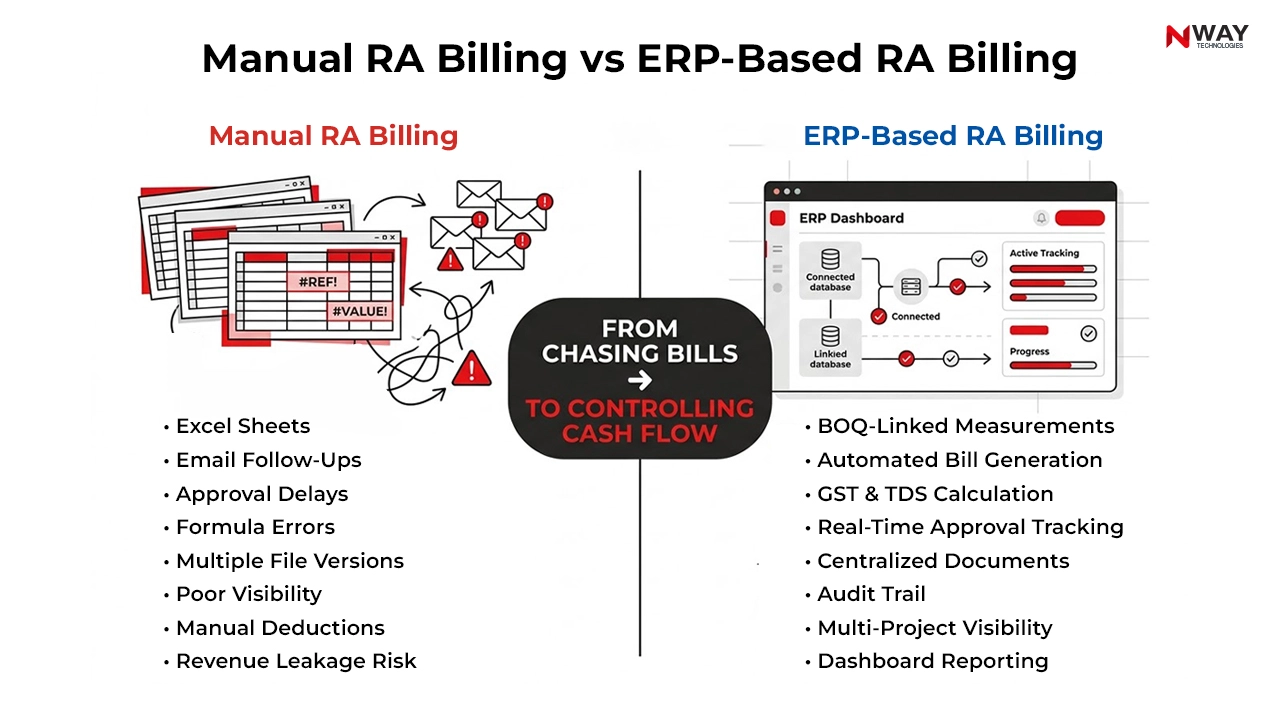
Manual vs Automated RA Billing
Strategic Comparison Matrix
| Area | Manual Process | Automated RA Billing |
|---|---|---|
| Bill Preparation | Excel Based | System Generated |
| Measurement Linking | Manual | Auto Linked |
| Approval Tracking | Calls & Emails | Real-Time Status |
| Deduction Calculation | Manual | Automated |
| Document Storage | Multiple Locations | Centralized |
| Audit Trail | Weak | Complete |
| Reporting | Delayed | Real Time |
| Cash Flow Visibility | Limited | High |
How Automated RA Billing Transforms Construction Operations Automated RA Billing Transforms Construction Operations
What Is Automated RA Billing?
Automated RA billing uses Construction ERP or specialized billing software to connect:
- BOQ
- Measurements
- Project progress
- Finance
- Deductions
- Client billing
into one centralized workflow.
↓
Site Progress
↓
Measurement Entry
↓
Auto Quantity Validation
↓
RA Bill Generation
↓
Approval Workflow
↓
Payment Tracking
↓
Revenue Recognition
Expert Tip
The highest-performing contractors do not merely automate bill creation. They automate the complete billing lifecycle from quantity capture to payment realization.
Key Features to Look for in RA Bill Tracking Software
Real-Time Bill Status Tracking
Track:
- Draft
- Submitted
- Under Review
- Approved
- Partially Paid
- Fully Paid
BOQ Integration
The system should automatically verify quantities against approved BOQ items.
Approval Workflow Management
Bills should move through configured approval stages automatically.
Deduction Management
Track:
- Retention
- TDS
- GST deductions
- Material recoveries
- Advance recoveries
Dashboard Reporting
Management should instantly see:
- Pending bills
- Collection forecasts
- Outstanding receivables
- Project-wise billing status
Best Practices to Follow for RA Billing
Operational Checklist
- Maintain accurate daily measurements
- Reconcile BOQ quantities regularly
- Verify variation items before billing
- Standardize billing templates
- Track bill ageing
- Monitor deduction trends
- Maintain digital documentation
- Review outstanding claims weekly
- Use automated approval workflows
- Link billing with project costing
Why Construction ERP Delivers Better Billing Control
Modern construction businesses are moving beyond standalone billing tools.
They are adopting integrated ERP platforms because billing is connected to:
- Project management
- Procurement
- Equipment utilization
- Contract management
- Cost control
- Finance
When these systems operate independently, visibility suffers.
When they operate together, leadership gains a real-time picture of project health.
Construction ERP Value Framework
Site Team Gains
- Faster bill preparation
- Reduced paperwork
- Better quantity visibility
Finance Team Gains
- Faster reconciliation
- Improved collection tracking
- Stronger audit readiness
Leadership Gains
- Better cash forecasting
- Higher margin visibility
- Improved decision quality
How NWAY ERP Simplifies RA Billing
NWAY ERP enables contractors to digitize and control the complete RA billing lifecycle through:
- BOQ-linked measurement recording
- Automated RA Bill generation from approved quantities
- Configurable deduction setup for retention, advances, recoveries, and taxes
- Multi-level approval workflows
- Real-time bill status tracking
- Centralized document management and audit trails
- Project-wise billing and collection visibility
By connecting project execution, measurement, billing and finance processes, NWAY ERP helps reduce billing delays and improve cash flow visibility.
Mini Case: Improving RA Billing Efficiency with ERP
A mid-sized contractor managing five concurrent projects relied on spreadsheets for measurement tracking and RA bill preparation.
Before ERP
- RA Bill preparation took 5-7 days
- Approval cycles averaged 8-10 days
- Frequent quantity reconciliation issues
- Limited visibility into deduction tracking
After ERP-Based Automation
- Bill preparation reduced to 1-2 days
- Approval turnaround reduced to 2-3 days
- Better measurement accuracy through centralized records
- Improved deduction tracking and audit readiness
- Greater visibility into billing status and collections
As a result, the contractor reduced billing bottlenecks, improved revenue realization, and gained better control over project cash flow.
Strategic Summary Table: RA Billing Cheat Sheet
| Challenge | Business Impact | Recommended Action |
|---|---|---|
| Delayed site measurements | Billing delays | Digital measurement integration |
| Spreadsheet-driven RA bills | Human errors and disputes | Automated RA billing software |
| Poor approval visibility | Cash flow uncertainty | RA bill tracking dashboard |
| Quantity mismatches | Client disputes | BOQ-linked measurement verification |
| Multiple project billing | Operational complexity | Centralized construction ERP |
| Manual deduction calculations | Incorrect payments | Automated deduction engine |
| Lack of audit trail | Compliance risk | Digital documentation repository |
| Disconnected finance and site teams | Delayed decisions | Integrated construction billing software |
Conclusion
The RA bill in construction is far more than a payment document. It is a financial control mechanism that directly influences cash flow, profitability, stakeholder relationships, and project performance.
As projects become larger and margins become tighter, manual billing processes expose contractors to avoidable risks, including delays, disputes, revenue leakage, and poor construction cost tracking.
Forward-looking contractors, EPC companies, and developers are increasingly embracing automated RA billing, RA bill tracking software, and integrated construction billing software to create visibility across the entire billing lifecycle.
The future of construction finance is not simply faster billing. It is intelligent, connected, and data-driven billing that transforms revenue realization into a strategic advantage.