Table of Contents:
- Introduction
- What is Rate Analysis in Construction?
- The Core Components of Rate Analysis
- Step-by-Step Method for Construction Rate Analysis
- Rate Analysis vs Cost Estimation vs BOQ
- Why Manual Rate Analysis Becomes a Bottleneck
- Manual Process vs ERP-Based Rate Analysis
- How Construction ERP Accelerates Tendering
- Construction Rate Analysis Maturity Model
- Conclusion
Introduction
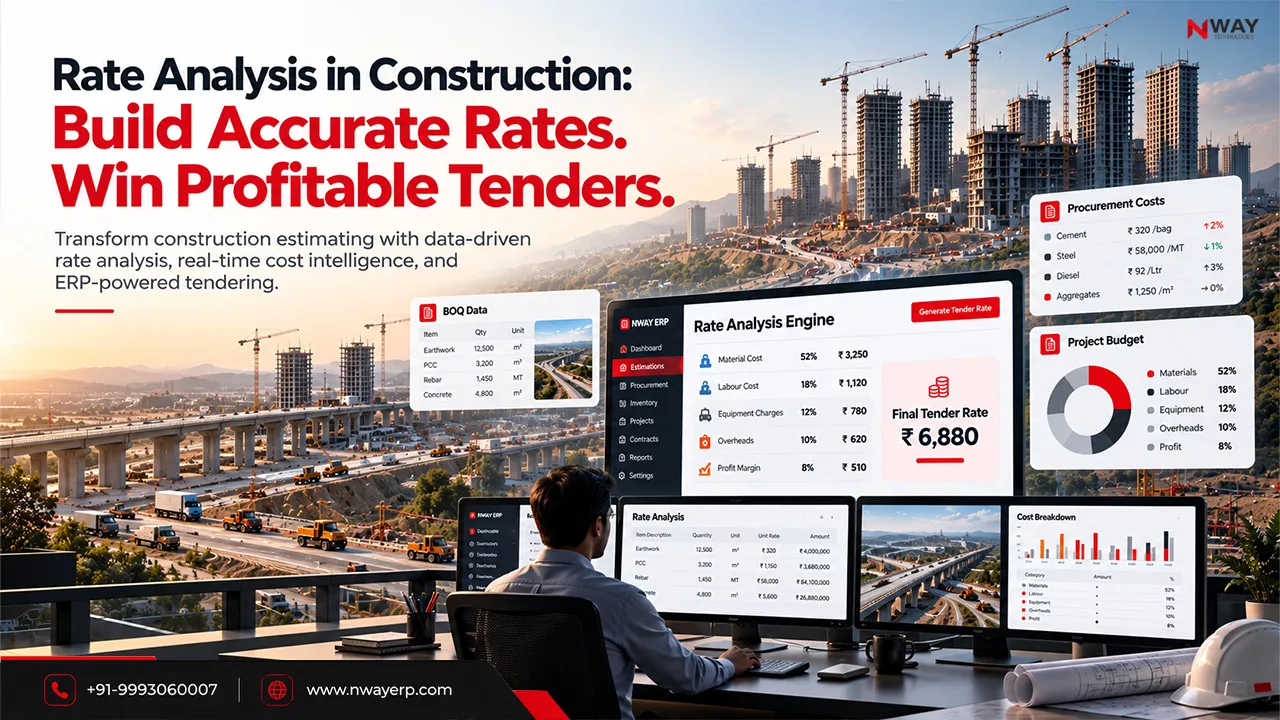
A highway contractor preparing a ₹150 crore tender has only five days left before submission. The quantity of take-offs is ready, subcontractor quotations are arriving, equipment costs have changed, and steel prices have fluctuated again.
The biggest question isn’t whether the contractor can complete the BOQ.
The real question is:
Are the rates accurate enough to win the tender without destroying project margins later?
This is where many construction businesses struggle. Winning a tender with an incorrect rate analysis can be more dangerous than losing the tender altogether. A difference of just 2%-3% in pricing assumptions can translate into crores of rupees in profit loss over the life of a project.
As infrastructure projects become larger, competition intensifies, and margins tighten. Contractors, builders, EPC companies, and developers need more than estimation of spreadsheets. They need a structured and repeatable approach to rate analysis backed by technology, historical cost intelligence, and real-time project data.
What is Rate Analysis in Construction?
Rate analysis in construction is the process of calculating the unit cost of a construction activity by evaluating all resources required to complete that activity, including:
- Materials
- Labour
- Equipment
- Transportation
- Site overheads
- Contractor profit
The objective is to determine the most realistic and profitable rate for an individual item of work before tender submission.
Typical Activities Requiring Rate Analysis
- Earthwork excavation
- PCC and RCC work
- Brick masonry
- Plastering
- Reinforcement work
- Road construction
- Pipeline installation
- Structural steel fabrication
Why Rate Analysis Matters More Than Ever
Business Impact of Accurate Rate Analysis
A well-executed rate analysis helps organizations:
- Improve bid competitiveness
- Protect project margins
- Reduce estimation errors
- Forecast cash flow accurately
- Support procurement planning
- Improve client confidence
Hidden Risks of Poor Rate Analysis
When rate analysis is incorrect:
- Projects may be underbid
- Cash flow projections fail
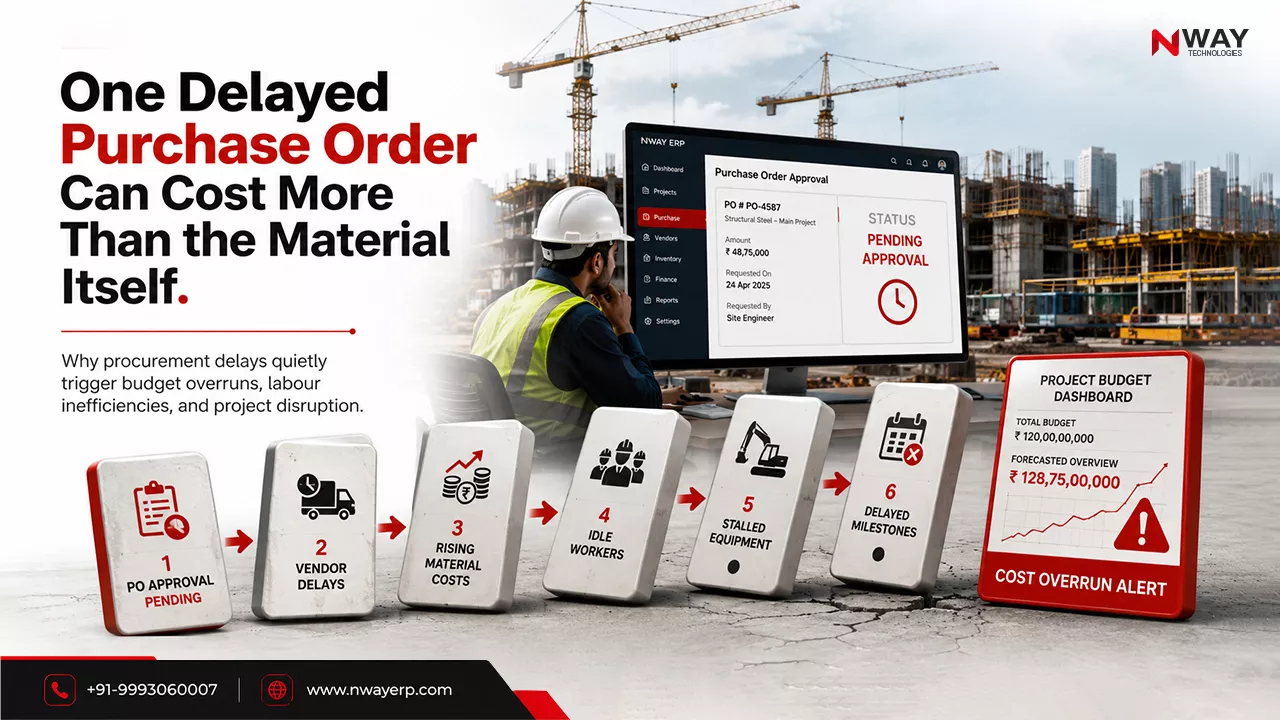
- Procurement budgets become unrealistic
- Labour productivity assumptions become inaccurate
- Profitability erodes during execution
Quick Insight
Most project losses do not start on-site.
They begin during tender preparation when inaccurate assumptions are converted into approved rates.
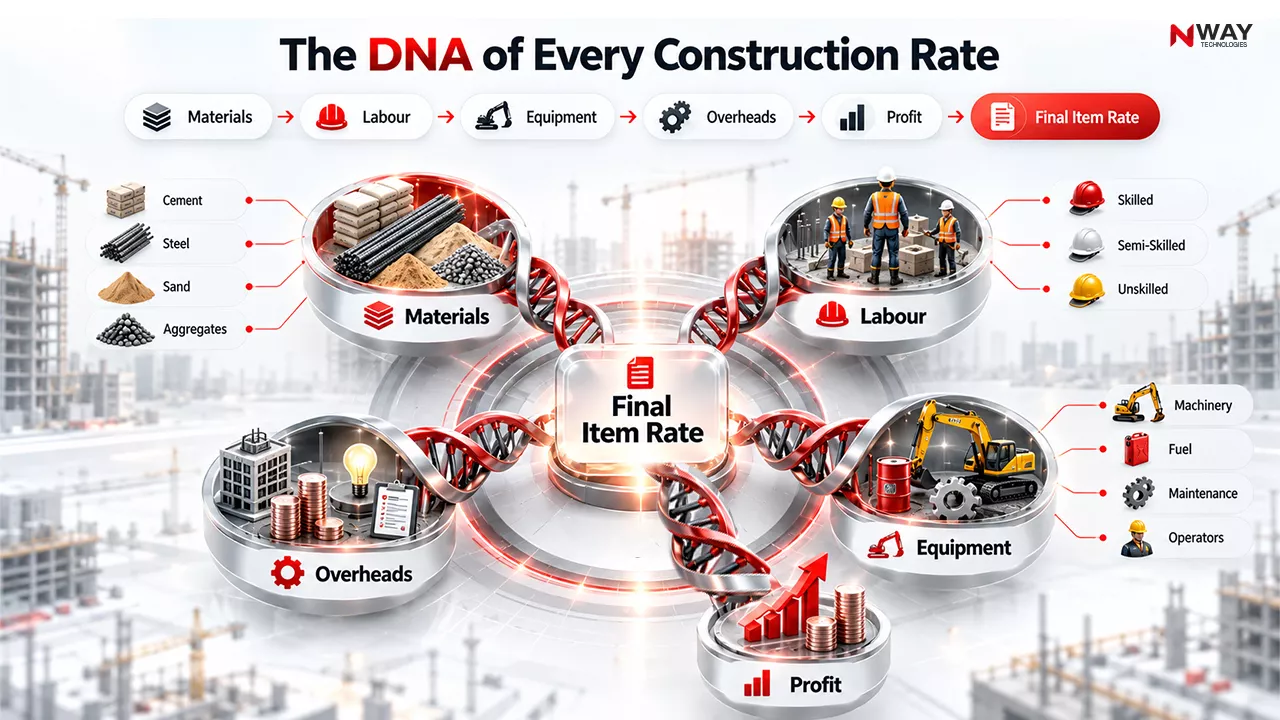
The Core Components of Rate Analysis
1. Material Cost
Materials typically represent the largest percentage of construction costs.
Examples:
- Cement
- Steel
- Sand
- Aggregates
- Bitumen
- Pipes
- Finishing materials
Best Practice
Always account for:
- Transportation
- Handling
- Loading/unloading
- Wastage percentage
- Regional price variation
2. Labour Cost
Labour cost includes:
- Skilled workers
- Semi-skilled workers
- Unskilled labour
- Supervisors
- Foremen
Factors affecting labour rates:
- Productivity levels
- Site location
- Construction complexity
- Working conditions
3. Equipment Cost
Typical equipment expenses:
- Excavators
- Cranes
- Batching plants
- Rollers
- Concrete mixers
- Vibrators
Common Mistake
Many estimators calculate rental costs but ignore:
- Fuel consumption
- Idle time
- Operator wages
- Maintenance expenses
4. Overheads
Indirect costs include:
- Site office
- Utilities
- Temporary facilities
- Insurance
- Safety management
- Administrative expenses
Industry practice often adds overhead percentages during rate build-up.
5. Profit Margin
The final component is contractor profit.
Profit allocation depends on:
- Competitive intensity
- Project risk
- Client profile
- Contract type
- Market conditions
Step-by-Step Method for Construction Rate Analysis
Step 1: Identify the Work Item
Example:
M20 Concrete (1 m³)
Clearly define:
- Specifications
- Standards
- Scope
- Measurement unit
Step 2: Calculate Resource Quantities
Determine:
- Cement quantity
- Sand quantity
- Aggregate quantity
- Labour requirement
- Equipment requirement
Step 3: Collect Current Rates
Gather:
- Vendor quotations
- Market rates
- Historical project rates
- Schedule of Rates (SOR)
- Departmental benchmarks
Step 4: Compute Direct Cost
Formula:
Step 5: Add Overheads and Profit
Formula:
Practical Example of Rate Analysis
Example: M20 Concrete (1 m³)
| Component | Cost (₹) |
|---|---|
| Cement | 2,660 |
| Sand | 600 |
| Aggregate | 800 |
| Labour | 1,200 |
| Equipment | 300 |
| Direct Cost | 5,560 |
| Overheads (10%) | 556 |
| Contingency (5%) | 278 |
| Final Rate | 6,394 / m³ |
Illustrative unit-rate calculation adapted from industry rate-analysis methodology.
Expert Tip
Do not rely exclusively on published schedules of rates.
Market fluctuations in steel, cement, diesel, and labour availability can quickly make static rates obsolete.

Rate Analysis vs Cost Estimation vs BOQ
| Factor | BOQ | Cost Estimate | Rate Analysis |
|---|---|---|---|
| Purpose | Quantify Work | Estimate Total Project Cost | Calculate Unit Rates |
| Focus | Quantity | Overall Cost | Cost Per Item |
| Used During Tendering | Yes | Yes | Yes |
| Procurement Support | Limited | Moderate | High |
| Cost Control Value | Moderate | High | High |
Did You Know?
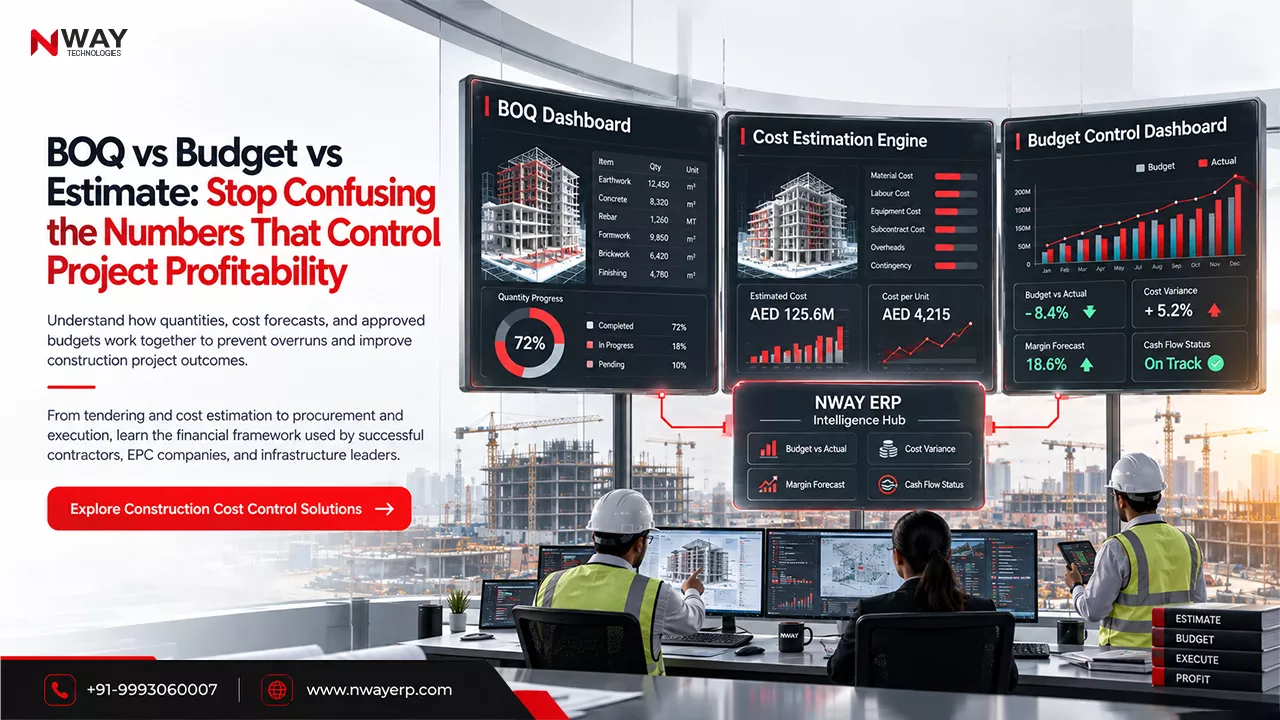
A BOQ tells you what needs to be built.
Rate analysis determines how much each activity should cost.
The estimate combines both to determine the total project value.
[Related Reading: BOQ vs Budget vs Estimate: What’s the Difference? ]
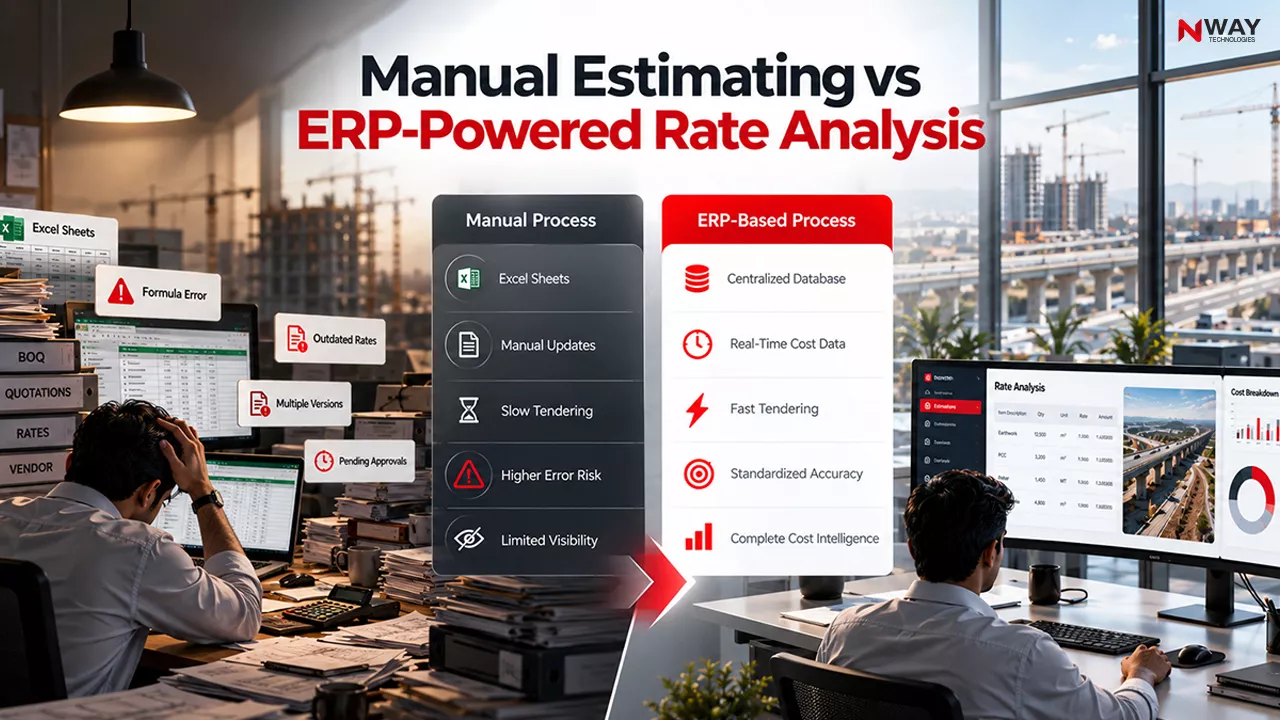
Why Manual Rate Analysis Becomes a Bottleneck
As projects grow, estimation complexity increases significantly.
Challenges include:
- Hundreds of BOQ items
- Vendor comparison tracking
- Changing market prices
- Multiple estimators
- Version conflicts
- Formula errors
Common Scenario
Many contractors still use:
- Spreadsheets
- Email approvals
- Manual quotations
- Disconnected cost databases
The result:
- Longer tender preparation cycles
- Higher risk of pricing errors
- Reduced confidence in estimates
Still Building Tenders in Excel? – Reduce estimation errors, standardize rate analysis, and prepare bids faster with NWAY Construction ERP.
Manual Process vs ERP-Based Rate Analysis
| Capability | Manual Approach | Construction ERP |
|---|---|---|
| Rate Libraries | Spreadsheet Based | Centralized |
| Vendor Comparisons | Manual | Automated |
| Historical Cost Data | Scattered | Unified |
| Tender Preparation | Time-Consuming | Faster |
| Approval Workflow | Email Based | Structured |
| Accuracy | User Dependent | Standardized |
| Multi-Project Access | Difficult | Centralized |
| Cost Visibility | Limited | Real-Time |
How Construction ERP Accelerates Tendering
Modern construction ERP solutions help estimation teams move from reactive calculations to intelligent costing.
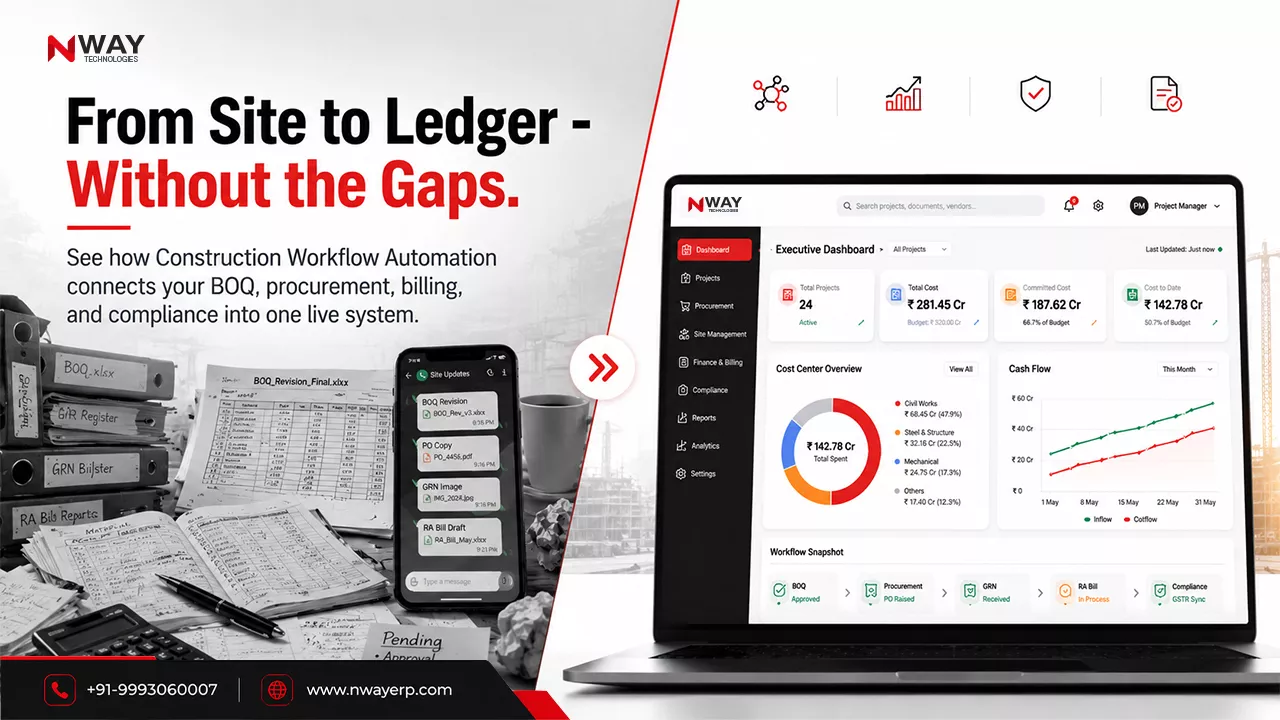
According to internal NWAY ERP material, modern ERP systems centralize estimation, BOQ management, cost control, procurement, and budgeting into a connected workflow.
What ERP Brings to Rate Analysis
Centralized Rate Library
Benefits:
- Standardized item rates
- Common costing methodology
- Faster estimate preparation
Historical Project Intelligence
Estimate teams can analyze:
- Past project costs
- Previous bidding performance
- Resource consumption patterns
Vendor Quotation Comparison
Estimator teams can:
- Compare multiple supplier quotes
- Identify cost-saving opportunities
- Improve procurement planning
Automated Tender Preparation
ERP reduces:
- Manual calculations
- Spreadsheet dependencies
- Data duplication
Construction Rate Analysis Maturity Model
| Level | Approach | Risk |
|---|---|---|
| Level 1 | Manual Register Pricing | Very High |
| Level 2 | Excel-Based Estimation | High |
| Level 3 | Standard Cost Database | Moderate |
| Level 4 | Integrated ERP Estimation | Low |
| Level 5 | ERP + AI-Powered Cost Intelligence | Very Low |
Organizations operating at Levels 4 and 5 generally achieve better cost visibility and faster decision-making.
Best Practice Checklist
Before Tender Submission
- Validate BOQ quantities
- Verify latest market prices
- Compare multiple vendor quotations
- Include transportation costs
- Add realistic wastage factors
- Consider equipment idle time
- Incorporate contingency provisions
- Review productivity assumptions
- Conduct independent estimate review
- Compare with historical project data
Conclusion
Rate analysis in construction is much more than an estimation exercise. It is the financial foundation upon which tender competitiveness, project profitability, procurement planning, and cost control are built. [See : Construction Planning & Estimation Software]
As projects become larger and margins become tighter, contractors can no longer rely solely on spreadsheets, isolated rate sheets, or historical assumptions. The organizations that consistently win profitable projects are those that standardize rate analysis, leverage historical cost intelligence, validate assumptions rigorously, and connect tendering with execution.
The future of construction estimating lies in connected, ERP-driven project intelligence, where BOQs, rate analysis, procurement, budgeting, and actual project costs work together in real time. For contractors seeking faster tendering and better margin protection, that transition is no longer a competitive advantage. It is rapidly becoming a business necessity.
Turn Accurate Rate Analysis into Profitable Projects