Table of Contents:
- Introduction
- Understanding Retention Money and Mobilization Advance
- Why Contractors Struggle to Recover Retention Money
- The Financial Impact of Poor Tracking
- How Contractors Should Track Retention Money
- Managing Mobilization Advance Effectively
- ERP vs Manual Tracking: A Contractor’s Reality
- How Construction ERP Software Improves Recovery Management
- Industry Scenario: Before and After Digital Tracking
- Building a Retention Recovery Strategy
- Conclusion
Introduction
A contractor may spend months negotiating project margins, optimizing procurement costs, and accelerating execution schedules, only to discover that a substantial portion of earned revenue remains trapped in retention accounts long after the project is complete.
This is one of the most overlooked financial challenges in the construction industry.
While discussions around project profitability often focus on cost overruns and productivity, retained payments and unrecovered advances can quietly erode working capital and create avoidable dependence on external financing. For contractors managing multiple projects simultaneously, even small delays in recovery can accumulate into significant cash flow constraints.
The companies that consistently outperform their peers are not necessarily those winning the largest projects. They are often the ones that maintain stronger financial discipline, better contract visibility, and tighter control over recoverable funds.
That’s where systematic retention and mobilization of advance management becomes a competitive advantage rather than merely a contractual requirement.
Understanding Retention Money and Mobilization Advance
What is Retention Money in Construction?
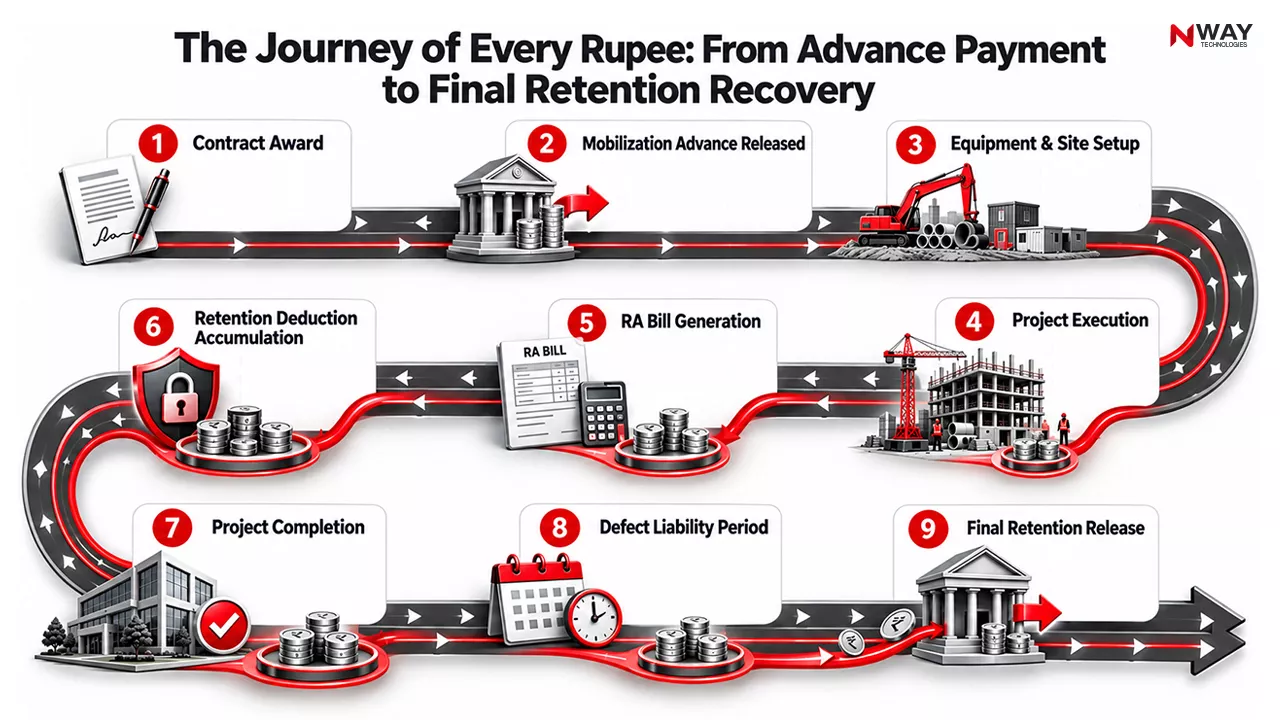
Retention of money in construction refers to a percentage of payment withheld by the client from each running bill as security against incomplete work, defects, or contractual non-compliance.
Typically:
- 5% to 10% of invoice value is retained
- Collected progressively throughout project execution
- Released partially at project completion
- Balance released after the defect liability period
The purpose is to safeguard the client’s interests and ensure contractors fulfill all contractual commitments.
Why It Matters
For contractors, retention money is not a cost.
It is earned revenue that remains temporarily inaccessible.
If not managed effectively, retained amounts can significantly affect:
- Working capital
- Cash flow planning
- Equipment financing
- Vendor payments
- Expansion opportunities
What is Mobilization Advance in Construction?
Mobilization advance in construction is an upfront payment provided by a client to help a contractor mobilize resources before project execution begins.
The advance may be used for:
- Equipment mobilization
- Site establishment
- Labor deployment
- Material procurement
- Temporary infrastructure setup
In most contracts, the mobilization advance is gradually recovered through deductions from subsequent running bills.
Quick Insight
A contractor may receive a substantial mobilization advance at project commencement while simultaneously accumulating retention money during execution.
Both need separate tracking mechanisms because:
- Mobilization advance is deducted by the client.
- Retention money is payable by the client.
Confusing the two often leads to accounting errors and recovery disputes.
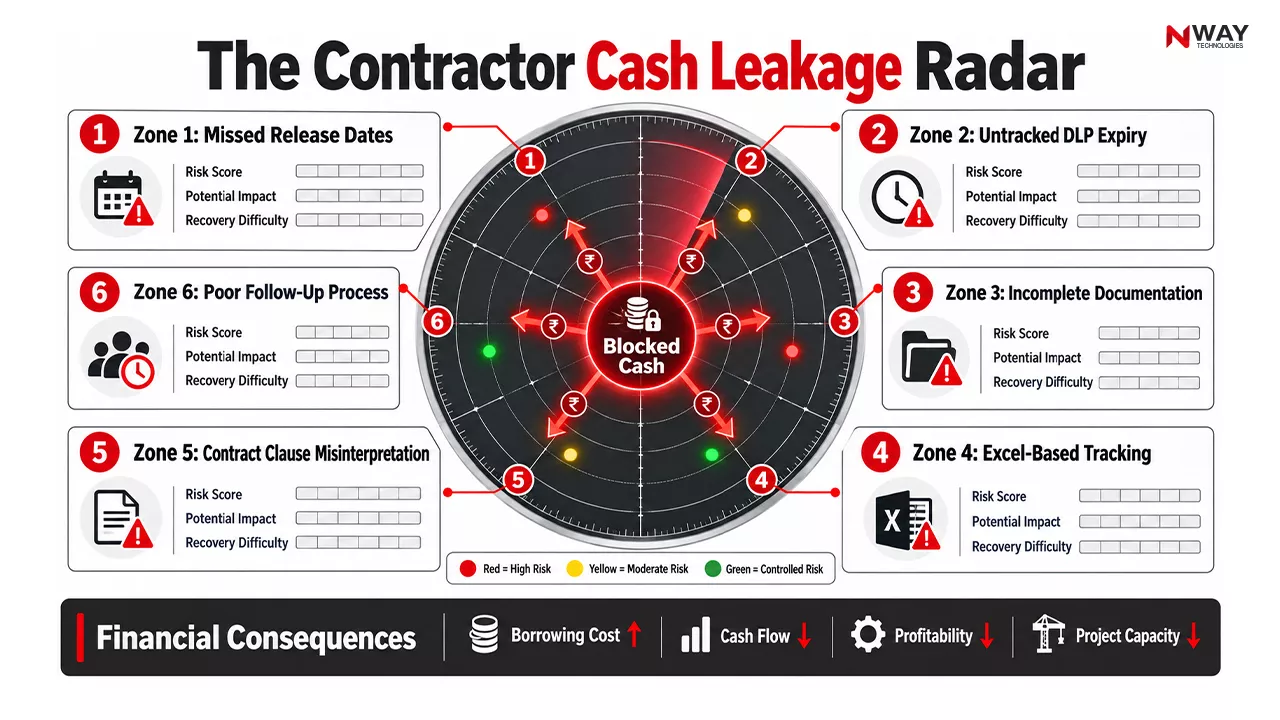
Why Contractors Struggle to Recover Retention Money
The Visibility Problem
Many contractors understand how much retention has been deducted but lack visibility into:
- Contract-wise balances
- Release conditions
- Defect liability timelines
- Certification status
- Outstanding documentation
As project portfolios grow, manual monitoring becomes increasingly difficult.
Common Challenges
1. Multiple Active Projects
A contractor handling 20 projects may have:
- Different retention percentages
- Different release schedules
- Different retention clause in construction contracts
- Different recovery conditions
Without a centralized system, tracking becomes fragmented.
2. Documentation Gaps
Retention release often depends on:
- Completion certificates
- Quality approvals
- As-built drawings
- Defect closure reports
- Final account settlements
Missing even one document can delay payment.
3. Defect Liability Period Confusion
Many organizations do not actively monitor:
- Start date of DLP
- End date of DLP
- Pending defects
- Release eligibility dates
Consequently, recoverable funds remain unclaimed.
4. Lack of Ownership
Finance teams assume project teams are tracking recoveries.
Project teams assume finance departments are following up.
The result is predictable: nobody owns the process.
Common Mistake
Many contractors focus heavily on winning new projects while neglecting outstanding retention recoveries from completed projects.
This creates artificial cash shortages even when substantial funds are legally recoverable.
The Financial Impact of Poor Tracking
Hidden Cost of Retention Delays
Consider a contractor executing projects worth ₹100 crore annually.
Assume:
- Retention rate = 5%
- Total retention accumulated = ₹5 crore
If recovery is delayed by 12 months:
- Additional borrowing may be required
- Interest costs increase
- Cash conversion cycle extends
- Profitability declines
The issue is not revenue generation.
The issue is revenue realization.
Risk Assessment Matrix
| Risk | Probability | Business Impact |
|---|---|---|
| Missed retention release date | High | High |
| Incorrect advance recovery calculation | Medium | High |
| Contract interpretation disputes | Medium | High |
| Missing supporting documents | High | Medium |
| Cash flow shortage | High | High |
| Audit observation | Medium | Medium |
How Contractors Should Track Retention Money
Step 1: Create a Contract-Based Recovery Register
Every project should have a dedicated tracking framework containing:
- Contract value
- Retention percentage
- Total retained amount
- Amount released
- Pending balance
- DLP end date
- Expected release date
This creates accountability and visibility.
Step 2: Monitor Contract Milestones
Recovery eligibility often depends on:
- Mechanical completion
- Project completion
- Final handover
- Defect closure
Tracking milestones is as important as tracking money.
Step 3: Link Documentation with Recovery
Maintain digital records of:
- Contract agreements
- Client approvals
- Completion certificates
- Quality clearances
- Release requests
When documentation is centralized, recovery cycles accelerate.
Best Practice Checklist
- Maintain project-wise retention ledger
- Review recoveries monthly
- Track DLP expiry dates
- Automate reminder alerts
- Store all supporting documents digitally
- Assign responsibility for follow-up
- Escalate overdue recoveries
- Reconcile client deductions regularly
Managing Mobilization Advance Effectively
A Recommended Framework
Before Project Start
Verify:
- Advance amount
- Recovery mechanism
- Interest conditions
- Bank guarantee requirements
During Project Execution
Track:
- Total advance received
- Recovery percentage
- Amount recovered
- Balance outstanding
During RA Billing
Ensure:
- Deductions match contract conditions
- Recovery calculations are accurate
- Billing reflects current advance balance
Expert Tip
Never depend solely on client calculations.
Contractors should maintain independent recovery records to validate deductions and prevent revenue leakage.
ERP vs Manual Tracking: A Contractor’s Reality
| Activity | Manual Process | ERP-Driven Process |
|---|---|---|
| Retention tracking | Excel files | Automated ledger |
| Advance recovery | Manual calculations | System-generated adjustments |
| DLP monitoring | Calendar reminders | Automated alerts |
| Documentation management | Email folders | Central repository |
| Management reporting | Time-consuming | Real-time dashboards |
| Recovery forecasting | Limited visibility | Predictive insights |
| Financial control | Reactive | Proactive |
How Construction ERP Software Improves Recovery Management
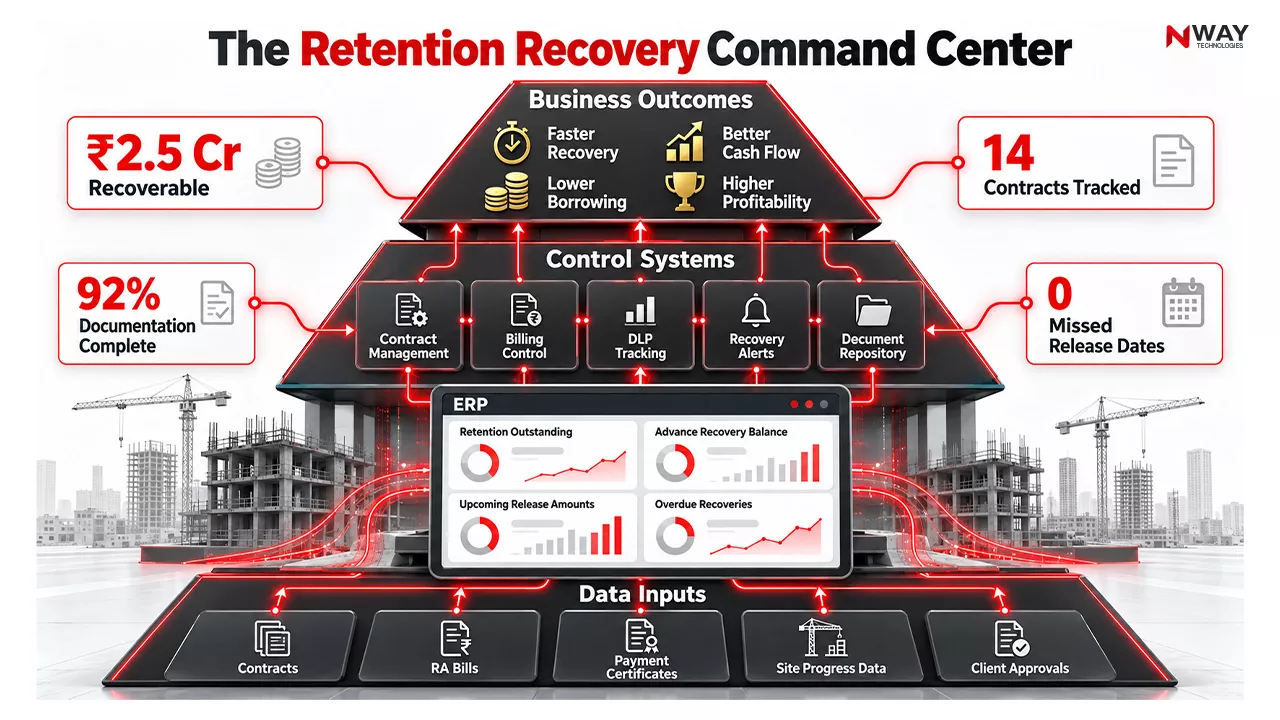
Modern construction ERP software transforms retention and advance management from a reactive process into a controlled business workflow.
Centralized Contract Management
A robust ERP system stores:
- Contract details
- Payment terms
- Retention percentages
- Release conditions
- Advance recovery schedules
All stakeholders access the same information.
Automated Retention Tracking
The system can automatically:
- Calculate deductions
- Track balances
- Generate recovery reports
- Monitor release eligibility
This reduces dependency on spreadsheets.
Advance Recovery Management
ERP systems help contractors:
- Track advance utilization
- Reconcile deductions
- Monitor recovery progress
- Avoid billing discrepancies
Dashboard-Based Visibility
Decision-makers receive visibility into:
- Total retention outstanding
- Project-wise recoveries
- Advance balances
- Aging analysis
- Expected cash inflows
Did You Know?
Many construction companies discover significant recoverable amounts only after consolidating project data inside ERP systems. Visibility often becomes the biggest financial gain. Explore : Construction MIS Software
Industry Scenario: Before and After Digital Tracking
Before
A contractor manages 30 projects through spreadsheets.
Problems include:
- Different file formats
- Duplicate records
- Missed deadlines
- Delayed follow-ups
- Cash flow stress
After ERP Implementation
The contractor gains:
- Centralized project visibility
- Automated alerts
- Faster reconciliations
- Better cash flow forecasting
- Stronger management control
Expected Outcomes
- Faster retention recovery
- Fewer disputes
- Improved working capital
- Higher finance team productivity
- Better project profitability visibility
Building a Retention Recovery Strategy
A Four-Pillar Framework
Pillar 1: Contract Intelligence
Understand every retention clause in construction contract documents before execution begins.
Pillar 2: Financial Visibility
Create real-time visibility for finance, project, and leadership teams.
Pillar 3: Digital Documentation
Ensure all approvals and certificates are digitally accessible.
Pillar 4: Recovery Governance
Conduct monthly reviews covering:
- Upcoming releases
- Pending claims
- Contractual risks
- Escalation actions
Conclusion
Retention money in construction and mobilization advances are far more than contractual accounting entries. They directly influence liquidity, project funding capacity, borrowing requirements, and overall business profitability. Contractors that rely on fragmented spreadsheets and manual follow-up processes often experience delayed recoveries, avoidable disputes, and unnecessary cash flow pressure.
The industry is steadily moving toward data-driven contract administration where recovery milestones, documentation requirements, and financial obligations are tracked with the same rigor as project execution. By combining disciplined contract management practices with modern Construction ERP software solutions such as NWAY ERP, contractors can improve visibility, accelerate recoveries, strengthen working capital, and convert earned revenue into realized cash more efficiently.
In an increasingly competitive construction market, recovery management is no longer just a finance function. It is a strategic capability that directly impacts growth, profitability, and business resilience.