Introduction
The construction industry is moving rapidly toward automation. Robots, autonomous equipment, drones, 3D printing, and AI-powered technologies are changing how construction companies plan, execute, monitor, and manage projects.
But there is an important question: Can construction robots really improve project performance if the data they generate remains disconnected from the rest of the business?
Robotics can automate physical tasks, but construction companies still need to manage projects, materials, equipment, labour, procurement, costs, and financial operations.
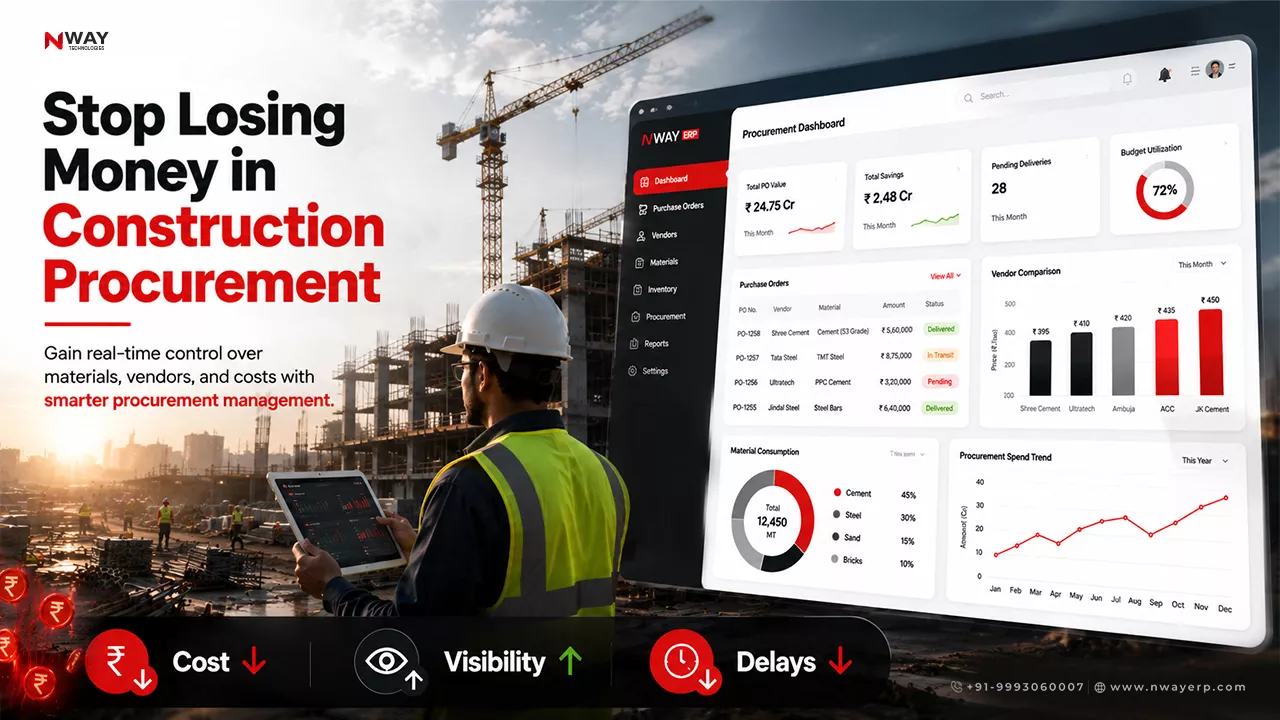
By connecting field operations with business data, construction ERP system can help construction companies turn automation into measurable improvements in productivity, cost control, resource utilization, and project visibility.
Table of Contents:
-
- Why Robotics Is Becoming Important in Construction
- How Robots Are Changing the Construction Industry
- Types of Robots Used in Construction
- Benefits of Robotics in Construction
- The Biggest Challenge: Connecting Robots With Construction Data
- How Construction ERP Software Supports Automation
- How NWAY ERP Supports Connected Construction Operations
- The Future of Robotics and ERP in Construction
- How Construction Companies Can Prepare for Automation
- Conclusion
- Frequently Asked Questions
Why Robotics Is Becoming Important in Construction
Construction is one of the most resource-intensive industries. Projects involve large workforces, heavy machinery, multiple materials, subcontractors, suppliers, and teams working across different locations.
For Indian construction and infrastructure companies, the automation conversation looks slightly different. Labour-intensive site practices, tighter margins, and large multi-site portfolios mean that robotics adoption is likely to be selective — used where safety risk or precision requirements are highest — rather than a wholesale replacement of manual crews. This makes the connection between automated equipment and centralised project data even more important for Indian builders, who are often managing several sites with varying levels of technology maturity at the same time.
At the same time, construction companies face increasing pressure to deliver projects faster while controlling costs and maintaining quality.
Robotics can help address some of these challenges by automating activities that are repetitive, physically demanding, dangerous, or highly dependent on precision.
Construction automation is not only about replacing manual work.
It is about creating safer, more consistent, and data-driven construction processes.
However, automation becomes significantly more valuable when information from automated equipment can be connected with project and business systems.
How Robots Are Changing the Construction Industry
Robots are already being used across several areas of construction. Their role is expanding as technologies such as artificial intelligence, sensors, computer vision, and autonomous equipment become more accessible.
1. Automating Repetitive Construction Tasks
Construction includes many repetitive activities such as bricklaying, drilling, cutting, demolition, and material movement.
Robotic systems can perform selected repetitive activities consistently and with predefined levels of accuracy.
This can help companies:
- Reduce repetitive manual work
- Improve consistency
- Increase productivity
- Reduce process-related errors
- Allow skilled workers to focus on higher-value activities
2. Improving Construction Site Safety
Construction workers can be exposed to heavy machinery, hazardous environments, demolition activities, working at height, and physically demanding tasks.
Robotic systems can perform selected high-risk activities remotely or with reduced direct worker exposure.
This makes robotics an important part of a broader construction safety and automation strategy.
3. Improving Accuracy and Quality
Small errors during construction can result in rework, material wastage, additional labour costs, and project delays.
Robotic systems can perform specific activities according to predefined measurements and processes, helping improve consistency.
When this information is combined with project data, managers can compare actual execution with planned quantities, schedules, and budgets.
4. Increasing Productivity
Robots can perform certain repetitive activities consistently and, depending on the application, for longer operating periods.
However, increasing productivity in one activity does not automatically guarantee faster project completion.
Construction performance depends on several connected processes:
Planning → Procurement → Materials → Labour → Equipment → Execution → Billing → Project Monitoring
If materials are delayed, equipment is unavailable, or approvals are pending, even highly automated work can be interrupted.
This is why robotics needs to be connected with construction management systems.
Types of Robots Used in Construction
Construction robotics includes several technologies, each designed for different activities.
Robotic Bricklaying
Bricklaying robots such as the SAM100 (Semi-Automated Mason, built by Construction Robotics) and Australia’s Hadrian X (by FBR) can lay bricks far faster than manual crews while working from a digital building plan, cutting and placing each brick with pre-calculated precision.
Autonomous Construction Equipment
San Francisco-based Built Robotics retrofits standard excavators, dozers and other heavy equipment with autonomous guidance systems, allowing them to grade, dig and move earth without an onsite operator. Boston Dynamics’ Spot robot is increasingly deployed on active sites to walk pre-planned routes and capture progress data in environments too hazardous for repeated human visits.
Robotic Demolition
Remote-controlled demolition robots from manufacturers such as Brokk are used to bring down structures or clear hazardous material in situations where sending in a human crew would carry unacceptable risk.
Drones for Construction
Beyond general aerial survey, platforms such as Scaled Robotics combine drone or handheld scanning with AI to flag deviations between the as-built structure and the design model, letting site teams catch discrepancies before they become expensive rework. Drones can support construction teams with:
- Site surveys
- Progress monitoring
- Aerial documentation
- Inspection
- Quantity measurement
- Site mapping
The real value of drone data increases when it can be connected with project management and reporting systems.
3D Construction Printing
Companies including ICON (USA) and China’s WinSun use large-format 3D printers, in some cases paired with a robotic arm, to print structural walls and even complete single-storey homes in a fraction of the time conventional construction requires.
Robotic Inspection & Progress Tracking
Doxel uses computer vision to scan a site on a regular cycle and automatically compare actual progress against the BIM model, surfacing errors and schedule slippage early. Dusty Robotics’ FieldPrinter robot prints layout markings directly onto the slab from digital plans, removing a manual, error-prone step from the workflow. Robotic and autonomous inspection systems can collect images, measurements, and other site information that can help teams identify issues earlier.
Benefits of Robotics in Construction
When implemented for the right construction activities, robotics can provide several operational benefits.
Higher Productivity
Automation can perform repetitive tasks consistently and reduce the time required for selected activities.
Better Accuracy
Robotic systems can follow predefined processes and measurements, helping improve consistency.
Improved Safety
Robotics can reduce direct worker exposure to selected hazardous or physically demanding activities.
Less Repetitive Labour
Workers can spend more time on supervision, decision-making, quality control, and specialised activities.
Reduced Rework
Greater consistency can help reduce errors and rework in suitable construction processes.
Better Resource Utilisation
Connected equipment and project data can help managers understand how resources are being used across projects.
The Biggest Challenge: Connecting Robots With Construction Data
Robots can generate large amounts of operational data.
For example, automated equipment may produce information about:
- Operating hours
- Productivity
- Equipment utilisation
- Fuel or energy consumption
- Maintenance requirements
- Project allocation
- Work completed
But what happens if this information stays inside separate systems?
Project managers may still need spreadsheets, emails, manual reports, and phone calls to understand the overall project situation.
Automation without connected data creates another information silo.
The objective should not simply be to automate individual tasks. Construction companies need to connect automated operations with project, financial, material, equipment, and workforce information.
This is where an ERP for construction can provide an important management layer.
A connected construction ERP can bring together:
Equipment Data → Project Progress → Materials → Labour → Costs → Management Reports
Instead of looking at each operation separately, management gets a broader view of project performance.
The Biggest Challenge: Connecting Robots With Construction Data
High Upfront Investment
Robotic systems, from bricklaying machines to autonomous excavator retrofits, typically require a significant capital outlay. Smaller and mid-sized contractors often need a clear productivity or safety case before this investment makes sense.
Skills and Training Gaps
Operating and maintaining robotic equipment requires training that most construction crews do not yet have. Companies adopting automation need a plan for upskilling existing staff, not just purchasing the equipment.
Limited Applicability Across Site Conditions
Most current construction robots are built for specific, controlled tasks. Unpredictable site conditions, tight urban sites, or highly customised work still depend heavily on skilled manual labour.
Integration With Existing Workflows
A robot that performs well in isolation adds limited value if its output hours worked, material used, progress data cannot be captured by the systems a company already uses for scheduling, procurement and billing. This is the integration challenge a construction ERP is built to solve.
How Construction ERP Software Supports Automation
An ERP system does not replace construction robots.
Instead, it helps connect automated operations with the wider business.
Modern construction ERP software can help manage the information generated across projects, equipment, materials, procurement, labour, and finance.
1. Equipment and Machinery Management
Automated machines are still construction assets that need to be scheduled, allocated, monitored, maintained, and tracked.
An ERP system can help companies manage:
- Equipment allocation
- Machine availability
- Equipment utilisation
- Maintenance schedules
- Operating costs
- Project-wise equipment usage
This becomes particularly important when expensive automated equipment is being deployed across multiple construction sites.
2. Construction Project Management
Automation should ultimately contribute to better project delivery.
Construction project management software can help teams monitor schedules, progress, resources, costs, milestones, and site activities.
This allows managers to understand whether automation is actually improving project performance.
3. Material and Procurement Management
A robotic machine can be ready to work, but if the required material is unavailable, the activity can still stop.
Construction ERP software can connect:
Material Planning → Procurement → Inventory → Site Issue → Consumption → Project Cost
This creates better visibility across the material lifecycle.
Learn more about construction purchase and procurement management.
4. Construction Cost Control
Automation requires investment. Companies therefore need to understand whether the technology is actually improving project economics.
ERP software can help compare:
- Planned costs
- Actual costs
- Equipment costs
- Labour costs
- Material costs
- Project progress
Construction companies can also connect project financial information through construction finance and accounting software.
5. Real-Time Reporting
Automated systems can generate large volumes of operational data.
A construction ERP can help turn this information into management reports and dashboards.
The goal is to move from:
“What happened on the site?”
to:
“What is happening now, why is it happening, and what action should we take?”
How NWAY ERP Supports Connected Construction Operations
NWAY ERP is designed specifically for construction businesses and brings project, equipment, material, labour, and financial information into a connected environment.
The platform supports construction-focused functions including project management, planning and estimation, purchase management, stores and inventory, machinery and vehicle management, finance and accounts, HR and payroll, and labour management.
Connected Equipment Management
NWAY ERP helps construction businesses manage machinery and vehicles alongside project operations, providing better visibility into equipment allocation and utilisation.
Integrated Material Management
Material information can be connected with procurement, inventory, and project operations, reducing dependency on disconnected spreadsheets and delayed reports.
Project-Level Visibility
Project teams can access project information and resource data from a central platform, helping managers make faster decisions across multiple sites.
AI and Automation
NWAY ERP is also bringing AI and automation into construction workflows.
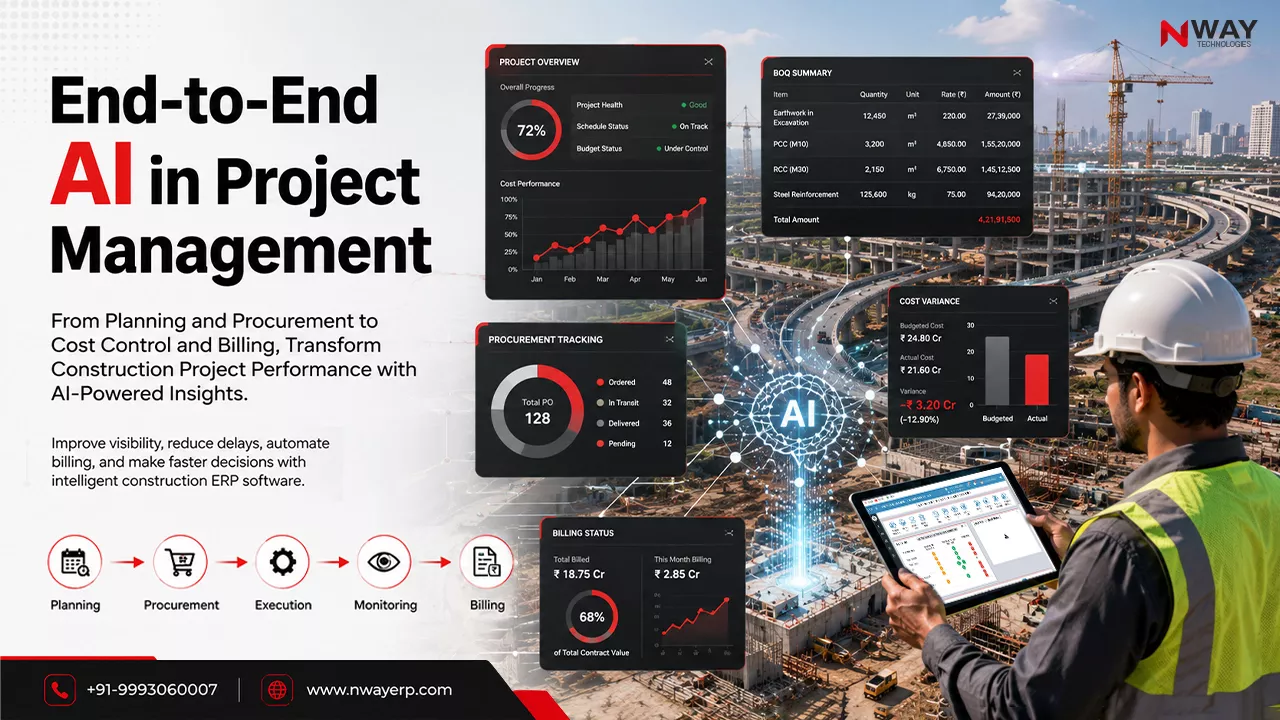
Explore how AI-powered construction project management software can support project monitoring, reporting, forecasting, and operational decision-making.
Ready to Connect Your Construction Operations?
Discover how NWAY ERP can help connect your projects, equipment, materials, workforce, and financial operations through one construction-focused ERP platform.
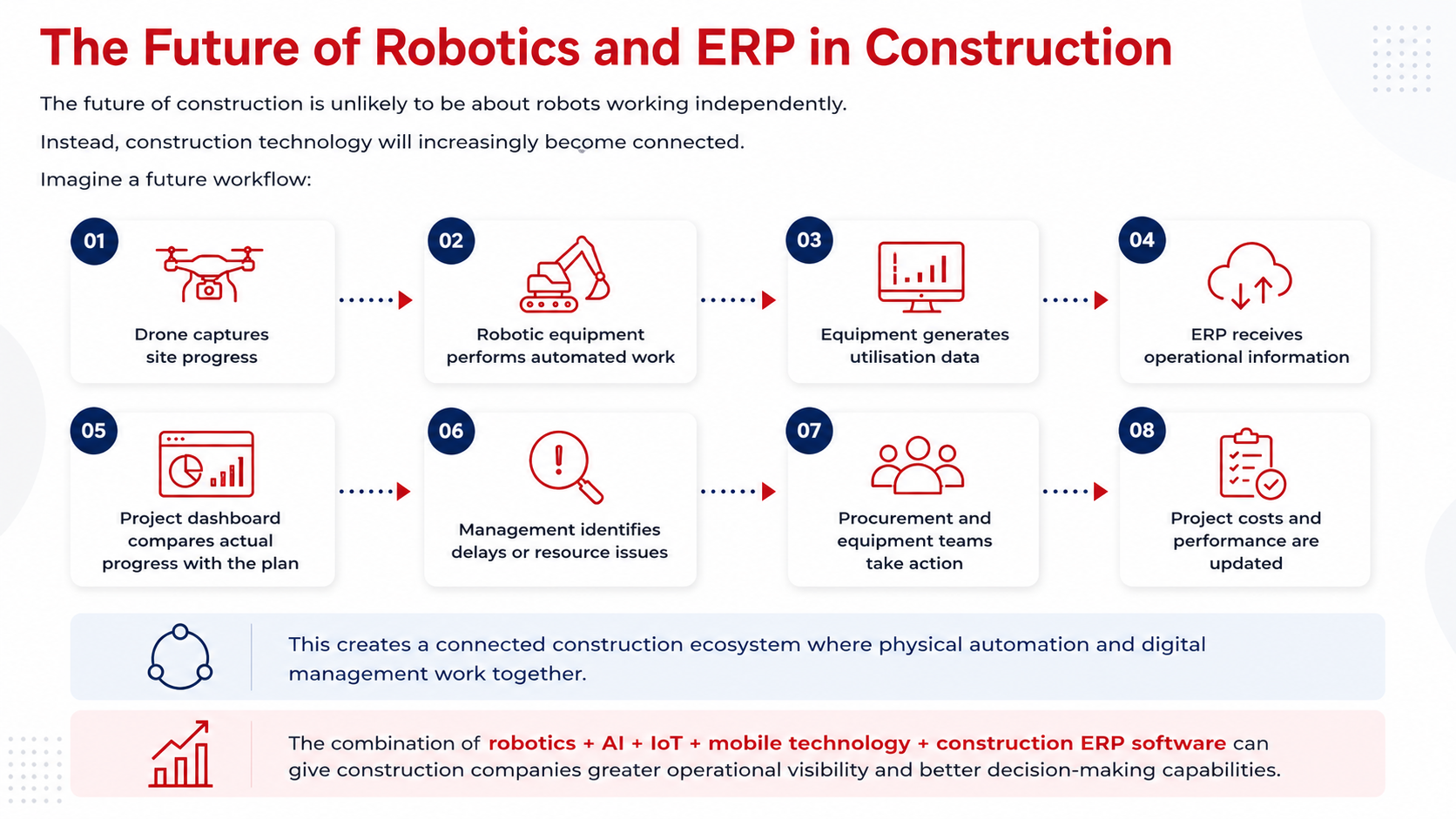
The Future of Robotics and ERP in Construction
How Construction Companies Can Prepare for Automation
Companies do not need to automate every activity at once. A practical approach is to start with processes where automation can provide measurable value.
Step 1: Identify Repetitive Activities
Find activities that consume significant time, involve repetitive work, or create safety risks.
Step 2: Measure Current Performance
Record productivity, labour hours, equipment utilization, rework, downtime, and costs before introducing automation.
Step 3: Select Suitable Technology
Evaluate whether robotics, drones, sensors, autonomous equipment, or other technologies can improve the selected process.
Step 4: Connect the Data
Make sure information generated by automated systems can be captured and used by your construction management system.
Step 5: Measure ROI
Compare productivity, costs, downtime, resource utilization, and project performance before and after implementation.
Step 6: Scale Gradually
Once automation demonstrates measurable value, expand it to other projects and construction activities.
Conclusion
Robotics is changing construction by making selected activities faster, safer, and more precise.
But robots alone cannot solve every construction management challenge.
Construction companies also need connected systems that can manage projects, materials, equipment, labour, procurement, and financial information.
This is where construction ERP software becomes increasingly important.
By connecting automated equipment with project and business data, an ERP system can help construction companies turn automation into measurable operational improvements.
NWAY ERP brings construction project management, planning, procurement, inventory, machinery, labour, and financial management together in one platform, helping construction businesses build a more connected and data-driven operation.
Build a More Connected Construction Business
See how NWAY ERP can help you manage projects, resources, equipment, materials, and business operations from one construction-focused ERP platform.
Frequently Asked Questions
What are construction robots?
Construction robots are automated machines or robotic systems designed to perform specific construction activities such as bricklaying, demolition, material handling, inspection, surveying, or other repetitive tasks.
How are robots changing the construction industry?
Robots can automate repetitive and potentially hazardous activities, improve precision, increase productivity, and reduce the amount of manual work required for selected construction processes.
What are the benefits of robotics in construction?
Key benefits include improved productivity, greater consistency, reduced repetitive labour, better safety for selected activities, improved precision, and potentially lower rework.
Can ERP software work with construction robots?
Yes. ERP software can provide a management and data layer around automated operations. Equipment, project, material, labour, and cost information can be brought together to provide better visibility and decision-making.
Why is ERP important for construction automation?
Robots generate operational data, but construction companies also need to connect that data with project schedules, materials, equipment, labour, and costs. A construction ERP can provide this connected view.
Does NWAY ERP support construction equipment management?
Yes. NWAY ERP includes machinery and vehicle management as part of its construction ERP platform, alongside project management, planning, purchase, inventory, finance, HR, and labour management.
Will construction robotics replace construction workers?
Robotics is more likely to change the type of work performed by construction workers than eliminate the need for people entirely. Workers will continue to be needed for supervision, planning, specialised work, decision-making, maintenance, and activities requiring human judgement.
How can a construction company start using automation?
Start by identifying repetitive or high-risk activities, measuring current performance, evaluating suitable automation technologies, connecting operational data with your construction management system, and measuring the return on investment.