Table of Contents:
- Introduction
- Important Features of a Construction ERP SolutionWhy Fuel Theft Is a Bigger Problem Than Most Contractors Realize
- Understanding Fuel Consumption Visibility in Construction Equipment
- The Evolution from Manual Fuel Logs to Digital Fuel Intelligence
- How Fuel Management Software Construction Companies Use Actually Works
- Before vs After: Construction Fuel Management Transformation
- How ERP Integration Creates Complete Cost Control
- Common Mistakes Contractors Make
- How to Optimize Construction Fuel
- The Future of Fuel Management in Construction
- Conclusion
Introduction
Imagine a highway EPC project spread across 75 kilometers.
The site has multiple excavators, graders, compactors, batching plants, cranes, DG sets, water tankers, and support vehicles operating simultaneously. Every day, thousands of litres of diesel are consumed across different locations.
At the end of the month, management notices something concerning.
Fuel expenses have risen sharply.
Equipment productivity hasn’t increased.
Project margins are shrinking.
Yet nobody can explain where the extra fuel went.
This is a common scenario across construction, infrastructure, mining, and EPC businesses in India.
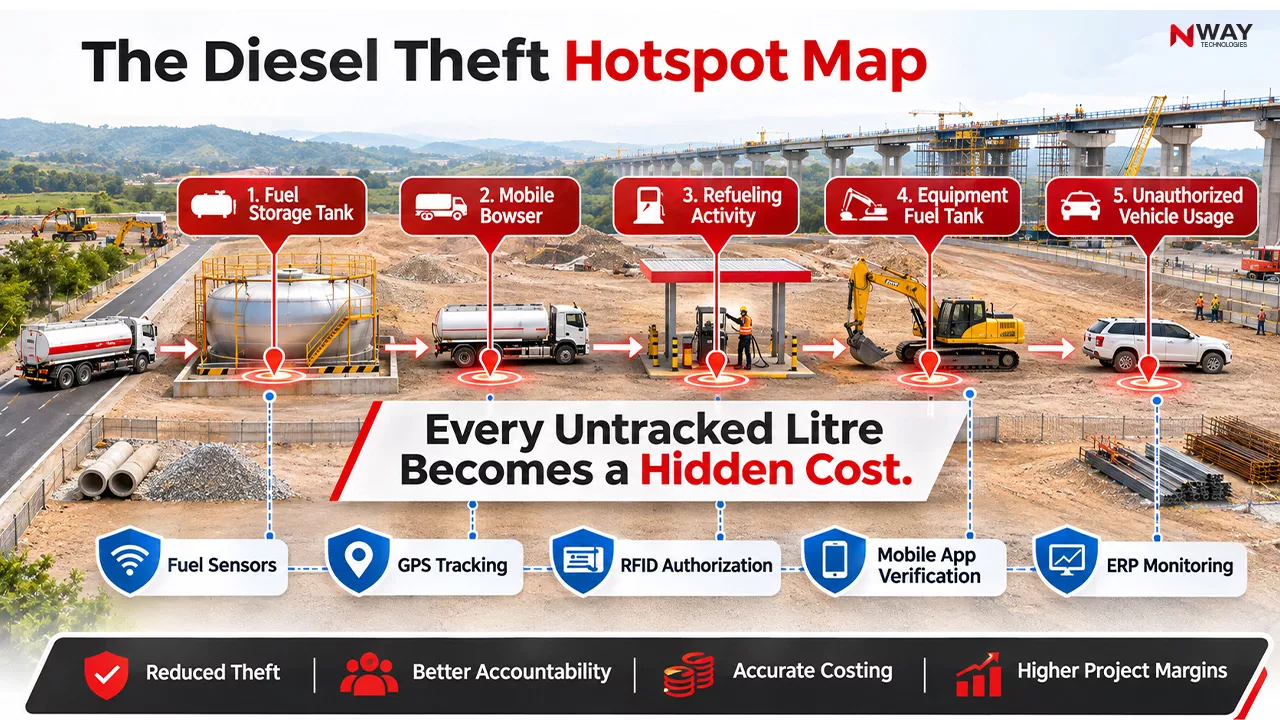
Unlike steel or cement, fuel is highly portable, difficult to monitor manually, and vulnerable to theft at multiple points including:
- Fuel storage tanks
- Mobile bowsers
- Refueling operations
- Equipment operators
- Transport vehicles
- Remote project sites
For many construction companies, diesel theft is not merely an operational issue. It is a profitability issue.
The solution is no longer increased supervision. The solution is visibility.
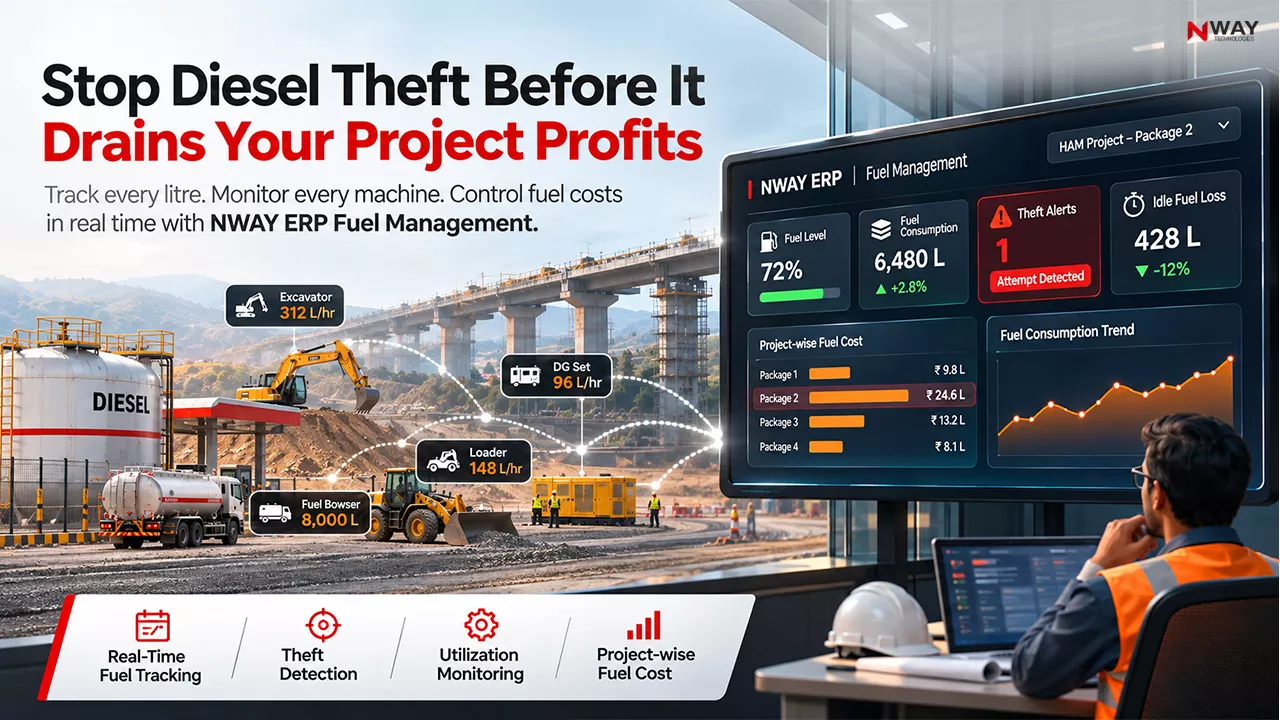
This is where fuel management software construction companies use today is transforming project cost control through real-time monitoring, automated tracking, telematics, and ERP integration.
Why Fuel Theft Is a Bigger Problem Than Most Contractors Realize
Fuel leakage rarely appears as a single large theft event.
Instead, it occurs through hundreds of small incidents spread across months.
Common Theft Scenarios
Scenario 1: Siphoning from Equipment Tanks
Operators extract small quantities of diesel from excavators, loaders, or generators.
The amount appears insignificant daily but becomes substantial over time.
Scenario 2: Fake Fuel Entries
Manual logs record fuel that was never actually dispensed.
Project accounting reflects legitimate fuel consumption despite physical losses.
Scenario 3: Unauthorized Refueling
Fuel is supplied to vehicles or equipment not assigned to the project.
Scenario 4: Fuel Bowser Manipulation
Mobile fuel tanks operating across large project areas become difficult to supervise continuously.
Hidden Risks Beyond Fuel Theft
Fuel mismanagement creates additional business challenges:
- Higher project costs
- Reduced equipment lifecycle
- Poor budgeting accuracy
- Wrong equipment utilization decisions
- Distorted profitability calculations
- Increased maintenance expenses
- Compliance and audit issues
Quick Insight
Most organizations only investigate fuel theft after seeing rising fuel expenses. By then, months of losses may already have occurred.
Understanding Fuel Consumption Visibility in Construction Equipment
Stopping theft is only one part of the equation.
Leading contractors focus equally on understanding how fuel is consumed.
Equipment Categories That Require Fuel Monitoring
| Equipment Type | Fuel Cost Impact |
|---|---|
| Excavators | Very High |
| Backhoe Loaders | High |
| Dozers | Very High |
| Motor Graders | High |
| Cranes | Medium to High |
| DG Sets | High |
| Batching Plants | High |
| Haulage Equipment | Very High |
Tracking equipment individually enables managers to answer critical questions:
- Which machine consumes the most fuel?
- Which project has highest fuel costs?
- Which operator is most efficient?
- Which machines spend excessive time idling?
- Which equipment requires maintenance?
The Evolution from Manual Fuel Logs to Digital Fuel Intelligence
Traditional Method
Most companies still use:
- Paper registers
- Excel sheets
- Manual approvals
- Phone-based reporting
- End-of-month reconciliation
Common Problems
- Delayed information
- Human errors
- Fraud opportunities
- No real-time visibility
- Poor accountability
Modern Digital Fuel Management Process
Step 1: Automated Fuel Measurement
Sensors installed in tanks monitor fuel levels continuously.
Step 2: GPS Tracking
Location data verifies exactly where fuel was consumed.
Step 3: Equipment Identification
RFID or digital authorization ensures fuel goes only to approved assets.
Step 4: ERP Integration
Fuel costs automatically flow to project accounting and equipment costing modules.
Step 5: Analytics & Alerts
Managers receive instant alerts regarding:
- Sudden fuel drops
- Excessive consumption
- Unauthorized refueling
- Fuel variance patterns
Process Flow: Intelligent Fuel Management Framework
How Fuel Management Software Construction Companies Use Actually Works
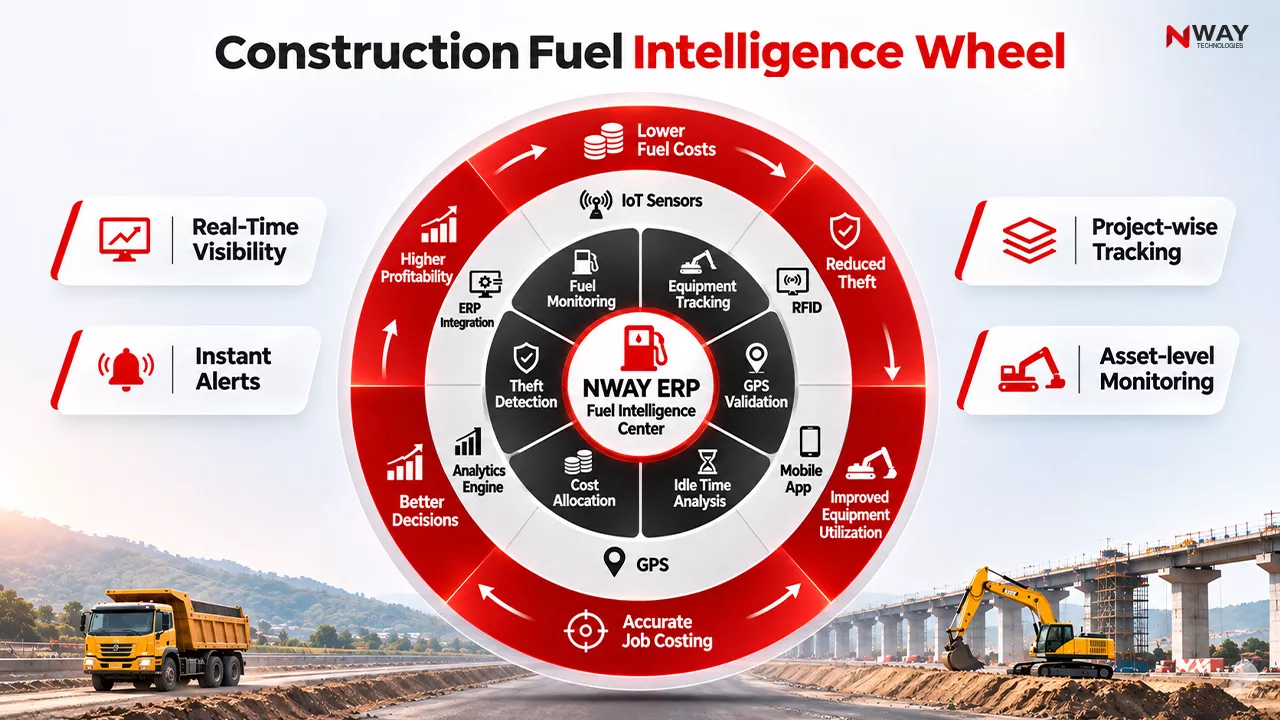
A modern solution combines several technologies into one unified system.
Core Components
Fuel Monitoring Sensors
Track:
- Fuel level
- Additions
- Withdrawals
- Sudden drops
- Consumption trends
Equipment Telematics
Captures:
- Engine hours
- Runtime
- Idle time
- Working productivity
- Location data
Central Dashboard
Provides visibility into:
- Equipment-wise fuel usage
- Project-wise consumption
- Daily trends
- Variance reports
ERP Integration
Links fuel usage with:
- Equipment cost
- Project cost
- Job costing
- Budget monitoring
Expert Tip
Never evaluate fuel consumption only in litres.
Measure:
Fuel Consumed per Engine Hour
and
Fuel Consumed per Unit of Work Done
These metrics reveal operational inefficiencies much faster than total fuel consumption numbers.
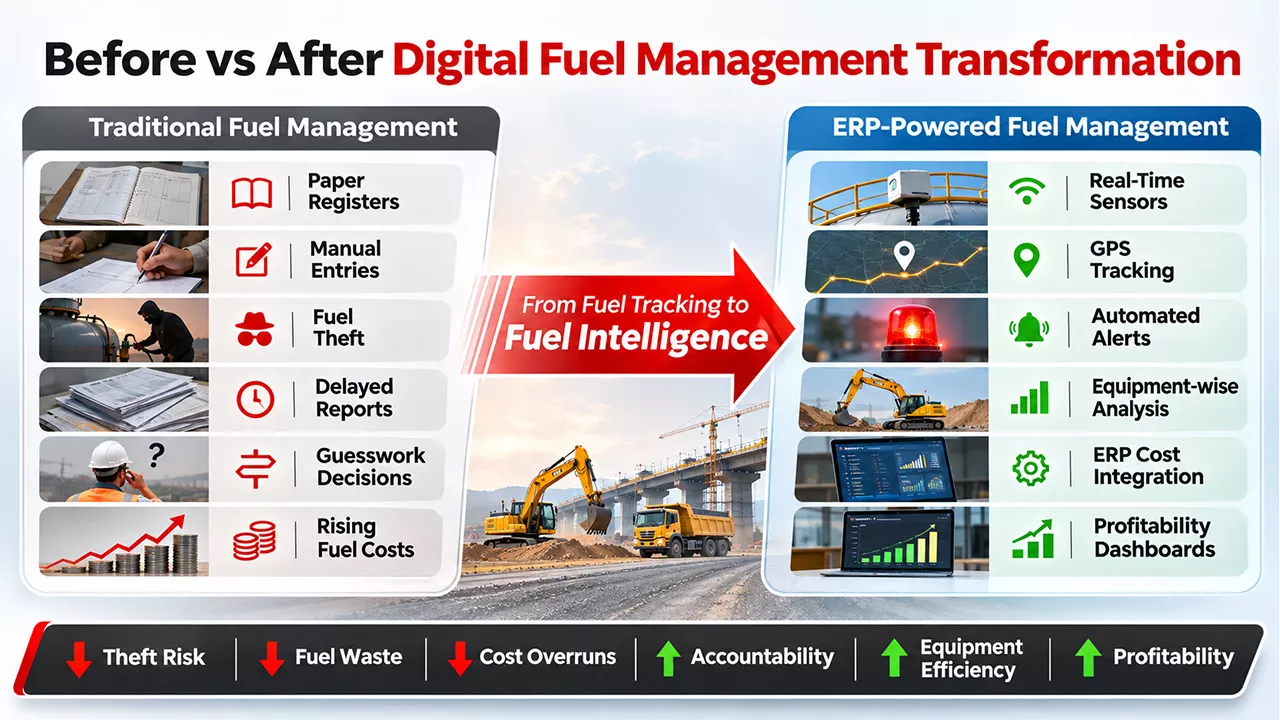
Before vs After: Construction Fuel Management Transformation
| Parameter | Manual Monitoring | ERP + Fuel Management Software |
|---|---|---|
| Theft Detection | After weeks or months | Real-time alerts |
| Data Accuracy | Low | High |
| Project Cost Allocation | Manual | Automatic |
| Equipment Tracking | Limited | Real-Time |
| Reporting Speed | End-of-month | Instant |
| Visibility | Site-specific | Organization-wide |
| Decision Making | Reactive | Proactive |
| Accountability | Weak | Strong |
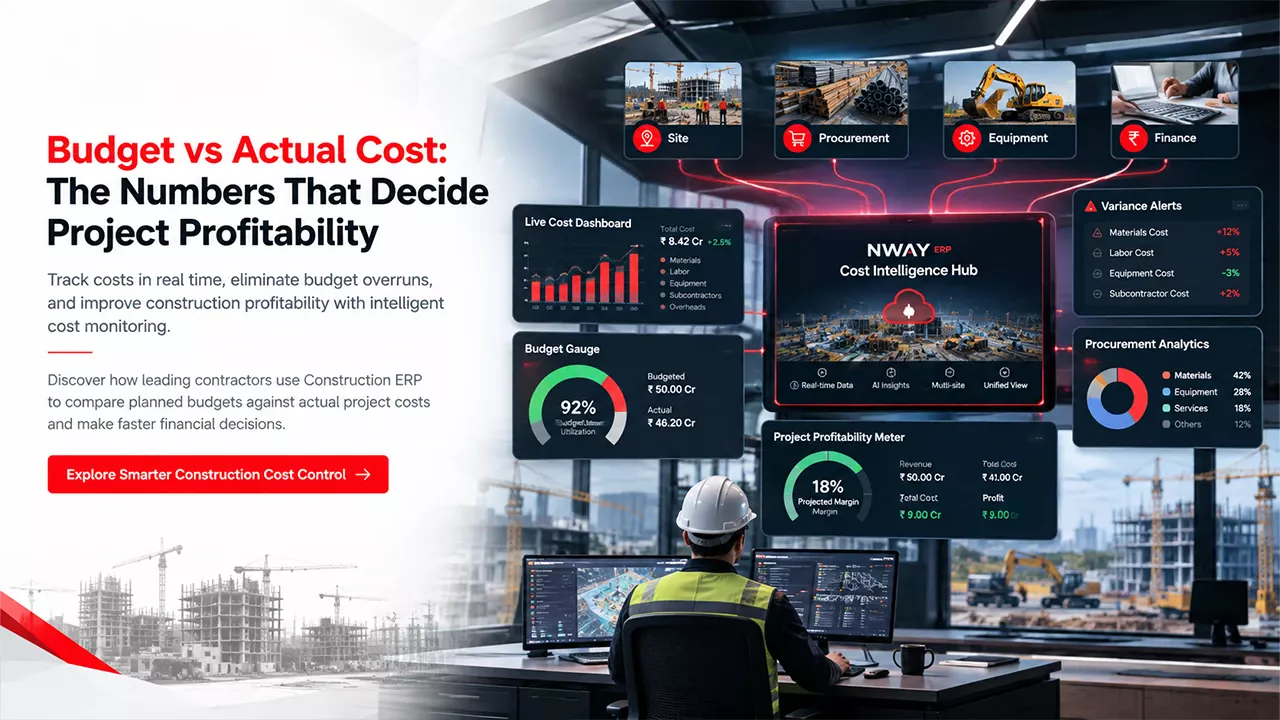
How ERP Integration Creates Complete Cost Control
Many businesses deploy isolated fuel tracking systems.
However, real value emerges when fuel intelligence becomes part of a Construction ERP platform.
Why ERP Integration Matters
Fuel is not an independent expense.
It influences:
- Equipment costing
- Project budgeting
- Construction billing
- Resource planning
- Profitability calculations
Example
Suppose:
Project A consumes ₹18 lakh in fuel.
Project B consumes ₹12 lakh.
Without ERP integration:
Management only sees fuel expenses.
With ERP integration:
Management sees:
- Cost per machine
- Cost per activity
- Cost per project
- Cost per kilometer
- Cost per cubic meter excavated
- Project profitability impact
This changes fuel data from an operational metric into a strategic business metric.
Common Mistakes Contractors Make
- Mistake 1: Tracking Fuel Only at Month-End – Problems are discovered too late.
- Mistake 2: Monitoring Only Total Fuel Usage – Variances remain hidden.
- Mistake 3: Ignoring Idle Fuel Consumption – Machines consume fuel even when not productive.
- Mistake 4: No Equipment-Level Analysis – Company-wide totals mask inefficient assets.
- Mistake 5: Using Standalone Systems – Disconnected software creates data silos.
Did You Know?
A machine operating at a high idle can burn significant fuel every hour without producing any measurable construction output.
Reducing idle time often delivers faster savings than replacing equipment.
How to Optimize Construction Fuel
Operational Controls
- Monitor every fuel transaction digitally
- Track fuel at equipment level
- Install tank monitoring sensors
- Use GPS-based validation
- Monitor fuel bowser movement
- Generate automated variance reports
- Conduct periodic audits
- Set fuel consumption benchmarks
Management Controls
- Review project-wise fuel expense
- Analyze idle vs productive hours
- Compare operator performance
- Integrate with ERP costing
- Establish alert thresholds
- Maintain equipment proactively
SEE : Important Features of a Construction ERP Solution
The Future of Fuel Management in Construction
Fuel monitoring is evolving from transaction tracking to predictive intelligence.
Emerging Trends
- AI-Based Fuel Analytics – Predict abnormal consumption before losses occur.
- Predictive Maintenance – Fuel patterns help identify engine health issues.
- Automated Cost Forecasting – Fuel trends influence project budgeting models.
- Integrated Project Intelligence – Fuel, equipment, labor, and materials become part of a unified control system.
Strategic Roadmap for Contractors
| Maturity Level | Capability |
|---|---|
| Level 1 | Manual Fuel Registers |
| Level 2 | Digital Fuel Entries |
| Level 3 | GPS Tracking |
| Level 4 | Fuel Sensors & Telematics |
| Level 5 | ERP Integration |
| Level 6 | AI-Based Predictive Analytics |
Organizations moving toward Levels 5 and 6 gain significant competitive advantages in cost control and operational efficiency.
Conclusion
In today’s competitive construction environment, fuel can no longer be treated as an operational expense that is reviewed only at month-end. It is a strategic cost component that directly impacts equipment productivity, project profitability, and business growth.
Contractors, EPC firms, developers, and infrastructure companies that continue relying on manual fuel registers face growing challenges in controlling diesel theft, identifying inefficiencies, and maintaining accurate project costing.
By implementing fuel management software construction businesses can achieve real-time fuel visibility, equipment-level monitoring, automated theft detection, and data-driven decision-making. When integrated with a construction ERP such as NWAY ERP, fuel management becomes more than a tracking activity. It becomes a powerful profitability management system that helps organizations reduce leakages, optimize equipment utilization, strengthen accountability, and improve project outcomes.
The future belongs to construction companies that can measure, monitor, and optimize every litre of fuel consumed across their operations.