Table of Contents:
- Introduction
- Understanding the Financial Dynamics of HAM Project Road Construction
- The Biggest Cost Control Challenges in HAM Projects
- Milestone Billing: The Profitability Engine of HAM Projects
- ERP Versus Traditional Billing Management
- The Cost Control Framework Successful HAM Contractors Follow
- A Common HAM Project Financial Control Workflow
- The Role of Construction ERP in HAM Road Project Success
- Cost Impact Matrix for HAM Contractors
- Conclusion
Introduction
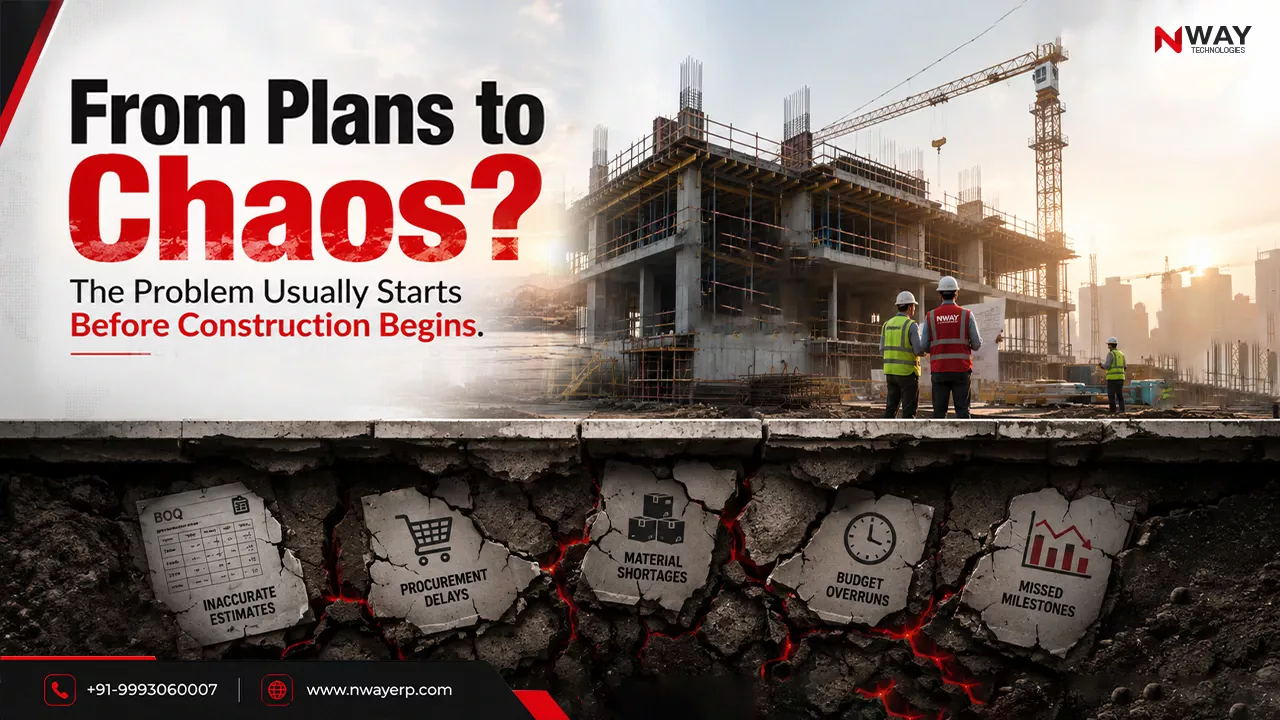
A highway contractor executing a ₹1,000 crore National Highways Authority of India (NHAI) HAM project reaches 45% physical progress. The site teams have delivered substantial earthwork, structures, and pavement activities on schedule. Yet the finance team faces growing pressure from lenders, vendors, and subcontractors.
The reason?
Project execution is ahead of documentation. Several billing milestones are awaiting certification. Material costs have increased beyond estimate assumptions. Equipment costs are running higher than planned. Management knows revenue will eventually come, but visibility into actual project profitability remains unclear.
This scenario is increasingly common across India’s HAM road infrastructure sector.
As highway projects become larger, more capital-intensive, and tightly regulated, contractors can no longer rely on spreadsheets, disconnected reporting systems, or retrospective financial reviews. Modern HAM contractors require real-time control over costs, billing milestones, cash flows, and project financial performance.
The growing adoption of construction ERP platforms reflects an industry shift from reactive project management toward proactive financial governance.
Understanding the Financial Dynamics of HAM Project Road Construction
The Hybrid Annuity Model combines features of EPC and BOT structures.
Under the HAM framework:
- Government authorities contribute part of the project cost during construction.
- Private contractors invest the remaining amount.
- Payments are linked to predefined milestones.
- Contractors receive annuity payments over the concession period.
Long-term financial sustainability becomes critical.
Unlike traditional EPC projects where payments are relatively straightforward, HAM projects involve:
- Complex financing structures
- Extended cash realization cycles
- Detailed compliance requirements
- Multi-stage billing processes
- Long-term asset obligations
Why It Matters
Even minor deviations in project cost assumptions can have significant effects because returns are distributed over an extended period.
A 3-5% cost overrun on a large HAM project can potentially reduce overall project profitability substantially over the concession lifecycle.
The Biggest Cost Control Challenges in HAM Projects
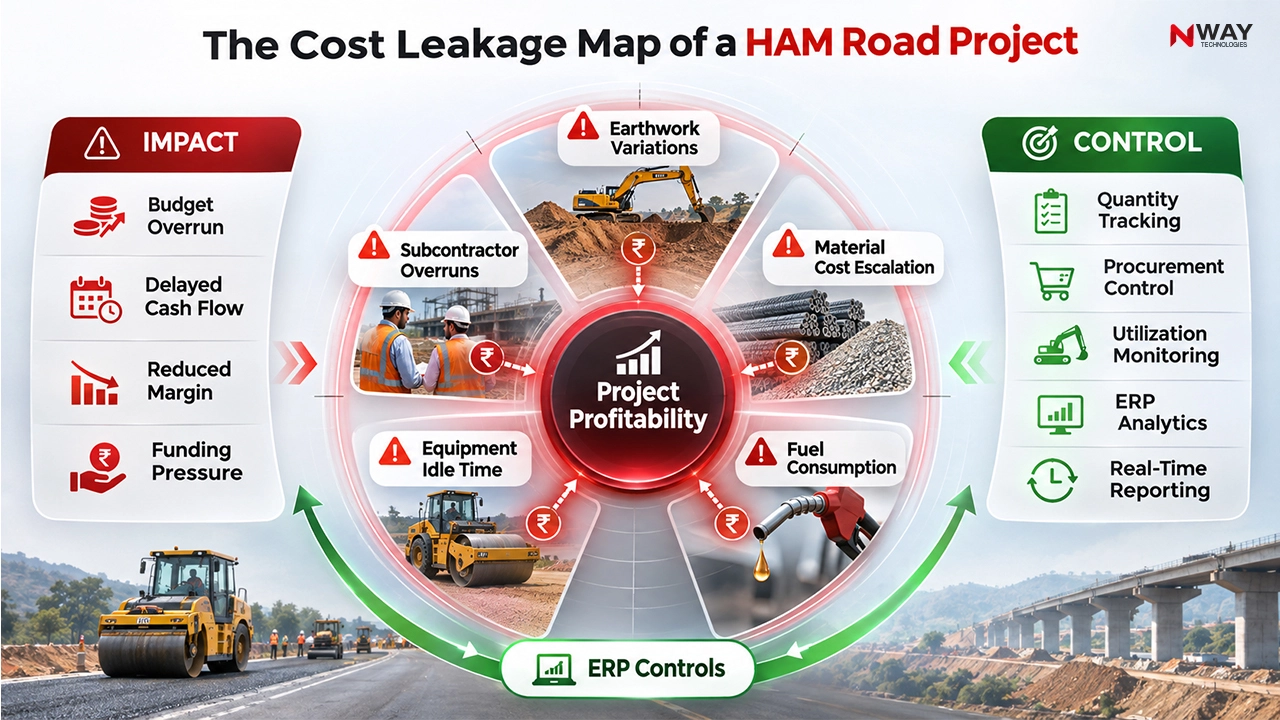
1. Earthwork Quantity Variations
Earthwork often represents one of the largest cost components in highway projects.
Common Challenges
- Incorrect quantity estimation
- Excessive lead distances
- Fuel consumption variations
- Unplanned site conditions
- Additional excavation requirements
Hidden Risk
Many contractors identify quantity overruns only during monthly reviews when corrective actions are already limited.
Expert Tip
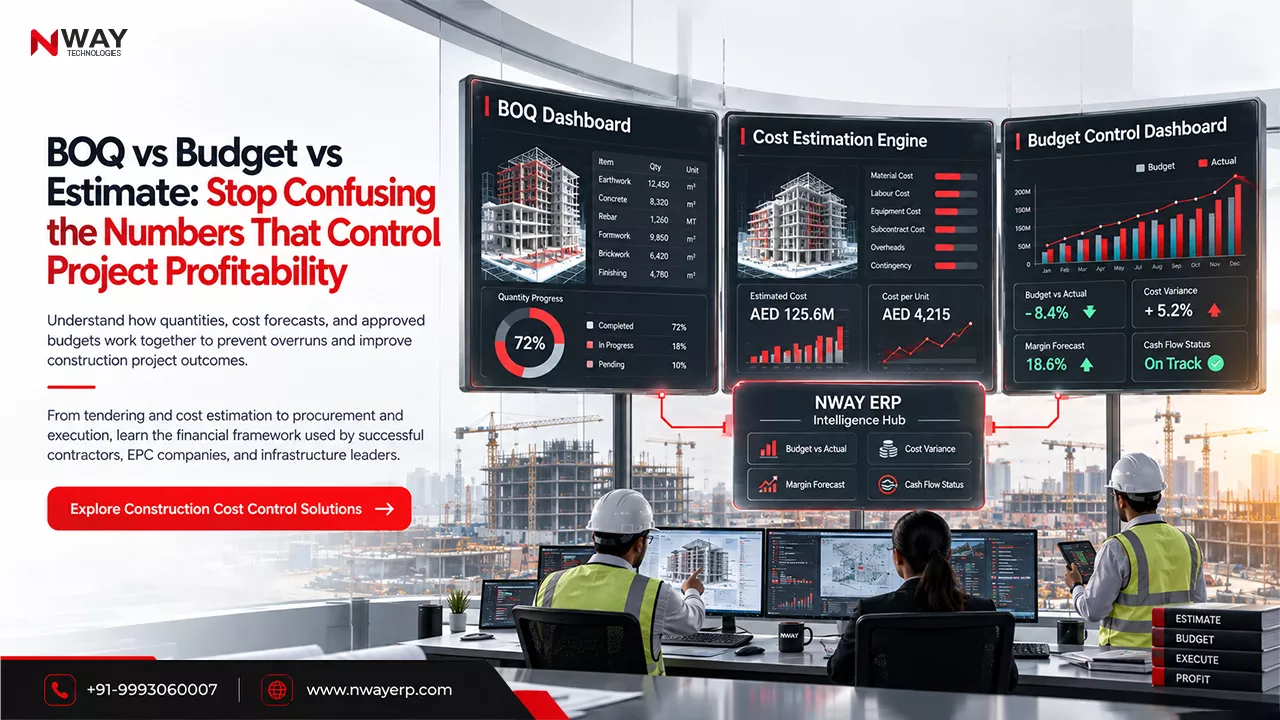
Track executed quantities daily against BOQ quantities and approved budgets rather than waiting for monthly financial reports.
2. Material Cost Escalation
Key materials including:
- Bitumen
- Cement
- Steel
- Aggregates
- Geosynthetics
Can significantly impact project economics.
Common Mistake
Assuming procurement teams alone can manage price volatility.
In reality, procurement decisions must be integrated with project cash flow forecasts and milestone schedules.
Best Practice Checklist
- Centralized procurement approvals
- Vendor rate comparison
- Rate contract management
- Material consumption monitoring
- Inventory aging control
- Forecast purchasing
3. Equipment Cost Leakage
HAM projects rely heavily on:
- Excavators
- Crushers
- Pavers
- Batching plants
- Dumpers
- Compactors
Idle equipment can quickly erode project profitability.
Did You Know?
Equipment utilization losses often remain hidden because ownership costs continue even when machines are underutilized.
Expected Outcome of Equipment Monitoring
- Better deployment decisions
- Reduced rental expenses
- Improved productivity
- Lower fuel wastage
- Enhanced project forecasting
Milestone Billing: The Profitability Engine of HAM Projects
Cost control alone does not guarantee financial success.
Profitability depends equally on milestone billing efficiency.
How Milestone Billing Works in HAM Projects
Typically, project payments are tied to:
- Physical progress achievement
- Quality compliance
- Engineer certification
- Documentation approval
- Authority verification
- Payment release
Each step introduces potential delays.
Quick Insight
Every day between milestone completion and invoice approval effectively increases working capital requirements.
Common Billing Bottlenecks
Delayed Measurements
When site teams and quantity surveyors maintain separate records, discrepancies emerge.
Incomplete Documentation
Missing reports often create approval delays.
Examples include:
- Test certificates
- Site records
- Progress photographs
- Inspection reports
- Material approvals
Manual Workflow Dependencies
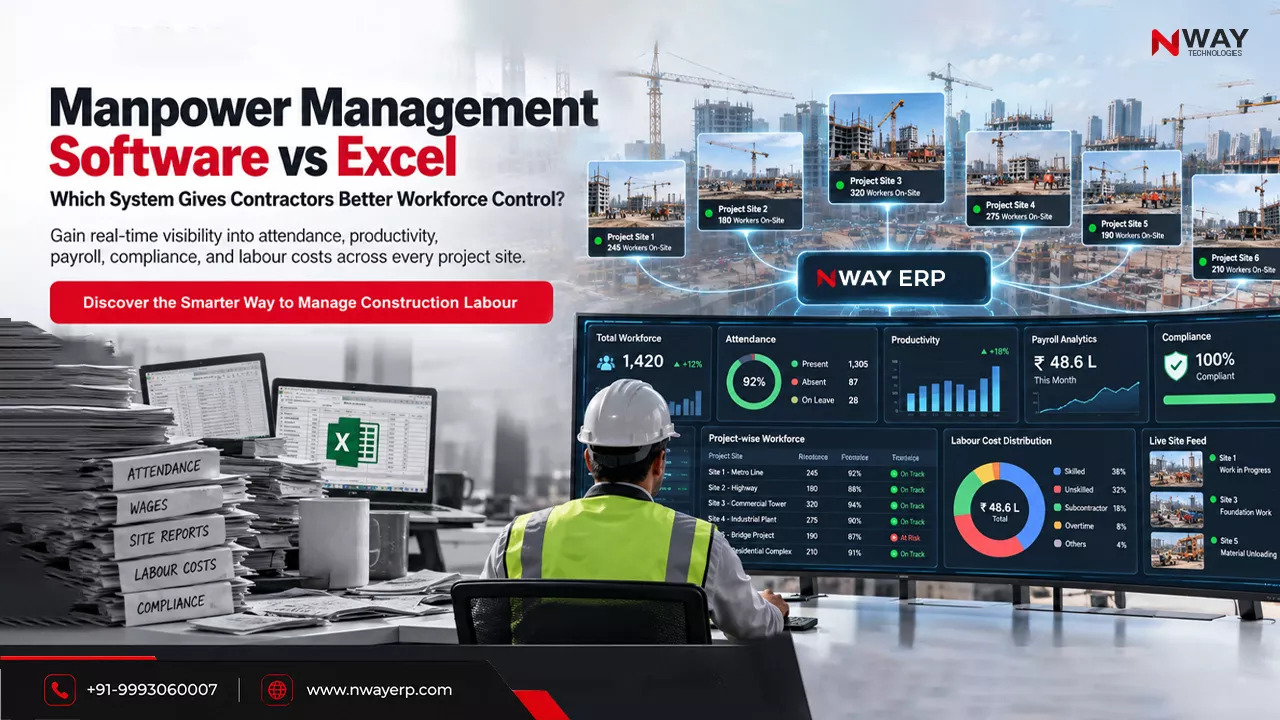
Multiple email approvals and spreadsheet-based tracking create bottlenecks across departments.
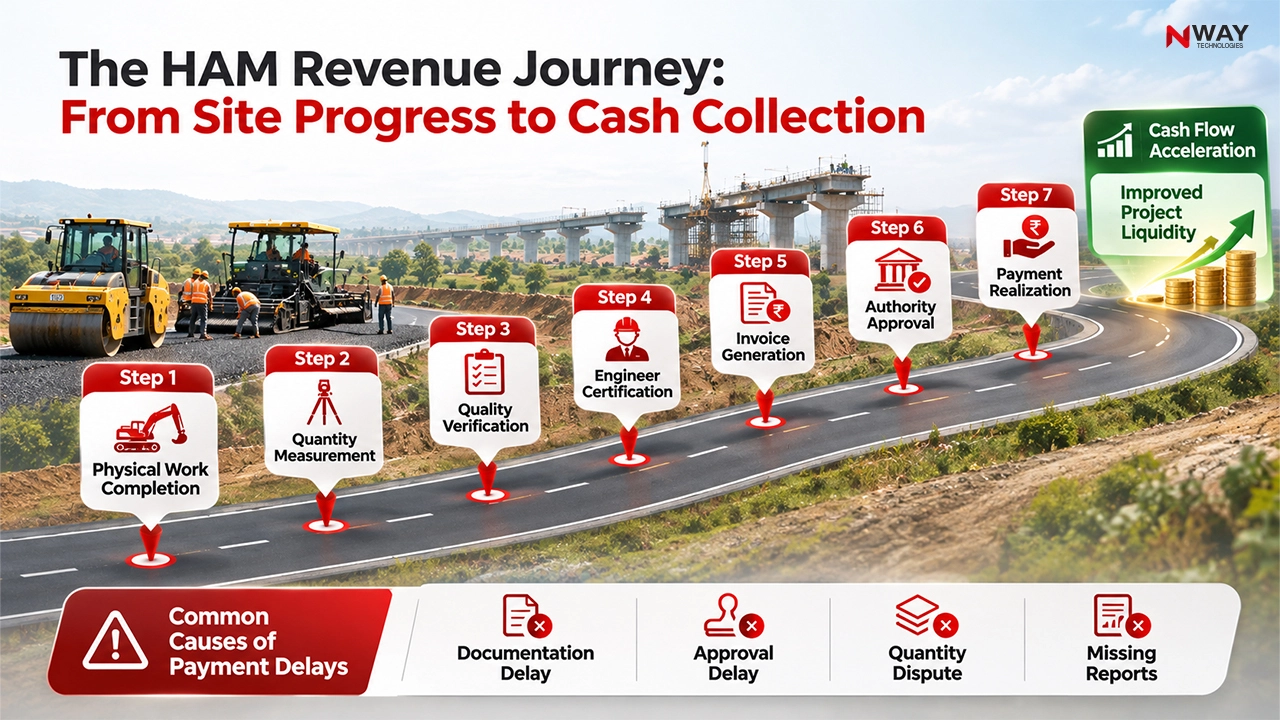
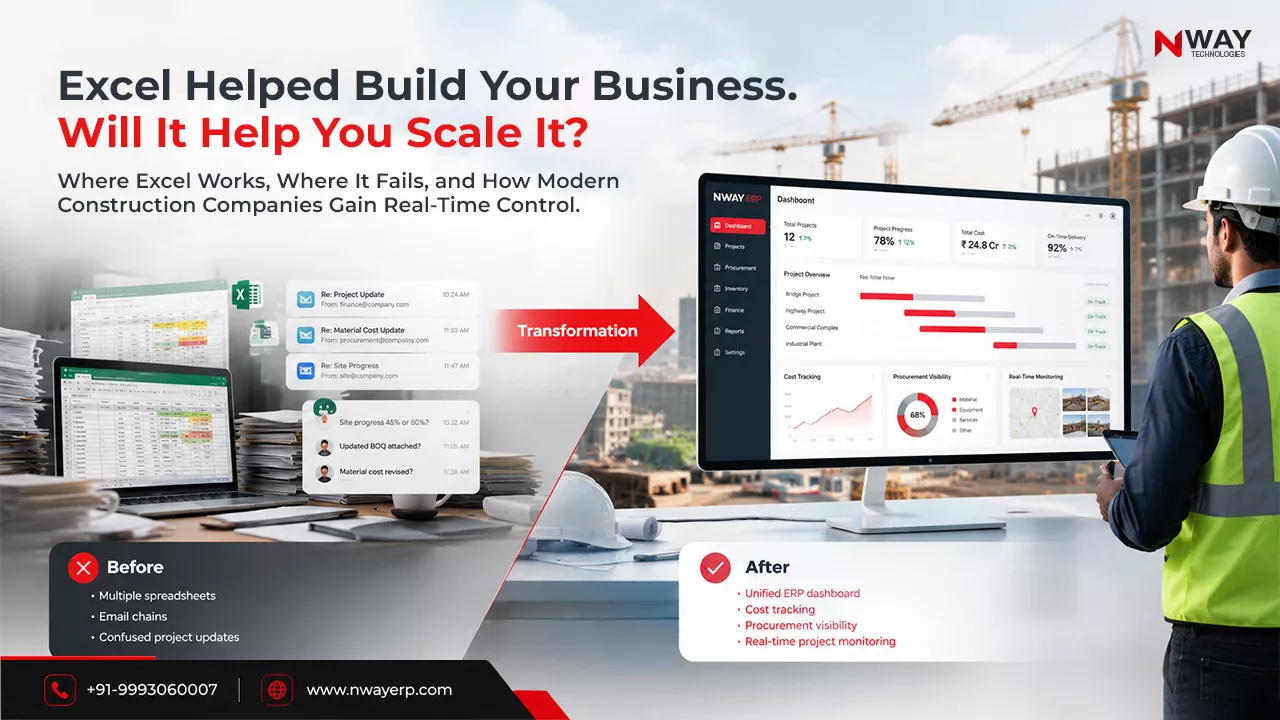
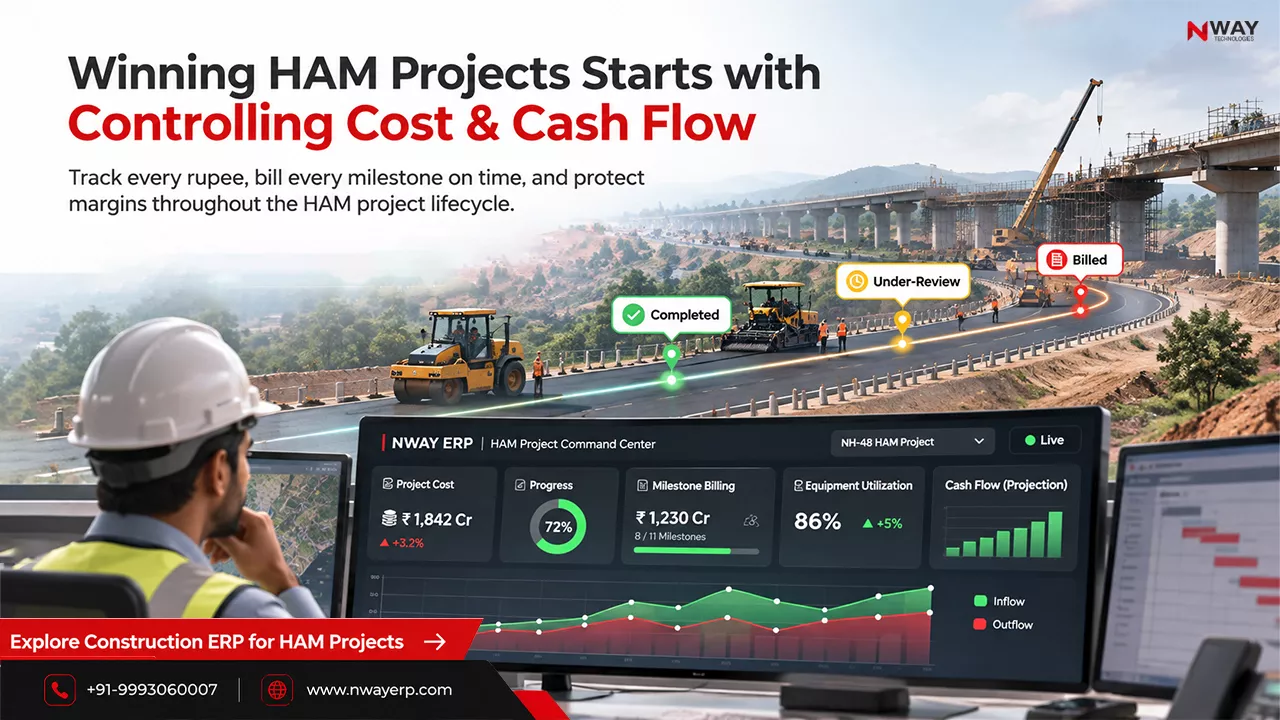
Still tracking milestones through spreadsheets and emails? Accelerate approvals, billing, and collections with a unified construction ERP.
ERP Versus Traditional Billing Management
| Process Area | Manual Management | Construction ERP |
|---|---|---|
| Quantity Tracking | Spreadsheet Driven | Real-Time Data Capture |
| Progress Monitoring | Weekly Updates | Live Dashboard |
| Measurement Records | Decentralized | Centralized Repository |
| Billing Status | Limited Visibility | Workflow Tracking |
| Approval Process | Manual Follow-up | Automated Workflow |
| Cash Forecasting | Historical Analysis | Predictive Forecasting |
| Audit Readiness | Document Search | Instant Retrieval |
| Management Reporting | Time-Consuming | Automated Reports |
Why This Difference Matters
When multiple project teams, consultants, finance departments, and government authorities are involved, centralized visibility becomes a competitive advantage.
The Cost Control Framework Successful HAM Contractors Follow
Stage 1: Budget Establishment
Create cost baselines for:
- Materials
- Machinery
- Labor
- Fuel
- Subcontracting
- Administrative costs
The baseline becomes the financial benchmark.
Stage 2: Commitment Tracking
Many contractors overlook committed costs.
These include:
- Purchase Orders
- Work Orders
- Equipment Rentals
- Vendor Contracts
Hidden Risk
Projects may appear profitable until commitments are considered.
Stage 3: Actual Cost Monitoring
Monitor:
- Daily expenditures
- Material issues
- Equipment hours
- Fuel consumption
- Labor productivity
Quick Insight
Actual costs should be available in near real-time rather than after month-end financial closure.
Stage 4: Variance Analysis
Track:
- Budget vs Commitment
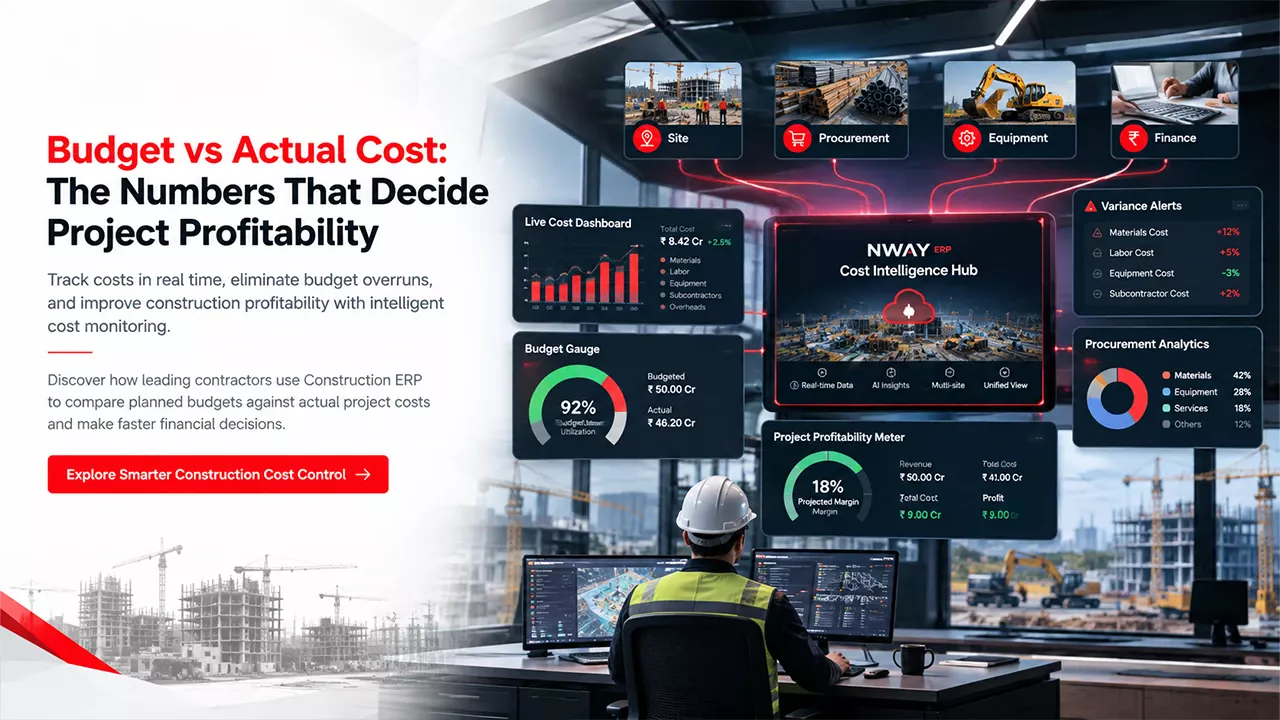
- Budget vs Actual
- Planned vs Executed Quantity
- Revenue vs Cost
Expected Outcome
Management can identify margin erosion before it becomes irreversible.
See: Finance & Accounts – Achieve Budgets with Strategic Accounting
A Common HAM Project Financial Control Workflow
Budget Creation → BOQ Mapping → Resource Allocation
↓
Execution
Material Procurement → Equipment Deployment → Progress Recording
↓
Cost Monitoring
Quantity Tracking → Cost Booking → Variance Analysis
↓
Billing
Milestone Achievement → Documentation Verification → Invoice Generation
↓
Cash Flow Control
Receivable Monitoring → Payment Follow-up → Forecast Updating
↓
Management Review
Project Profitability Review → Corrective Action
Mini Case Scenario: Preventing a Margin Erosion Crisis
Consider a contractor executing a highway HAM project.
Initial margin projection:
- Project Value: ₹800 Crore
- Estimated Cost: ₹700 Crore
- Expected Margin: ₹100 Crore
Six months later:
- Diesel costs increased
- Earthwork quantities exceeded estimates
- Equipment utilization declined
- Vendor rates increased
Without visibility, management discovers the problem after significant cost escalation.
With Construction ERP:
- Cost deviations appear immediately.
- Fuel consumption anomalies are highlighted.
- Budget alerts are triggered.
- Procurement costs are compared automatically against estimates.
Corrective decisions happen before substantial margin loss.
The result is not merely better reporting.
It is better profitability protection.
The Role of Construction ERP in HAM Road Project Success
Unified Financial Visibility
Decision-makers obtain visibility across:
- Project costs
- Procurement
- Billing
- Equipment
- Inventory
- Cash flow
- Receivables
Faster Milestone Billing
ERP systems help by:
- Capturing progress digitally
- Tracking certification status
- Managing documentation
- Generating billing reports
- Automating workflow approvals
Improved Cash Flow Forecasting
Finance teams can forecast:
- Expected billing
- Payment schedules
- Funding requirements
- Vendor obligations
This reduces reliance on assumptions.
Better Governance
For large infrastructure organizations, ERP creates:
- Audit trails
- Approval controls
- Data standardization
- Regulatory compliance support
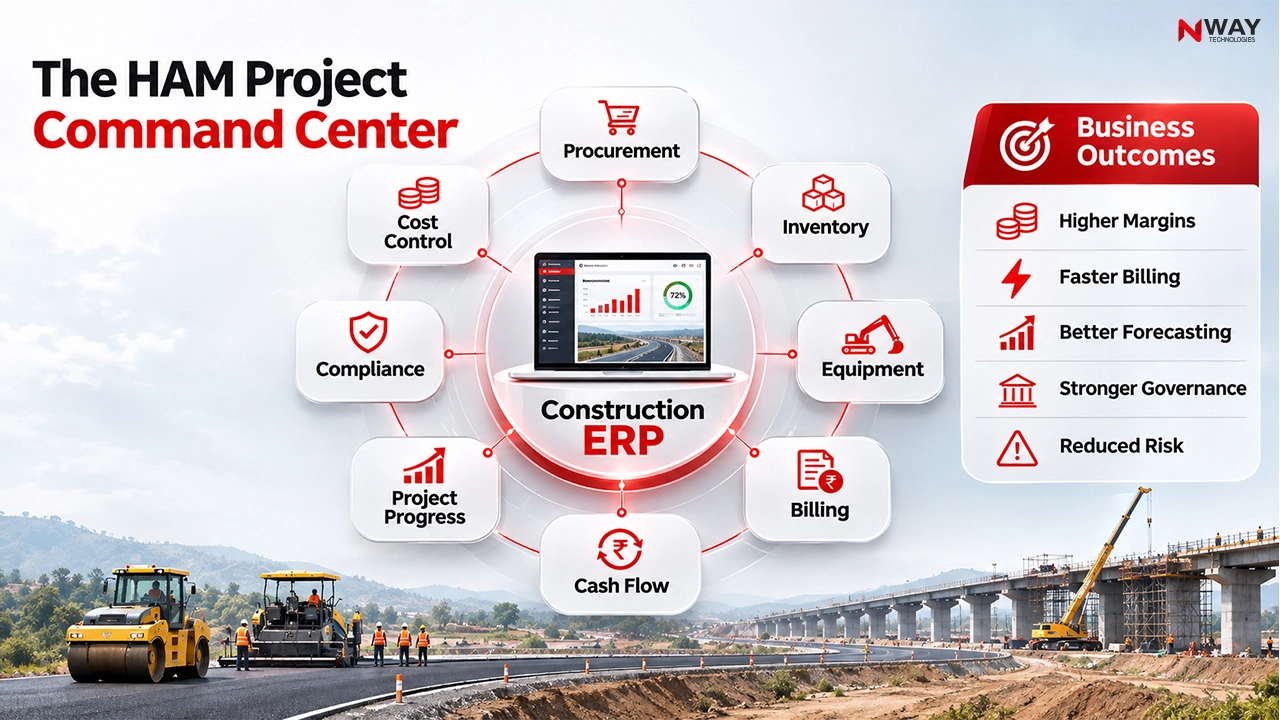
Cost Impact Matrix for HAM Contractors
| Area | Poor Control Impact | Strong ERP-Based Control |
|---|---|---|
| Material Cost | Margin Erosion | Controlled Procurement |
| Fuel Usage | Hidden Leakage | Consumption Monitoring |
| Equipment | Idle Assets | Optimization |
| Billing | Payment Delays | Faster Collections |
| Cash Flow | Funding Pressure | Predictability |
| Documentation | Claim Rejection | Audit Readiness |
| Project Reviews | Reactive Decisions | Proactive Control |
| Profitability | Uncertainty | Higher Visibility |
The most profitable HAM contractors don’t just build roads. They build financial visibility.
Conclusion
In today’s competitive infrastructure environment, successful HAM project road construction requires more than project execution expertise. Contractors must simultaneously control costs, manage cash flow, monitor financial risks, and accelerate milestone billing across extended project lifecycles.
The contractors who consistently outperform their peers are not necessarily those building roads faster. They are the ones making financial decisions faster because they have complete visibility into project performance.
As HAM projects continue to expand in size and complexity across India’s highway sector, Construction ERP will become less of a technology investment and more of a strategic necessity. Organizations that build integrated cost control and billing intelligence capabilities today will be better positioned to protect margins, secure financing, and deliver sustainable profitability in the years ahead.
Also Read: How Road Construction Software Resolves Major Construction Challenges?