Table of Contents:
- Introduction
- Why Procurement Delays Don’t Stay in Procurement
- The Chain Reaction Nobody Sees Coming
- Lead-Time Risk: The Hidden Budget Killer
- How a Delayed Purchase Order Becomes a Cost Overrun
- The True Cost of Material Procurement Delays
- Why Traditional Procurement Methods Make Delays Worse
- What Strong Construction Procurement Management Looks Like
- Conclusion
Introduction
A project manager reviews the weekly progress report and discovers that a critical activity has slipped by three weeks.
The immediate assumption is usually the same: “The supplier delayed delivery.”
But suppliers are often blamed for problems that started much earlier.
The steel didn’t arrive late because the supplier failed.
The cement wasn’t unavailable because the market suddenly ran out.
The MEP package wasn’t delayed because logistics stopped working.
In many cases, the real cause is much simpler and much more dangerous: the purchase order was raised too late.
Construction companies rarely lose money because of one dramatic mistake. They lose money because small delays accumulate, interact, and create consequences far beyond their original source.
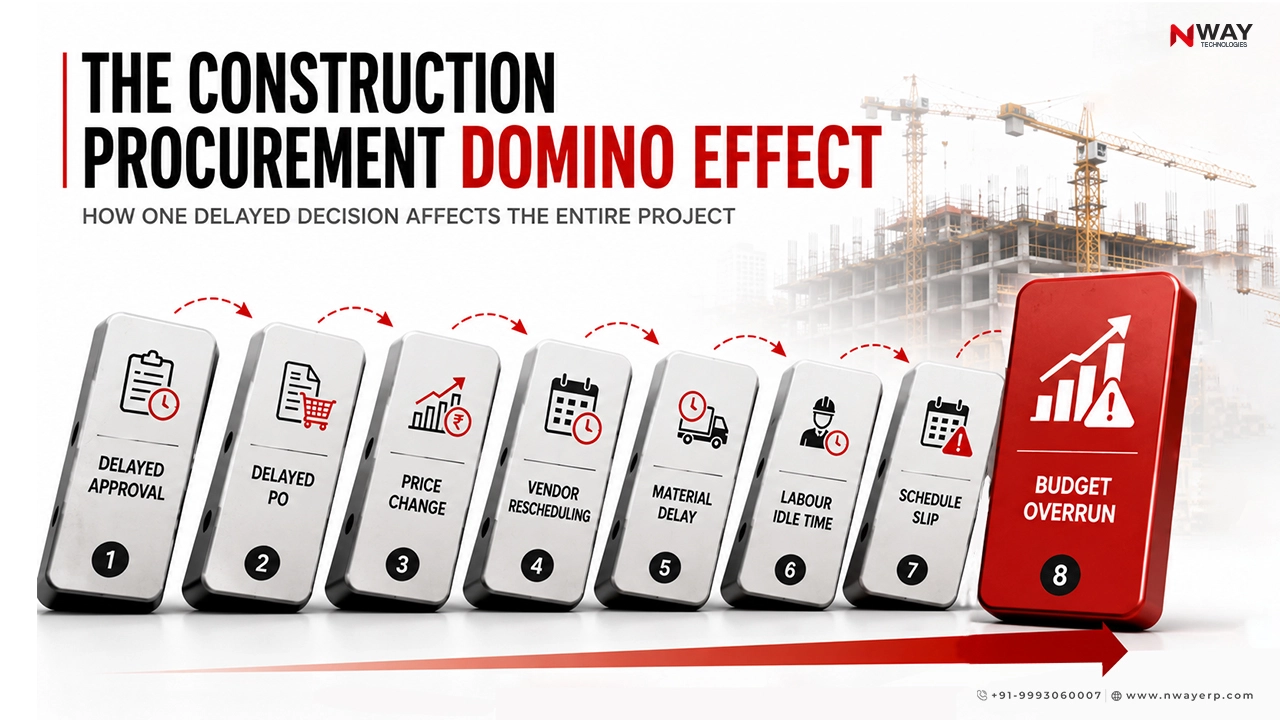
- A delayed design approval pushes vendor selection back.
- A delayed vendor selection pushes the purchase order back.
- A delayed purchase order extends procurement lead times.
- The extended lead time exposes the project to price fluctuations, availability issues, transportation delays, and resource disruptions.
By the time the issue appears on-site, the chain reaction is already underway.
This is why construction procurement management is not just a purchasing function. It is one of the most important controls for protecting project budgets, schedules, and profitability.
Why Procurement Delays Don’t Stay in Procurement
One of the most common misconceptions among contractors is that procurement problems belong to the procurement team.
They don’t.
Procurement delays affect almost every department involved in project delivery.
| Function | Impact of Procurement Delay |
|---|---|
| Site Team | Material shortages |
| Planning Team | Schedule disruption |
| Finance Team | Budget pressure |
| Project Manager | Activity slippage |
| Commercial Team | Margin erosion |
| Management | Reduced profitability |
This happens because procurement sits at the center of multiple project workflows.
Materials connect planning to execution.
Without materials:
- Labor sits idle
- Equipment remains underutilized
- Subcontractors cannot perform scheduled activities
- Billing milestones get delayed
- Cash flow slows down
What appears to be a procurement issue quickly becomes a business performance issue.
The Chain Reaction Nobody Sees Coming
Most contractors are familiar with material procurement delays.
What many do not realize is how quickly those delays compound.
A late purchase order construction issue usually follows a predictable pattern.
Step 1: Approvals Take Longer Than Planned
Material requirements are identified.
Quotes are collected.
Then the process stalls.
Sometimes it is waiting for technical approvals.
Sometimes it is waiting for management sign-off.
Sometimes it is simply because the request is not considered urgent yet.
The project loses valuable procurement time before ordering even begins.
Step 2: The Vendor Window Closes
Many suppliers allocate production capacity weeks in advance.
When purchase orders are delayed:
- Prices may change
- Quotation validity expires
- Production slots shift
- Alternative customers receive priority
The contractor suddenly finds that the original procurement plan is no longer available.
Step 3: Supply Chain Risk Increases
The longer procurement is delayed, the greater the exposure to:
- Freight cost fluctuations
- Transportation bottlenecks
- Supplier backlog
- Inventory shortages
This is particularly true for long-lead items and specialized materials.
Step 4: Site Productivity Suffers
Eventually the impact reaches the site.
- Workers wait.
- Activities are rescheduled.
- Sequencing breaks down.
- Project managers spend time solving preventable problems instead of driving progress.
This is where construction supply chain delays begin affecting profitability.
How Material Procurement Delays Create Budget Overruns
Contractors often focus on the visible costs of procurement.
The hidden costs are usually much larger.
| Problem | Immediate Impact | Budget Consequence |
|---|---|---|
| Delayed PO | Price revision | Higher material cost |
| Late delivery | Idle workforce | Labour inefficiency |
| Material shortage | Equipment downtime | Increased operating cost |
| Vendor change | Quality risks | Rework expenses |
| Expedited procurement | Emergency purchasing | Margin erosion |
This is why construction procurement management directly affects profitability.
A delayed order doesn’t simply increase procurement costs. It reduces productivity across multiple project functions.
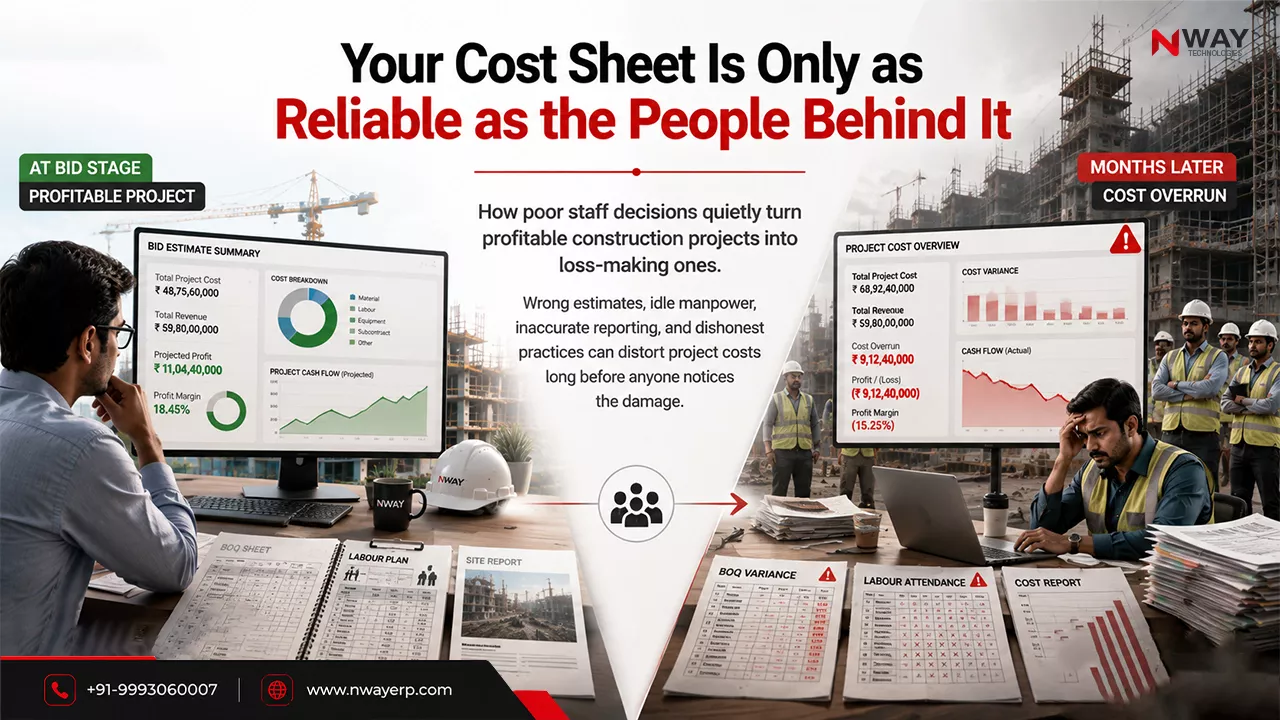
You didn’t lose money on the material. You lost it on the four weeks before you ordered it.
Lead-Time Risk: The Hidden Budget Killer
Most discussions about material procurement focus on pricing.
However, lead-time risk is often more dangerous than price risk.
Lead-time risk is not about what you buy.
It is about how long it takes to get it and what happens while you wait.
Consider two projects purchasing the same structural steel package.
Project A raises the purchase order immediately.
Project B delays approval by four weeks.
Both projects are buying the same material.
Yet Project B faces:
- Higher exposure to price volatility
- Increased supplier uncertainty
- Greater transportation risk
- Less schedule flexibility
A cost estimate built around a two-week procurement lead time becomes invalid when approvals extend that timeline to six weeks.
The budget did not fail because the estimate was wrong.
The budget failed because the assumptions changed.
This is one of the most overlooked causes of construction budget overruns.
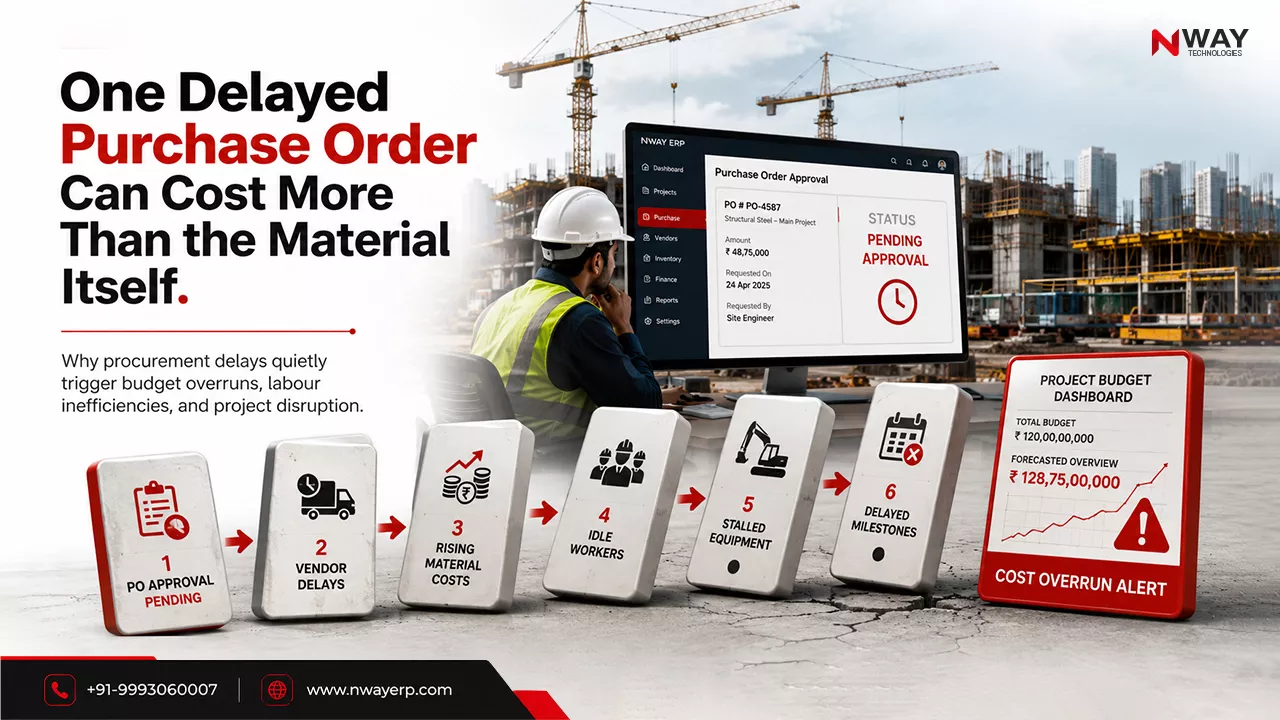
How a Delayed Purchase Order Becomes a Cost Overrun
Hypothetical Example
A mid-sized contractor is executing a ₹50 crore commercial project.
The next phase requires structural steel fabrication.
The procurement team identifies the requirement well in advance.
However, vendor approval takes an additional four weeks.
During that period:
- Steel prices increase
- The selected vendor’s fabrication slot is assigned elsewhere
- Delivery moves back by five weeks
- Erection crews remain underutilized
- Equipment rental continues despite limited progress
On paper, the procurement delay appears small.
In reality, the project absorbs:
- Increased material costs
- Additional labour expenses
- Equipment idle costs
- Schedule recovery costs
The cost impact extends far beyond the original purchase order.
(See: Why Construction Companies Lose Money in Procurement)
The True Cost of Material Procurement Delays
Most contractors calculate procurement costs incorrectly.
They focus only on purchasing costs.
The larger damage often comes from indirect losses.
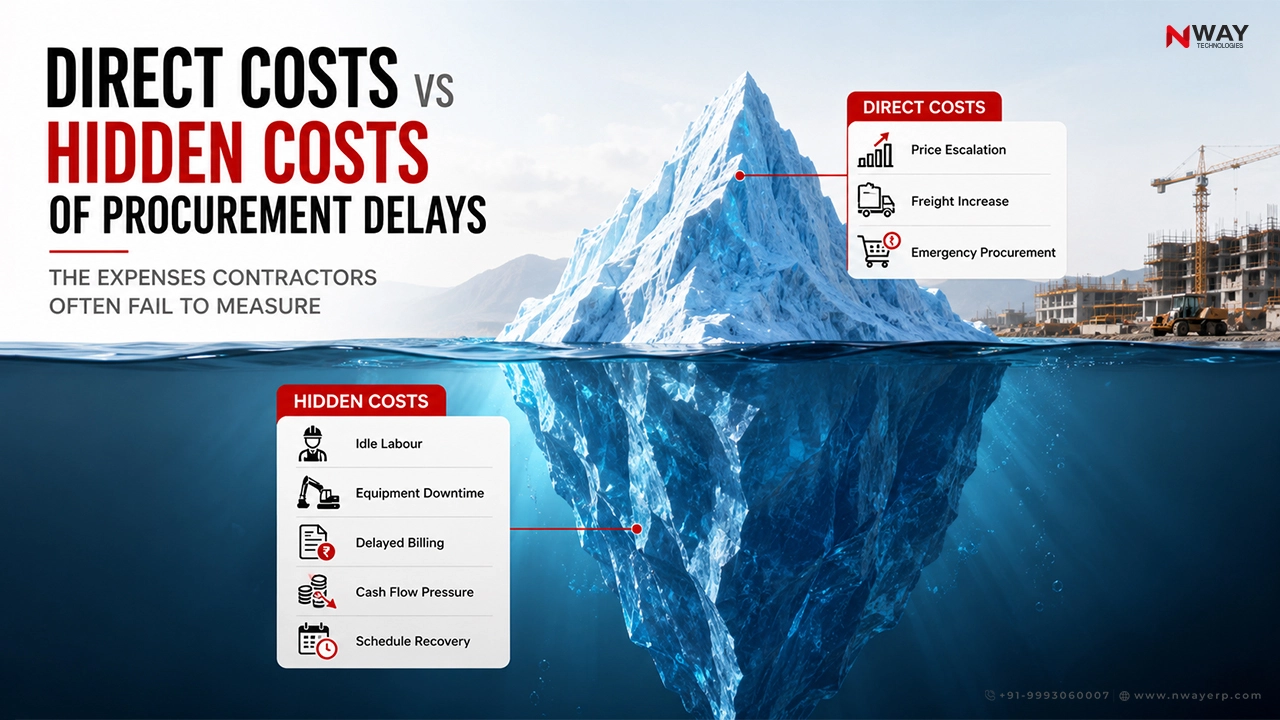
Direct Costs
- Material price increases
- Expedited freight charges
- Emergency vendor sourcing
- Contract price escalation
Hidden Costs
- Idle labour
- Equipment downtime
- Productivity loss
- Missed milestones
- Delayed billing
- Reduced cash flow
- Penalty exposure
The hidden costs frequently exceed the material cost increase itself.
This is why procurement cost control should be measured across the entire project lifecycle, not just the purchasing department.
Why Traditional Procurement Methods Make Delays Worse
Many procurement issues are not caused by suppliers.
They are caused by poor visibility.
Contractors still commonly rely on:
- Excel spreadsheets
- Email approvals
- WhatsApp communication
- Manual quotation comparisons
These methods create decision latency.
The issue is not a lack of information.
The issue is that information moves too slowly.
By the time management realizes procurement is behind schedule, the consequences have already spread across planning, inventory, execution, and finance.
This is why modern construction supply chain management increasingly focuses on visibility rather than simply purchasing efficiency.
What Strong Construction Procurement Management Looks Like
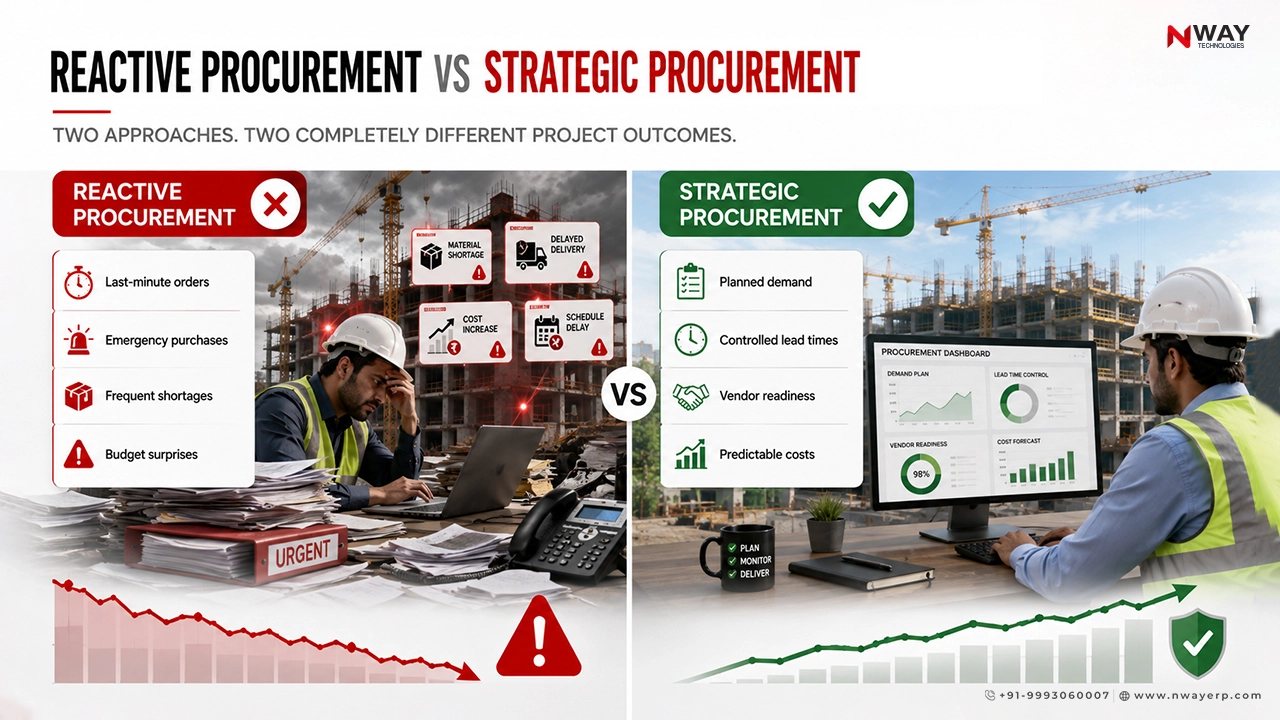
Leading contractors don’t wait until materials are urgently needed.
They manage procurement proactively.
Key characteristics include:
BOQ-Driven Procurement Planning
Material demand is linked directly to project milestones.
Early Vendor Engagement
Critical vendors are identified before procurement becomes urgent.
Procurement Monitoring
- Lead times
- Supplier performance
- Material availability
- Pending approvals
Real-Time Cost Visibility
Procurement decisions are connected to live budget tracking.
Integrated Workflows
Planning, procurement, inventory, and finance operate as one connected process.
This transforms procurement from a reactive function into a strategic project control mechanism.
Conclusion
Most projects do not fail because a supplier misses a delivery.
They fail because someone assumed there was still time to place the order.
That assumption can trigger a chain reaction that affects procurement, planning, execution, labour productivity, cash flow, and profitability.
The most successful contractors are not necessarily the ones negotiating the lowest material rates.
They are the ones making procurement decisions early enough to protect the entire project ecosystem.
Because in construction, one delayed purchase order is rarely just a procurement delay.
It is often the moment a project quietly starts moving toward a budget overrun.
Somewhere in your project right now, a small delay is quietly becoming a big one.