The Project That Never Ends on Time
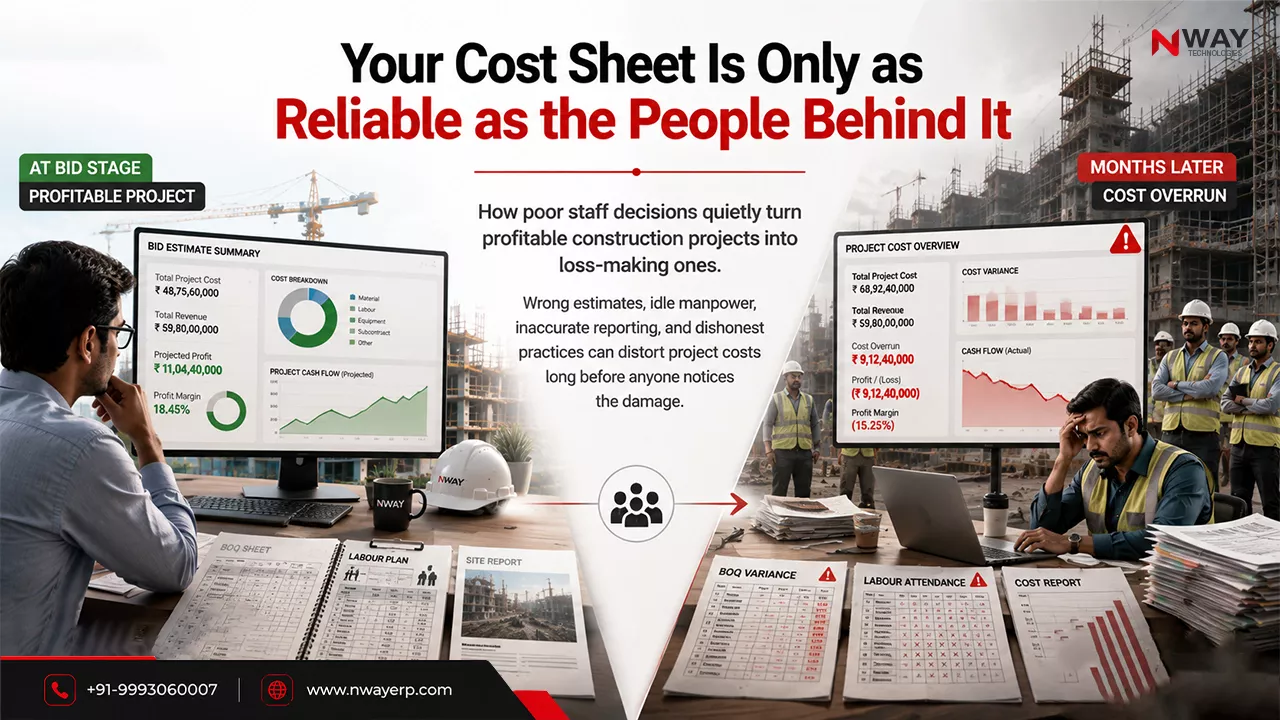
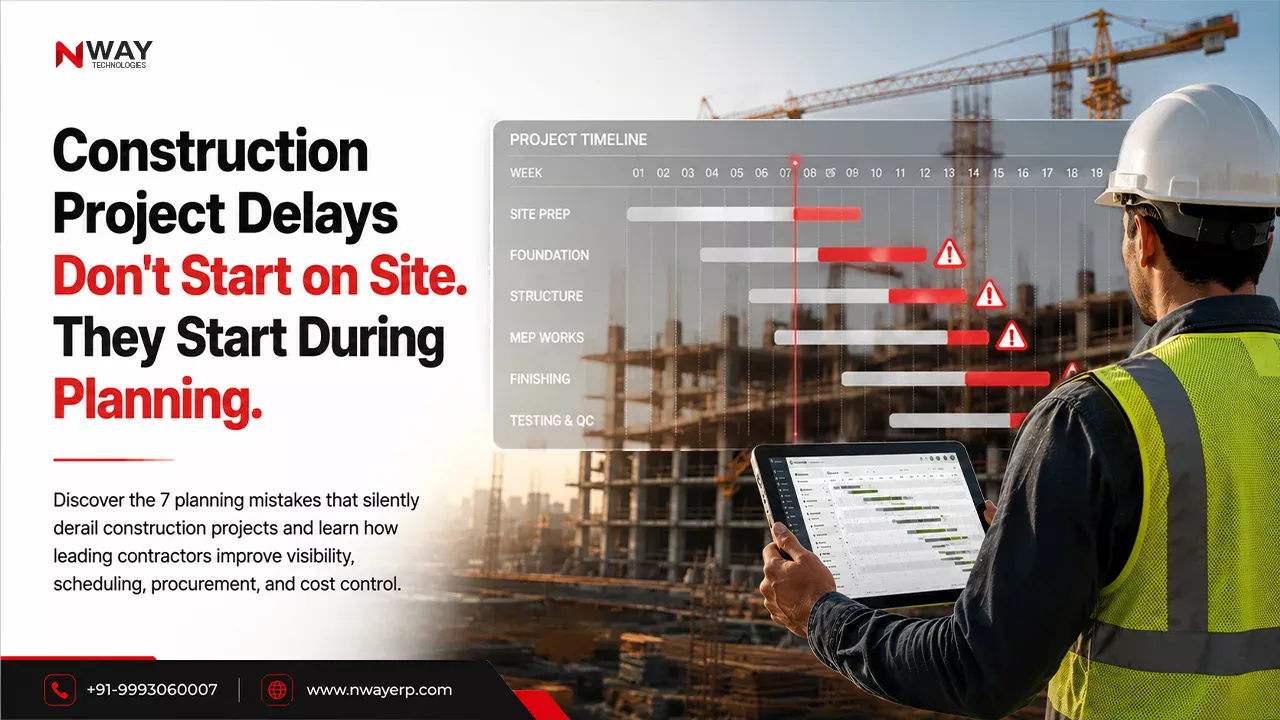
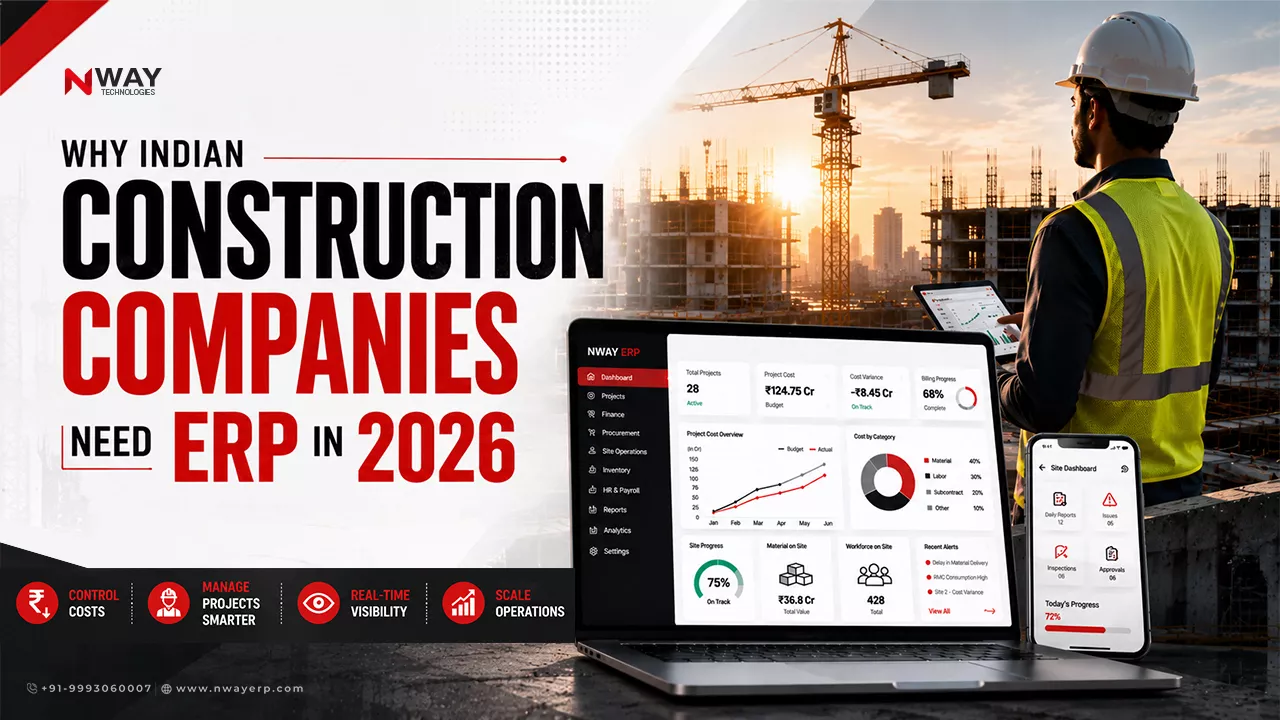
In 2025, A mid-sized highway contractor in Maharashtra (name withheld at the company’s request) completed a state highway widening contract roughly 11 months behind schedule. The project was awarded in 2022 with a contract value in the ₹150–250 crore range. The culprit wasn’t a labour shortage or a monsoon. It was data: scattered across spreadsheets, WhatsApp threads, and disconnected site registers. Nobody had a real-time view of progress, costs, or risks until the damage was already done.
This isn’t a one-off story it reflects the standard across the industry.
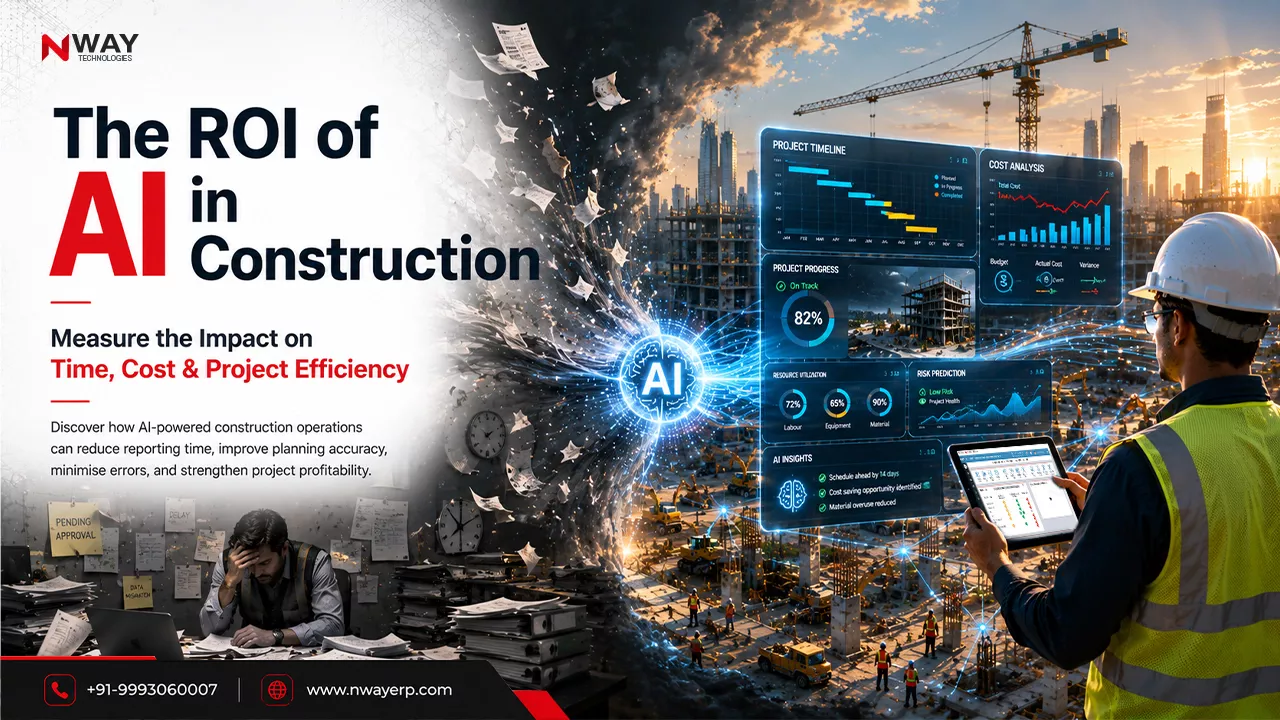
Across India’s construction and infrastructure sector, project overruns, cost escalations, and procurement inefficiencies have long been accepted as unavoidable. But a new generation of AI-powered ERP platforms is beginning to challenge that assumption with measurable, quantifiable proof — building on the broader ROI case for ERP in construction, but specifically through what AI adds on top.
Table of Contents:
- The Construction Industry’s Data Problem
- Why It’s Hard: The Limitations of Manual Methods
- What AI in Construction Actually Does and Measures
- The ROI Summary: Putting Numbers to the Claims
- What to Look for in an AI-Ready Construction ERP
- The Honest Challenges of AI Adoption in Construction
- Conclusion: ROI Is Not a promise, it is a Process
The Construction Industry’s Data Problem
Construction is one of the least digitized major industries in the world, and India’s sector reflects that at scale.
According to Next MSC, the Indian construction market was valued at USD 633.63 billion in 2025 and is expected to reach USD 698.52 billion by 2026.
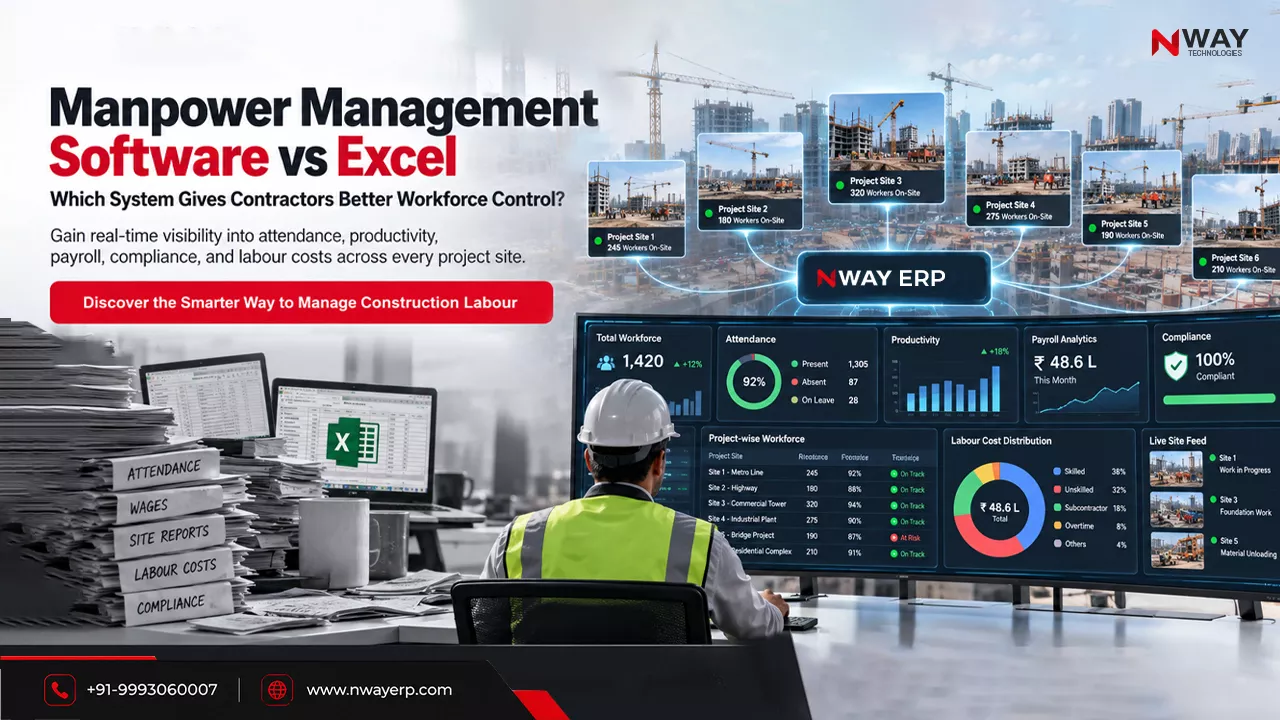
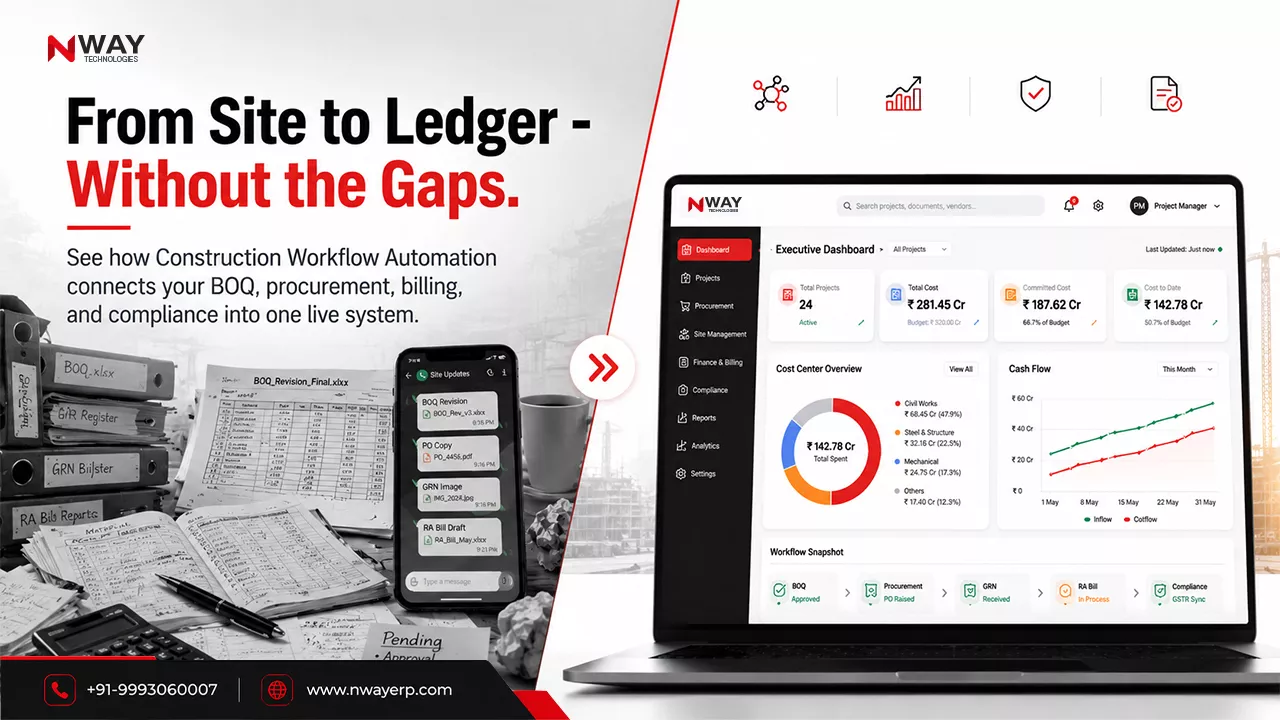
Despite being a billion-dollar industry, many project-driven businesses continue to rely on a mix of fragmented manual processes to manage their operations:
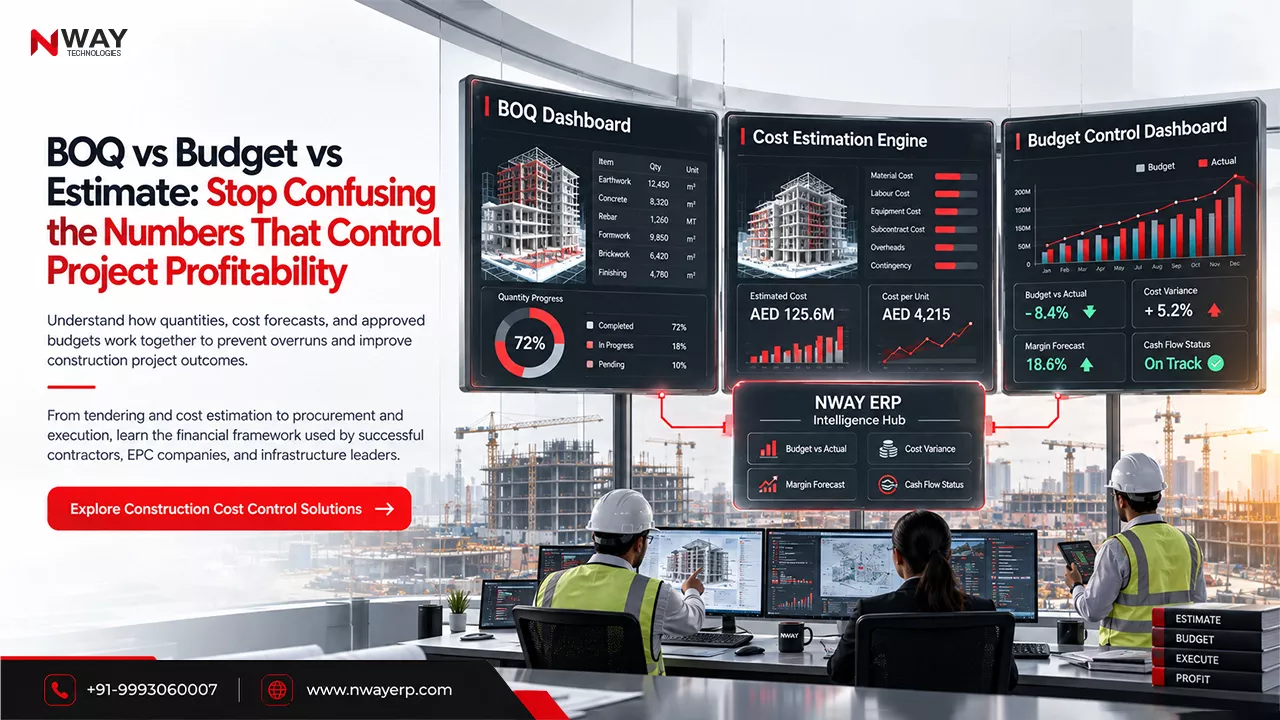
- BOQ (Bill of Quantities) prepared in Excel, prone to version conflicts
- RA (Running Account) billing tracked in standalone files with no live cost linkage
- GRN (Goods Receipt Notes) logged manually, causing reconciliation delays
- Sub-contractor bills reconciled weeks after work is completed
- Project progress updates shared over WhatsApp, not through structured systems
The result: finance teams are always working with stale data, site managers lack accountability visibility, and senior leadership makes critical decisions based on reports that are already 15 days old.
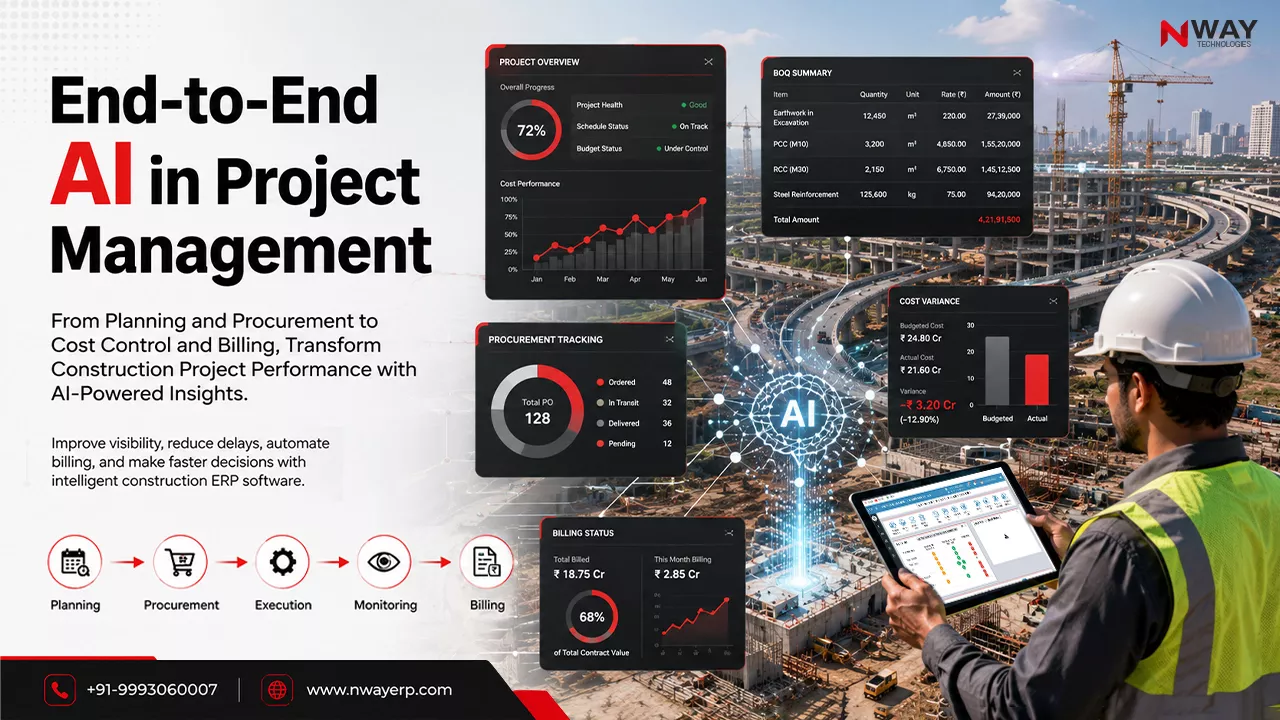
This is the environment into which AI in construction enters — not as a futuristic concept, but as a practical corrective tool. (See: AI-Enabled Construction ERP Software.)
Why It’s Hard: The Limitations of Manual Methods
Before exploring what AI solves, it is worth acknowledging why the current state persists. Manual methods in construction are not just a habit; they are deeply embedded in how the industry has built its workflows.
The Real Barriers
- Data fragmentation: Site data, finance data, procurement data, and HR data live in separate systems or no systems at all.
- Delayed reporting: Weekly or monthly MIS reports mean problems are identified long after they become expensive.
- Human error at scale: A single wrong entry in a BOQ can cascade into incorrect valuations, overbilling, or compliance issues.
- Lack of domain-specific tools: Generic ERP platforms require heavy customisation and often fail to address construction-specific workflows like WBS-linked cost tracking, BOCW compliance, or sub-contractor management.
- Resistance to change: Site-level users are often not tech-savvy, creating adoption friction for complex platforms.
These barriers are real, and any honest conversation about AI in construction must acknowledge them before making claims about transformation — we cover how Nway ERP works around each of these specifically in Construction Management Software Challenges: How Nway ERP Overcomes Them.
What AI in Construction Actually Does and Measures
The term ‘AI’ is used loosely. In the context of construction ERP, AI-driven capabilities typically include predictive analytics, automated anomaly detection, intelligent reporting, and machine learning-based cost forecasting. Independent research backs the scale of the opportunity: McKinsey research has found that global construction productivity grew just 0.4% annually between 2000 and 2022, against roughly 2% for the wider economy — a gap industry surveys increasingly point to AI and digitization as a tool to close. Separate McKinsey analysis estimates AI can lift construction productivity by up to 20%, with related industry estimates pointing to up to 15–20% reductions in project costs and up to 30% faster delivery timelines, depending on the use case and rollout maturity.
3.1 Faster Reporting and MIS
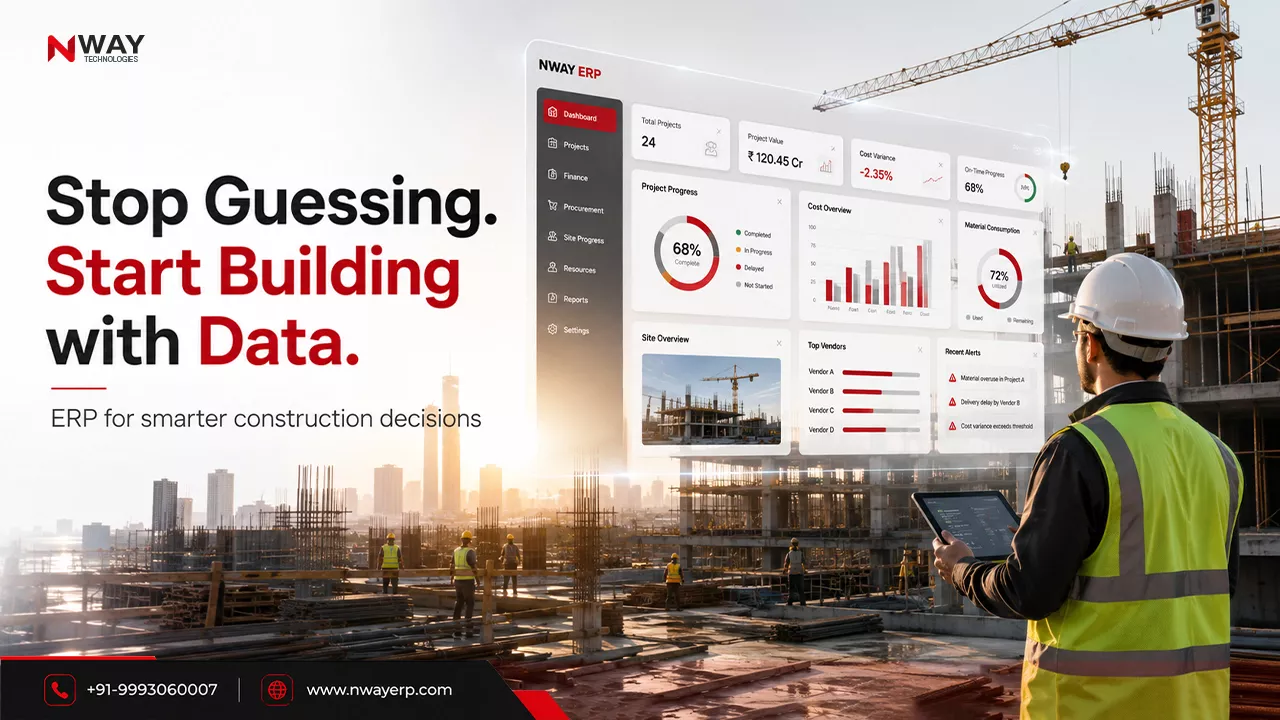
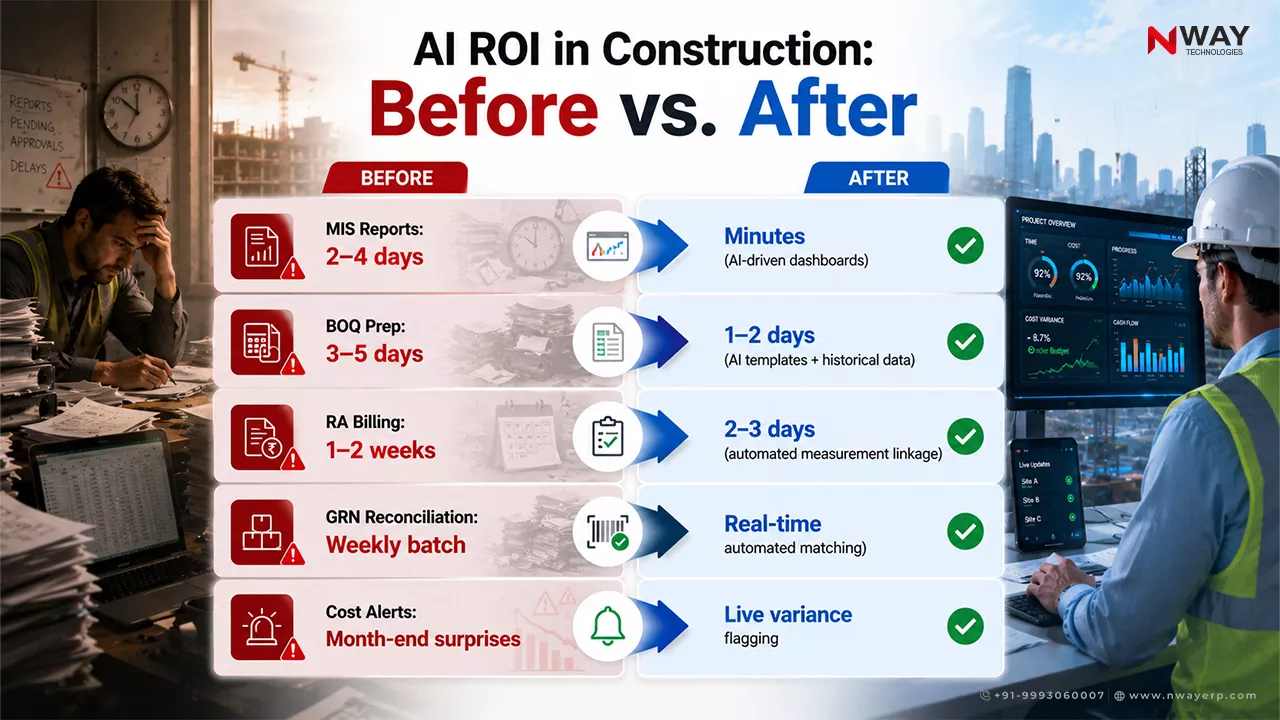
Manual MIS preparation for a mid-sized project typically takes 2–4 days per reporting cycle. AI-assisted dashboards in modern ERP platforms pull live data from across the project lifecycle, procurement, billing, attendance, equipment utilisation and generate reports in minutes, not days.
Measurable Impact
Reduction in reporting time: 70–80%
Accuracy improvement: Significant reduction in human error from manual data consolidation
Decision lag: From 15+ days to near real-time visibility
Nway-specific: customers using Nway’s S-Curve and Cash Flow dashboards report up to 3× faster monthly progress reporting, with decision lag dropping from 15+ days to near real-time.
3.2 Smarter BOQ and Cost Estimation
AI-powered cost estimation tools can analyse historical project data, material consumption rates, labour productivity, and equipment downtime to generate more accurate BOQs. Nway ERP’s AI Contract Reader extracts clauses, quantities, and conditions directly from a contract PDF, and the AI Drawing Analyzer reads engineering and architectural drawings to auto-generate quantities from blueprints — pushing the BOQ from a multi-day manual exercise to a near-automatic one.
Measurable Impact
BOQ preparation time: Typically reduced by 40–50% through AI-assisted estimation, historical benchmarks, and automated quantity calculations.
Cost variance alerts: Real-time flagging vs. end-of-month surprises
Estimation accuracy: Improved by 20–30% on repeat project types
Nway-specific: While industry-wide improvements generally range between 40–50%, some Nway ERP customers using the AI Contract Reader, AI Drawing Analyzer, and AI Resource Planner have reported BOQ preparation time reductions of up to 80% and significantly lower estimation errors on repeat project types. Actual results depend on project complexity, data quality, and process maturity.
3.3 Procurement and Vendor Intelligence
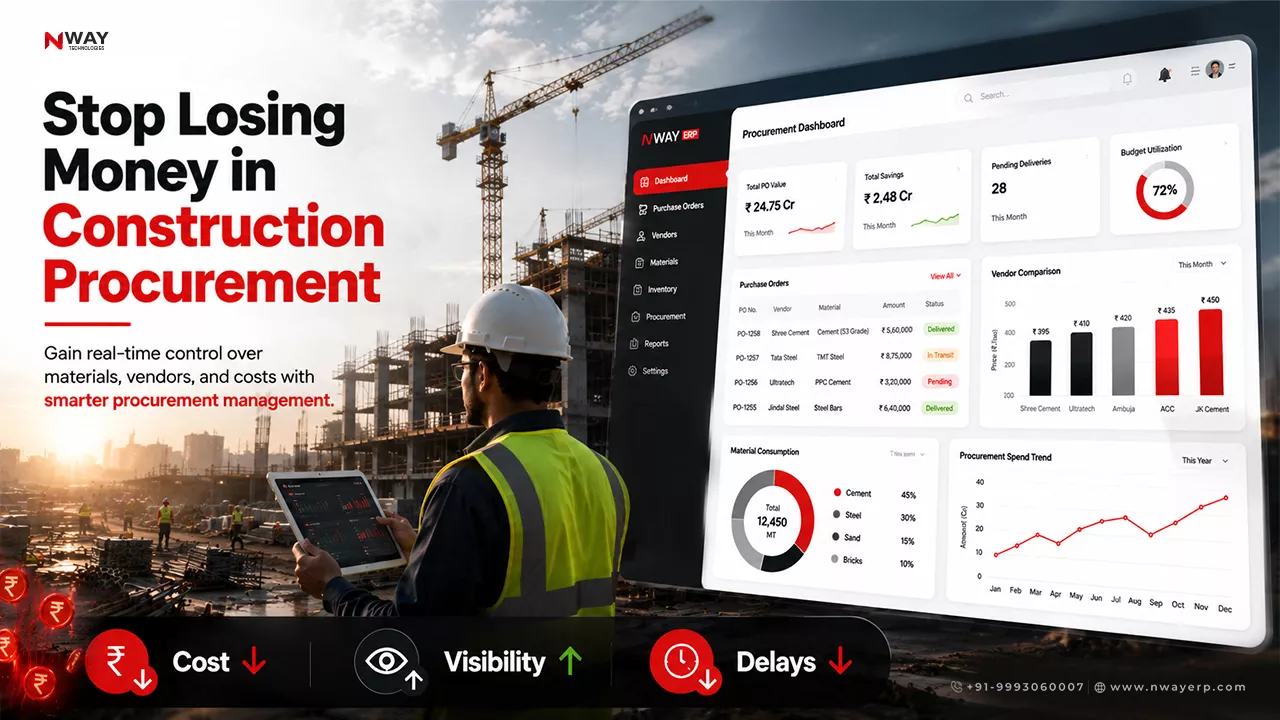
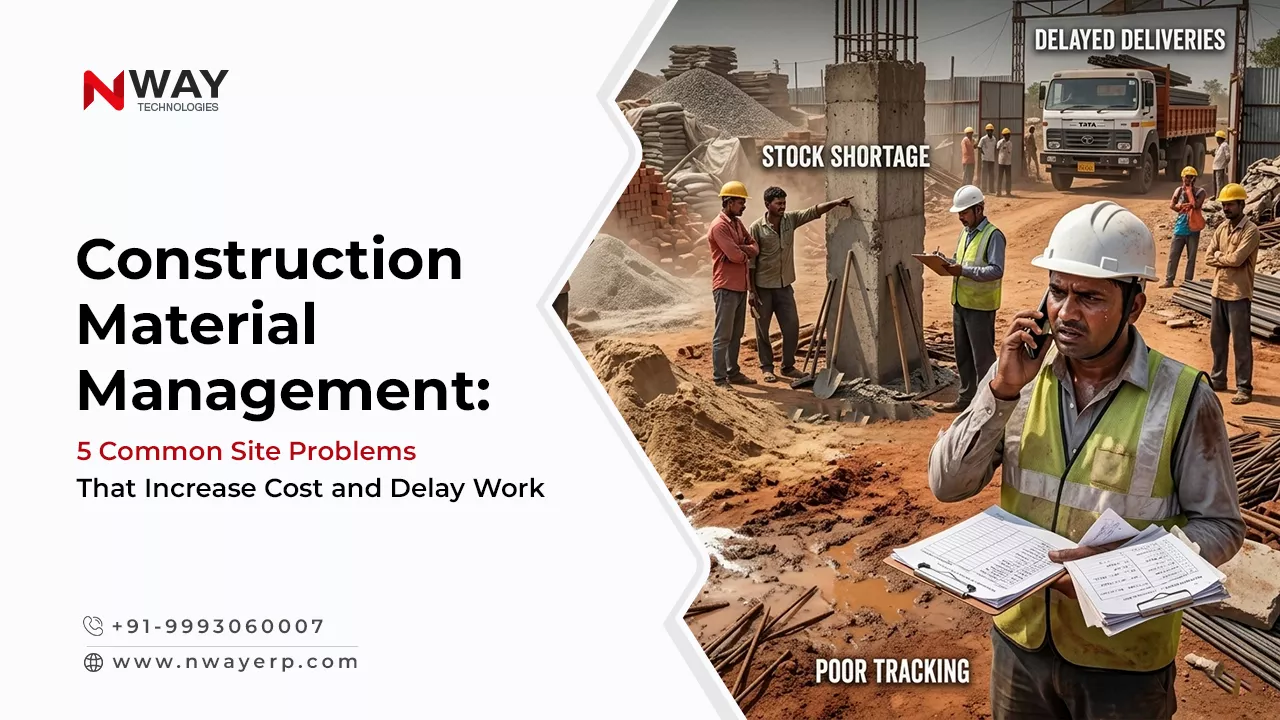
Procurement leakage is one of the highest hidden costs in construction. AI-driven procurement modules can identify duplicate purchase orders, flag price anomalies versus market benchmarks, and automate GRN-to-invoice matching, a workflow that typically requires dedicated manpower.
Measurable Impact
PO-to-GRN reconciliation time: Reduced from days to hours
Duplicate/fraudulent PO detection: Automated flagging
Vendor payment accuracy: Improvement in correct first-time payments
Nway covers this in depth in AI-Powered Procurement Software.
3.4 RA Billing and Sub-Contractor Management
Running Account billing is a chronic pain point. Disputes between contractors and clients over measurement, work completion, and deductions are common often because records are maintained manually with no audit trail. AI-assisted RA bill processing links measurements to approved BOQ line items, generates bills automatically, and maintains a tamper-proof history.
Measurable Impact
RA bill processing time: Reduced by 50–60%
Billing disputes: Decrease through automated measurement linkage
Sub-contractor reconciliation: Real-time visibility vs. monthly catch-up
Nway-specific: automated RA bills, stage payments, and escalation handling have cut billing errors and disputes by up to 40% for Nway customers.
3.5 Predictive Analytics and Compliance Automation
Beyond individual workflows, AI-powered ERP platforms apply predictive analytics across the project — S-Curve and cash flow forecasting that flags schedule risk early and surfaces a real-time project health score. On the compliance side, the same data feeds automatic generation of Schedule G/H/I and other contract-mandated documentation, reducing the manual paperwork burden on site teams.
The ROI Summary: Putting Numbers to the Claims
| Operational Area | Measurable ROI |
|---|---|
| Reporting & MIS | 70–80% reduction in report preparation time; near real-time project visibility |
| BOQ & Estimation | 40–50% faster preparation; 20–30% improvement in cost estimation accuracy |
| Procurement | Automated GRN-to-invoice matching; reduction in procurement leakage |
| RA Billing | 50–60% faster bill processing; significant decrease in disputes |
| Compliance (GST/BOCW) | Automated GSTR-2A/2B reconciliation; reduced penalty risk |
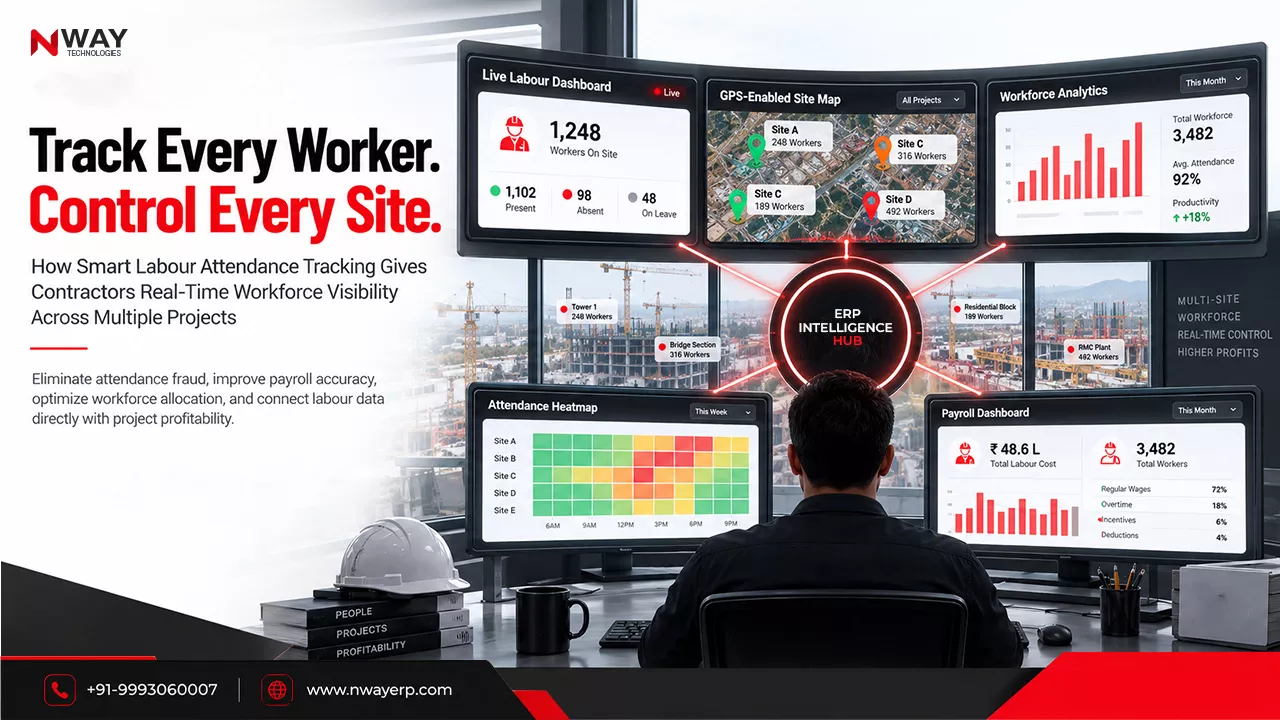
| Labour & Attendance | Real-time tracking linked to payroll; fewer payroll errors |
See how AI-powered ERP can give your team real-time cost visibility from BOQ to final billing.
What to Look for in an AI-Ready Construction ERP
Not all ERP platforms are created equal, and the construction sector has paid a high price for generic tools that do not understand how a project-based business actually runs. When evaluating an AI-enabled ERP, project managers and CFOs should look for:
- Domain-specific workflows: BOQ management, WBS-linked cost tracking, RA billing, and sub-contractor management are not adapted from manufacturing or retail modules.
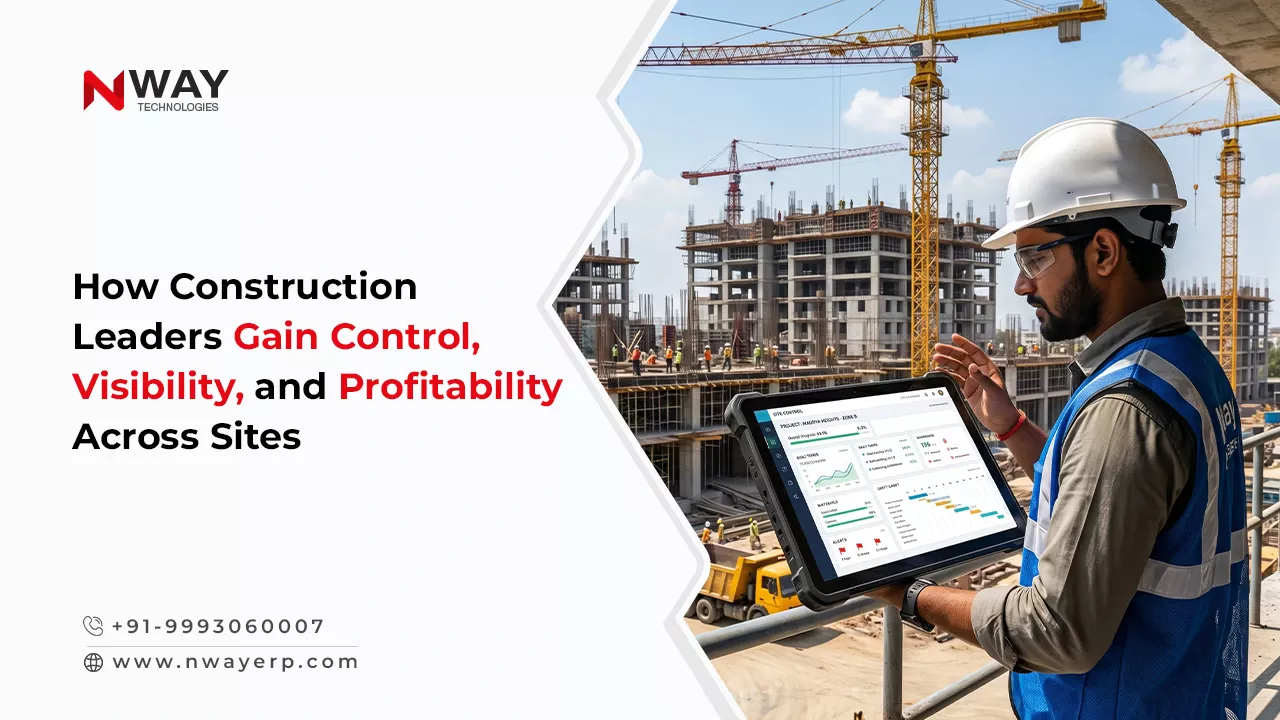
- Real-time dashboards: Live project health indicators, not static Excel exports.
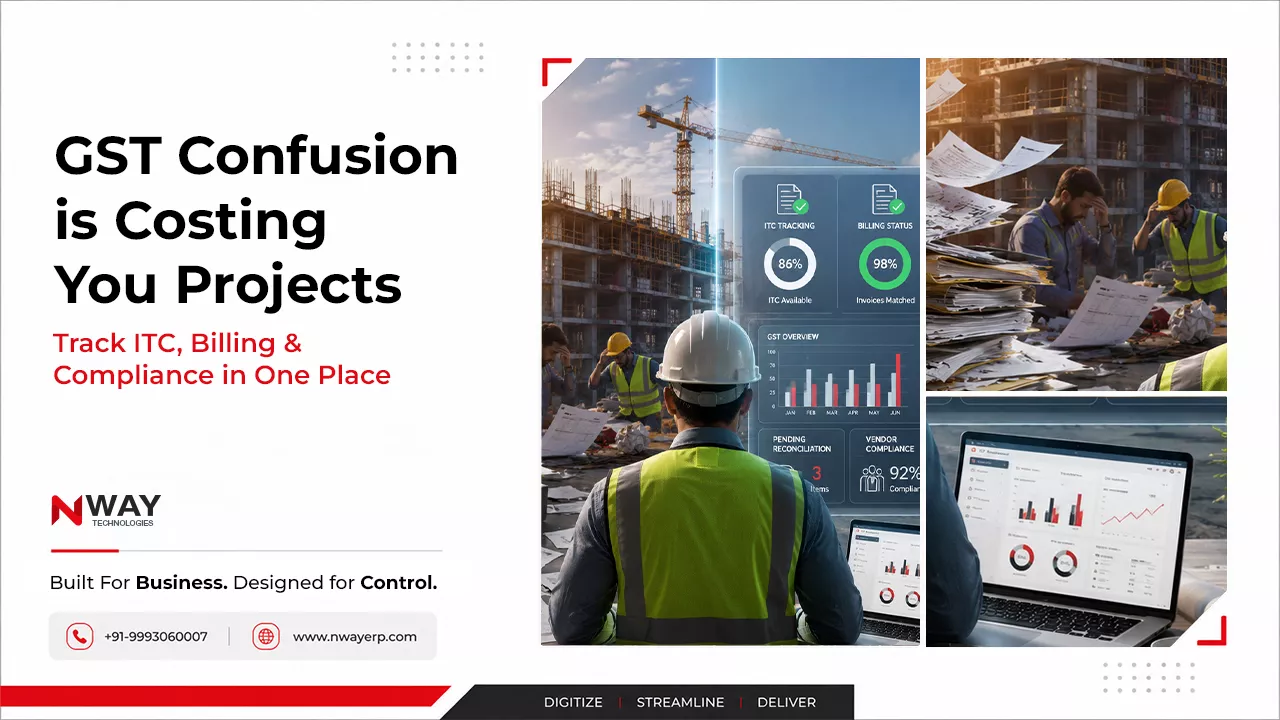
- Compliance automation: Integrated GST (GSTR-2A/2B reconciliation, RCM handling, SAC/HSN codes), BOCW compliance, and e-invoicing support.
- Procurement intelligence: PO-to-GRN-to-invoice automation with anomaly detection.
- Scalability: Ability to handle multi-project, multi-location operations without performance degradation.
- Cloud-native architecture: Remote access for site teams, with mobile-ready interfaces.
About Nway ERP
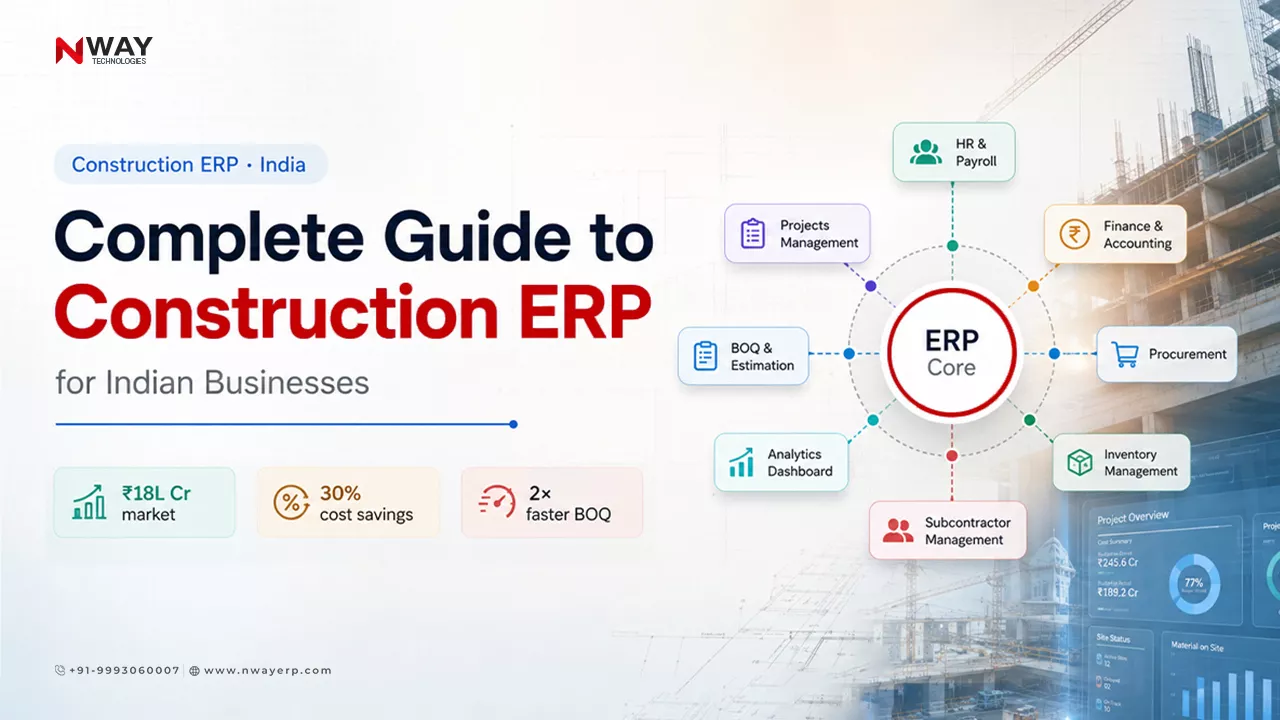
Nway Technologies builds ERP software purpose-designed for construction, infrastructure, real estate, and project-based industries in India. The AI-powered project management module spans the full BOQ-to-billing lifecycle — contract and drawing analysis, resource planning, execution, RA billing, and tracking — and connects in real time with Inventory, Machinery, Finance, HR/Payroll, Procurement, and Sub-contractor Management. It’s built by people who understand how a construction business actually works. Learn more about Nway ERP.
The Honest Challenges of AI Adoption in Construction
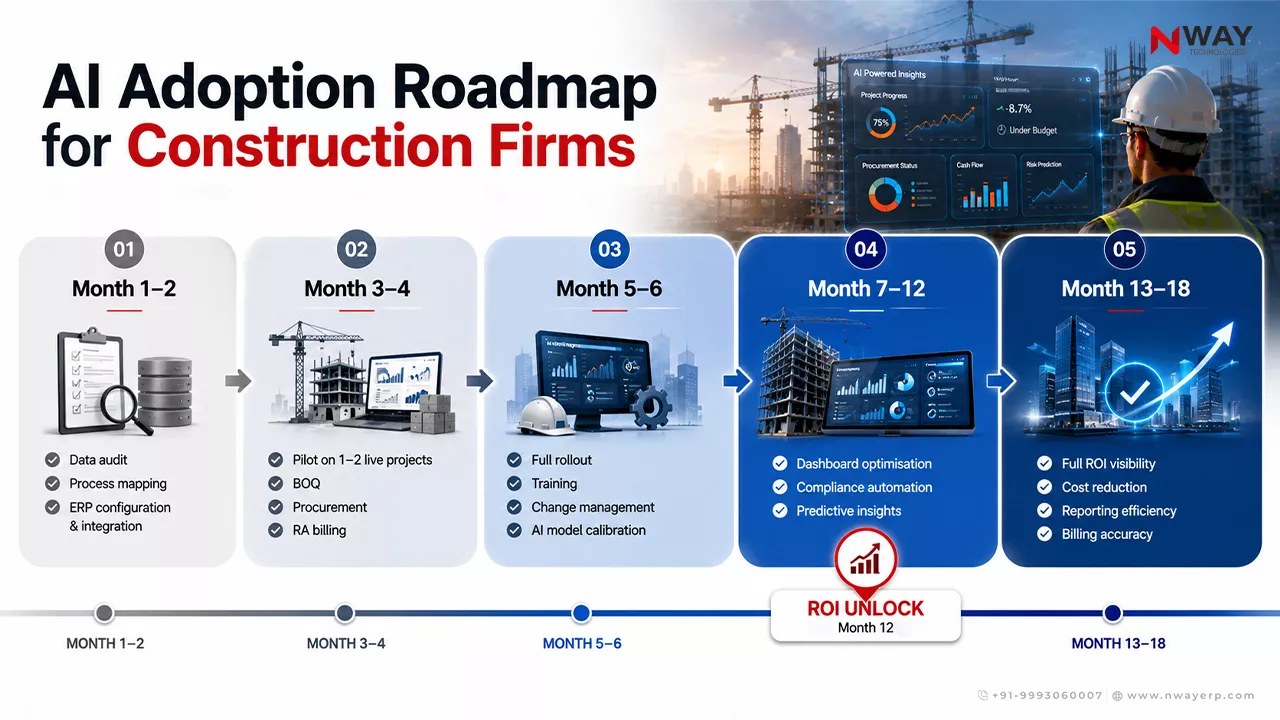
ROI is real, but it does not arrive automatically. The key implementation challenges that organisations should anticipate are:
- Data quality: AI systems are only as good as the data they are trained on. Legacy businesses with years of inconsistent data need a structured data migration and cleansing phase.
- Change management: Site-level adoption is the most common failure point. Training, process redesign, and ongoing support matter as much as the technology itself.
- Integration complexity: Many businesses have existing accounting software, procurement tools, or custom-built systems. ERP selection must account for integration feasibility.
- Realistic timelines: AI-driven ROI in construction typically materialises over 6–18 months. Organisations expecting overnight results will be disappointed.
The businesses that capture the most value from AI in construction are not necessarily the ones that invest the most; they are the ones that plan the transition most carefully.
Key Takeaways
- AI in construction delivers measurable ROI across reporting, BOQ preparation, procurement, billing, and compliance not just theoretical efficiency gains.
- Manual methods remain the industry norm but carry significant hidden costs: delayed decisions, billing errors, procurement leakage, and compliance risk.
- The most impactful AI applications for construction businesses are those embedded directly into domain-specific ERP workflows, not generic automation tools.
- ROI typically materialises over 6–18 months; the organisations that plan for change management and data quality succeed; those that do not, fail to capture value.
- Cloud-native, scalable ERP platforms designed specifically for construction, covering BOQ, RA billing, sub-contractor management, and GST compliance, offer the fastest path to measurable outcomes.
Conclusion: ROI Is Not a promise; it is a Process
The ROI of AI in construction is real, documented, and increasingly accessible. But it does not come from deploying technology in isolation. It comes from deploying the right technology, one that is built for the complexity of project-based operations, integrated deeply into daily workflows, and supported by a commitment to clean data and disciplined adoption.
For project managers dealing with cost overruns, CFOs tired of month-end reporting surprises, and for operations heads managing multi-site complexity, AI-powered
construction ERP software represents a structural shift, not just a software upgrade.
The question is no longer whether the ROI is there. It is whether your organisation is ready to capture it.
Ready to Move Beyond Spreadsheets?