
Table of Contents:
- Introduction
- Why Construction Cost Analysis Depends on People More Than Spreadsheets
- The Hidden Risk of Hiring for Designation Instead of Competence
- The Hidden Cost Nobody Tracks: Idle Staff
- How Labour Productivity Directly Influences Project Profitability
- Incompetence Is Costly, Dishonesty Is Worse
- Why This Problem Is So Common in Construction
- Conclusion
Introduction
Most contractors have experienced it.
The estimate looked solid. The quantities were checked. The rates seemed accurate. The projected profit was acceptable.
Yet six months later, the project is consuming cash faster than expected, labour costs are rising, and management is struggling to understand where the margins disappeared.
In many cases, the problem is not steel prices, cement rates, or client delays.
The problem is people.
Every construction cost analysis depends on human inputs. Estimators prepare quantity calculations. Site engineers report productivity. Supervisors verify manpower attendance. Procurement teams raise purchase requests. Billing engineers certify executed quantities.
When the wrong people are involved, either because they lack competence or because controls are weak, incorrect information enters the system. Once that happens, every decision based on that information becomes unreliable.
This is not a rare contractor problem. It is a challenge faced across the construction industry. Understanding how staff decisions affect construction labour cost and overall project profitability is the first step toward better project cost control. (See: Construction Labour Management Software)
Why Construction Cost Analysis Depends on People More Than Spreadsheets
Many contractors focus heavily on software, formulas, and reporting formats when discussing construction cost analysis.
But even the best ERP system or cost sheet cannot compensate for poor human decisions. That’s why contractors are moving to a manpower management system built for construction sites.
A cost analysis typically relies on:
- BOQ interpretation
- Quantity estimation
- Productivity assumptions
- Labour deployment plans
- Material consumption estimates
- Procurement schedules
- Progress reporting
- Billing and reconciliation records
Every one of these inputs originates from a person.
A spreadsheet rarely creates errors on its own. People do.
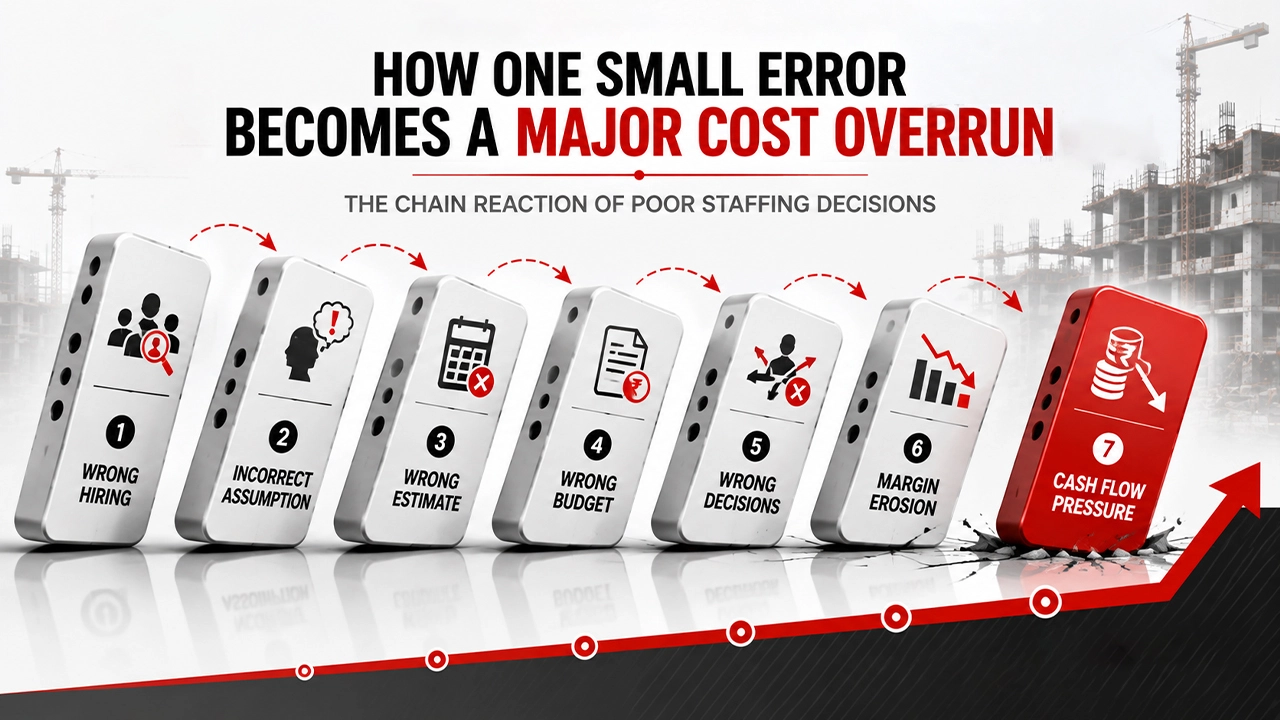
The Hidden Risk of Hiring for Designation Instead of Competence
Construction projects often need to mobilize quickly. Under schedule pressure, companies sometimes hire based on job title rather than demonstrated capability.
This creates risks such as:
- Incorrect quantity calculations
- Misinterpretation of drawings
- Unrealistic productivity assumptions
- Poor site planning
- Inaccurate labour forecasting
- Faulty cost reporting
The result is often a wrong construction cost estimate that looks accurate on paper but fails during execution.
Example
A hypothetical mid-sized road contractor assigns bitumen quantity calculations to a junior estimator who has never worked on highway projects.
The estimator applies a formula used for a different pavement design and underestimates bitumen requirements by 6%. A structured rate analysis method with reviewed coefficients catches this before submission.
Initially, the error appears insignificant.
However, because bitumen is one of the highest-value items in the BOQ, the underestimated quantity creates a major gap between planned and actual costs. By the time the mistake is discovered, multiple billing cycles have already been completed, and the contractor absorbs the additional expense directly from project margins.
Want to improve estimate accuracy?
The Hidden Cost Nobody Tracks: Idle Staff
Contractors carefully track material consumption, equipment usage, and subcontractor bills.
Unfortunately, workforce inefficiency often receives far less attention.
Idle manpower is one of the biggest hidden contributors to construction cost overruns.
A project might budget for:
- 1 Project Manager
- 3 Site Engineers
- 2 Supervisors
But during execution, additional personnel are retained “just in case.”
Over time, payroll expenses continue even when productivity does not.
Why Idle Staff Become Expensive
Idle staff costs are dangerous because they rarely appear as separate problem areas.
Instead, they quietly accumulate inside:
- Site overheads
- Indirect expenses
- Administrative costs
- Labour budgets
On a project lasting 12 to 18 months, even a few unnecessary positions can significantly affect profitability.
The Impact on Construction Labour Cost Management
Poor workforce planning typically causes:
| Workforce Issue | Business Impact |
|---|---|
| Excess supervisors | Increased overhead cost |
| Poor labour allocation | Lower productivity |
| Unbalanced crew sizes | Work stoppages |
| Duplicate responsibilities | Decision delays |
| Underutilized engineers | Reduced profit margins |
Effective manpower planning in construction is not simply about having enough people.
It is about having the right people performing the right tasks at the right time.
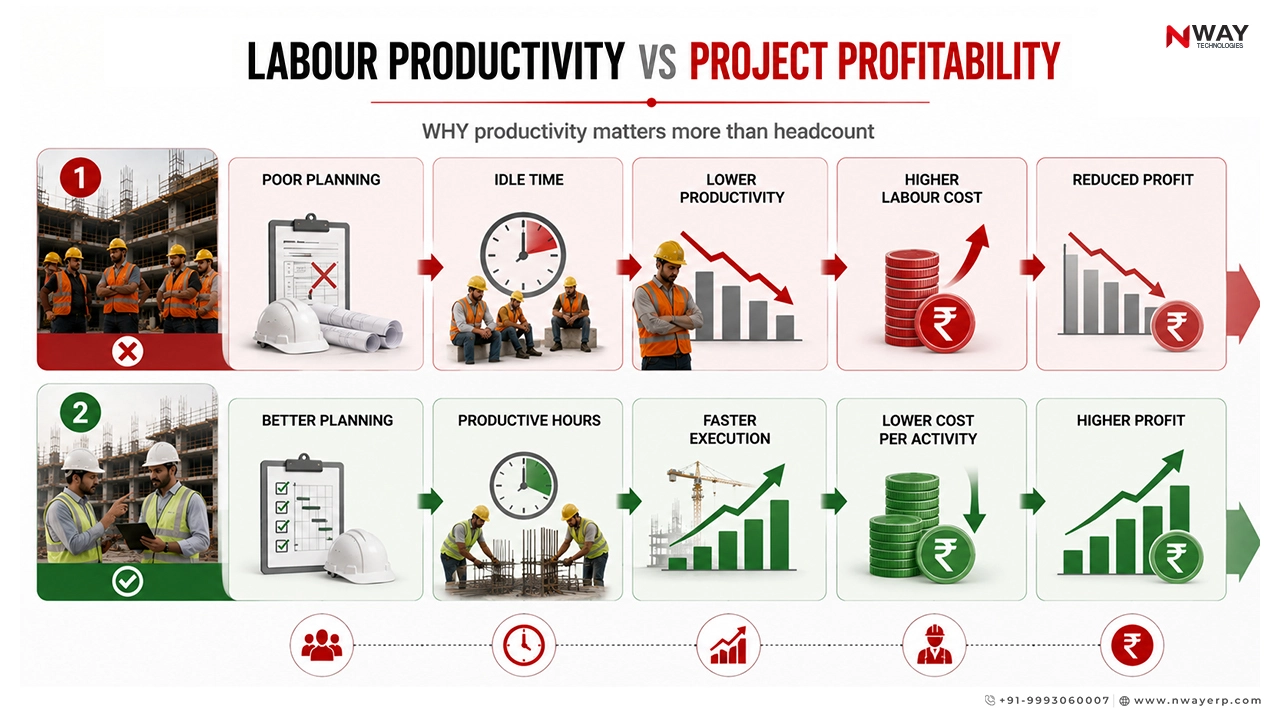
How Labour Productivity Directly Influences Project Profitability
Labour is often one of the largest controllable costs in a construction project.
According to FMI’s 2023 Labour Productivity Study, contractors lose an estimated $30 billion to $40 billion annually due to labour inefficiencies, and nearly half of surveyed contractors reported declining labour productivity.
The lesson for contractors is simple:
Even small declines in labour productivity can have a major impact on construction project cost.
Common Productivity Killers
- Poor crew planning
- Frequent rework
- Lack of supervision
- Waiting for materials
- Delayed approvals
- Incorrect task sequencing
- Inadequate skill levels
These issues increase construction labour cost without adding actual progress.
Incompetence Is Costly, Dishonesty Is Worse
Most contractors can address incompetence through training, mentoring, and better hiring practices.
Dishonesty is more difficult because it actively manipulates project information.
Examples include:
- Inflated labour attendance records, which verified site attendance prevents.
- False productivity reports
- Quantity manipulation
- Excess procurement requests
- Material diversion
- Vendor collusion
- Tracking labour cost by project
Unlike technical mistakes, these actions are intentionally designed to look legitimate.
Why Dishonesty Distorts Construction Cost Analysis
A contractor can only make good decisions when the underlying information is accurate.
When inaccurate information enters reports:
- Cost forecasts become unreliable
- Productivity analysis becomes misleading
- Resource planning becomes ineffective
- Future bids become risky
The most dangerous consequence is that management loses confidence in project data itself.
Once trust in reporting disappears, every financial decision becomes slower and more difficult.
Direct Costs vs Indirect Costs: The Real Damage
Many contractors focus only on direct financial losses.
Direct losses are easy to identify:
- Excess labour payments
- Material wastage
- Rework expenses
- Billing disputes
Indirect losses are often much larger.
Indirect Consequences
- Incorrect bidding decisions
- Faulty cash flow planning
- Delayed management action
- Poor resource allocation
- Loss of confidence in project reports
Consider a contractor who believes a project still has an 8% margin because internal data appears healthy.
If the data is wrong, management might aggressively price a new contract assuming sufficient financial capacity exists.
In reality, the company could already be operating at a loss.
That is how poor staffing decisions spread beyond a single project and begin affecting the entire business.
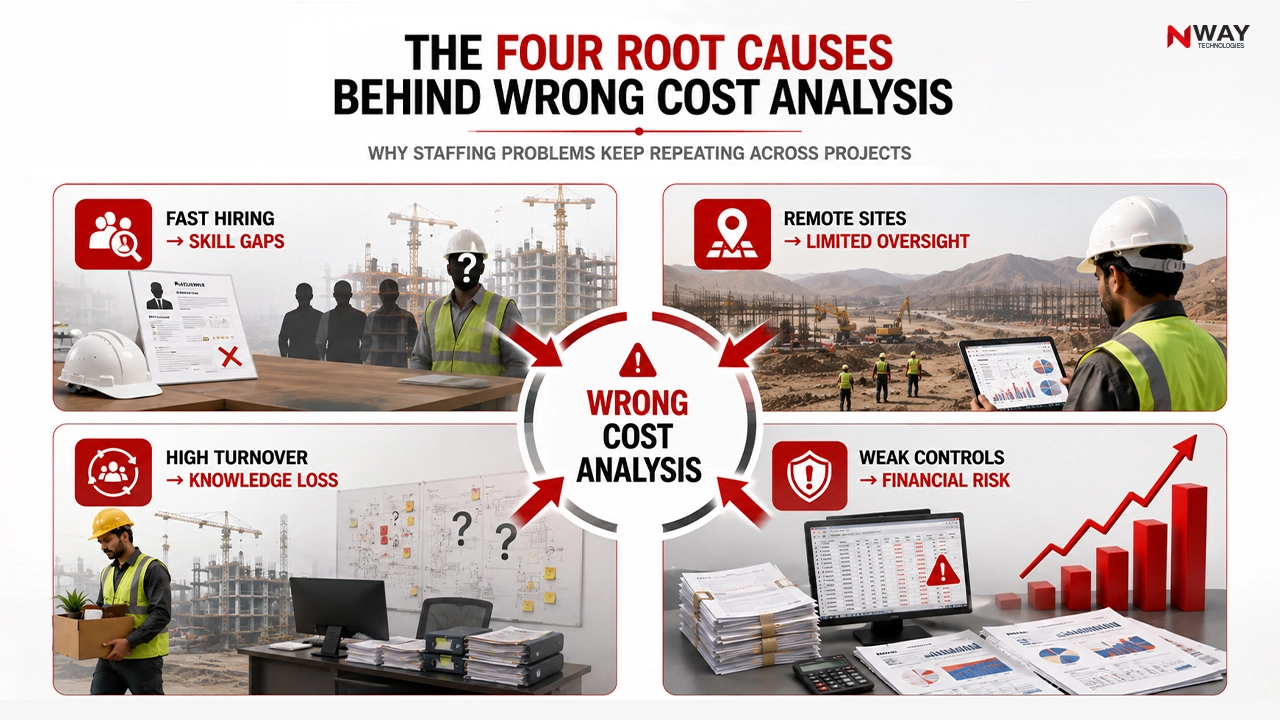
Why This Problem Is So Common in Construction
Many contractors assume these issues happen only in poorly managed organizations.
The reality is very different.
Construction naturally creates conditions where staff-related errors can survive for months.
Industry Challenges
- Rapid project mobilization
- High employee turnover
- Remote project locations
- Multiple subcontractors
- Pressure to fill vacancies quickly
- Limited supervision across sites
This often leads to a hiring mindset of:
“Can this person start on Monday?”
instead of:
“Can this person perform effectively for the next 18 months?”
That short-term thinking frequently becomes a long-term cost problem.
(See: Why Labour Management Software is helpful for your Construction Business)
Conclusion
Every contractor has faced projects where the numbers looked right initially but failed to match reality during execution.
While market volatility, client delays, and procurement issues certainly influence project outcomes, staff decisions remain one of the most overlooked causes of inaccurate construction cost analysis.
Wrong hiring, weak supervision, idle manpower, and dishonest reporting do not create immediate disasters.
Instead, they quietly distort the information upon which every future decision is based.
The important takeaway is that this challenge is not unique to your company.
It is a widespread reality across the construction industry.
The contractors who protect their margins most effectively are not necessarily those with the cheapest labour. They are the ones with the strongest workforce planning, the most reliable project data, and the most disciplined controls around how information enters their cost analysis process.
Want better visibility into labour costs, productivity, billing, procurement, and project profitability?