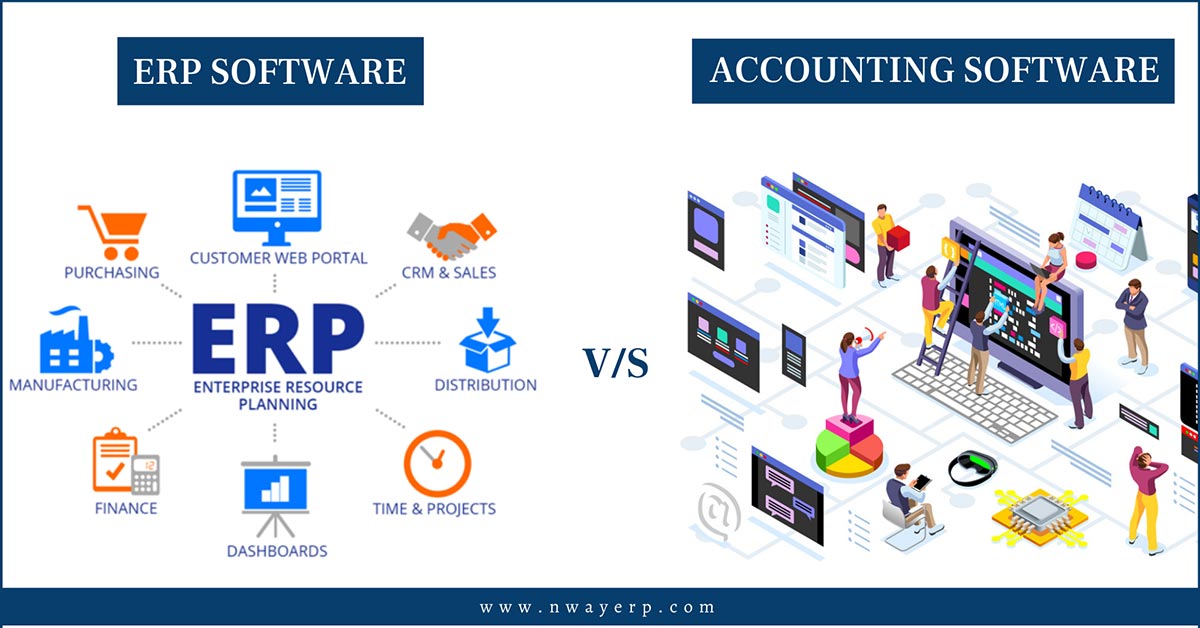
Accounting software and ERP software both help businesses manage financial information, but they solve different problems.
Accounting software primarily records financial transactions such as sales, purchases, expenses, GST, receivables, and payments. Construction ERP goes further by connecting finance with project execution, procurement, materials, labour, machinery, subcontractors, billing, and project-wise cost control.
For a construction company, the real difference is not simply accounting versus software automation. It is the difference between recording what has already happened and managing the operational activities that affect project cost, progress, and profitability.
If you’re running a construction or infrastructure business and still relying on Tally, Busy, or Zoho Books to “manage” the company, you’ve probably already felt the gap: your books look fine, but you have no idea what’s actually happening on your sites in real time.
That gap is exactly the difference between accounting software and a construction ERP system—and it’s a decision every growing contractor eventually has to make.
Quick answer: Accounting software records what money came in and went out. Construction ERP connects your accounts to your sites, labour, machinery, material, and subcontractors—so you see project profitability, not just company profitability, in real time. If you’re managing more than one site or multiple subcontractors, or you’re finding out about cost overruns after the bill is already paid, you’ve outgrown accounting software.
What Is Accounting Software?
Accounting software records and processes financial transactions—accounts payable, accounts receivable, general ledger, trial balance, GST returns and payroll. Tools like Tally, Busy, and Zoho Books fall into this category. They’re built to answer one question well: where did the money go?
For a small contractor running one or two sites, this is often enough—for a while.
What Is Construction ERP?
Construction ERP (Enterprise Resource Planning) software does everything accounting software does. It connects it to the operational side of your business: site-wise costing, labour attendance and wages, machinery utilisation and running cost, material indent-to-issue tracking, subcontractor billing, RA bill generation, and planning & estimation — all in one system, updated in real time, accessible from the site or the office.
Nway Construction ERP Software is built specifically for Indian contractors and infrastructure companies to run this way — one system instead of five disconnected tools.
The major difference between an ERP system and accounting software are below:
-
Accounting Software provides limited real-time data, whereas ERP handles the entire function of an organization
ERP software consolidates every financial information in one database and accounting software handles individual business accounts. ERP systems eliminate the need for different tools to manage the requirements of different departments by providing combined solutions for a wide range of business processes. Moreover, company-wide data is available in the cloud for anywhere, anytime access to real-time information using a mobile device. ERP systems connect every part of the business, so decisions are based on real-time intelligence. On the other hand, the accounting system doesn’t come up with this kind of functionality.
-
Accounting software is nothing but a subtype of ERP Software
An accounting system is a subtype of ERP. Accounting software specifically deals with all accounting transactions and the modules basically used by the accounting software are General Ledger, Chart of Accounts, Trial Balance, Balance Sheet, Accounts Receivable, Accounts Payable, Point of Sale. On the other hand, an ERP is a fully integrated solution deals with all of the functions offered by accounting software integrates them with non-financial tools. It specifically includes inventory management, supply chain management, customer relationship & warehouse management.
-
Accounting software has a limited ability to meet industry-specific needs as compared to ERP
The accounting system is adopted by the industry which is looking only for Financial management. However, the ERP system gives provisions for all the departments of an organization to include their specific business processes to be customized with an ERP software.
-
Accounting software is designed to manage only one specific area of business
Accounting software is designed to manage only one specific area of business. While the ERP system is a fully integrated software deals with the functions or modules of accounting software along with a whole host of other functions within a business. It includes inventory, supply chain management, customer relationship management, online selling & buying & warehouse management. It doesn’t work for a specific area instead covers all your business areas.
-
ERP Provide One Stop Solution for your Domain
An ERP system can provide functionality & value to your entire domain whereas an accounting solution is just designed to be leveraged to cover essential financial requirements by your finance team like Accounts payable, Accounts receivable, Revenue, Sales & Invoicing, Financial reporting.
ERP vs Accounting Software: Side-by-Side Comparison
| Parameter | Accounting Software | Construction ERP |
|---|---|---|
| Core Function | Records financial transactions | Manages finance + full project operations |
| Data Scope | Company-level books | Site-wise, project-wise real-time data |
| Visibility | What happened (after the fact) | What’s happening now, on every site |
| Labour & Attendance | Not covered | Built-in, linked to wage payout |
| Machinery Costing | Not covered | Tracks fuel, maintenance and utilisation per machine |
| Material Tracking | Not covered | Indent → PO → GRN → Issue → Reconciliation |
| Subcontractor Billing | Manual, outside the system | RA bills, retention and deductions automated |
| Multi-Site Consolidation | Difficult, usually manual in Excel | Native—one dashboard for all sites |
| Mobile/Site Access | Limited or none | Web + mobile, usable from the site office |
| Who It’s Built For | Any small business | Contractors, EPC, infrastructure and real estate companies |
Tally or Accounting Software vs Tally + Excel vs Construction ERP
Many construction companies do not depend on accounting software alone. Their actual working environment often includes accounting software for finance, Excel for project tracking, WhatsApp for site communication and separate reports for materials, labour and machinery.
As the number of projects increases, maintaining these disconnected records becomes more difficult.
A construction ERP brings these activities into a connected system so that project teams, stores, procurement, finance and management work with the same information.
| Requirement | Tally / Accounting | Tally + Excel | Construction ERP |
|---|---|---|---|
| GST / Accounting | ✓ | ✓ | ✓ |
| Project-wise Accounting | Partial | Manual | Integrated |
| BOQ vs Actual | — | Manual | ✓ |
| Material Requisition | — | Manual | ✓ |
| PO / GRN / Site Issue | Limited | Separate Files | ✓ |
| Labour Cost by Project | Limited | Manual | ✓ |
| Machinery Cost | — | Manual | ✓ |
| RA Billing | Limited | Manual | ✓ |
| Subcontractor Billing | Limited | Manual | ✓ |
| Committed Cost | — | Difficult | ✓ |
| Live Project Profitability | — | Difficult | ✓ |
| Multi-project MIS | Limited | Manual Consolidation | ✓ |
The need for ERP generally increases when teams spend significant time reconciling information between accounting software, Excel sheets and project reports.
Company Profitability Is Not the Same as Project Profitability
Traditional accounting reports can show whether the overall business is profitable. Construction management, however, also needs to know whether each individual project is profitable.
A company may perform well overall while one project is experiencing:
- higher-than-planned material consumption,
- labour cost overruns,
- machinery expenses,
- subcontractor variations,
- procurement delays,
- unplanned purchases,
- or slow billing and collections.
Construction ERP helps connect these operational costs with individual projects, cost centres, BOQ items and activities.
This gives management a clearer view of:
Budget → Actual Cost → Variance → Project Profitability
Instead of waiting for month-end financial reconciliation, project and management teams can identify cost deviations earlier.
Actual Cost vs Committed Cost: Why It Matters in Construction
Accounting reports usually become most useful once a financial transaction has been recorded.
But construction companies also need visibility into costs that have already been committed, even when the final invoice has not yet been received.
For example, if a purchase order worth ₹25 lakh has already been approved, the project has effectively committed that amount. The supplier invoice may arrive later, but project management still needs to consider the commitment while evaluating the remaining budget.
Construction ERP can help management compare:
Budgeted Cost → Committed Cost → Actual Cost → Balance Budget
This gives project managers and finance teams a more realistic view of future project expenditure and helps reduce unexpected budget overruns.
When Is Accounting Software Enough?
A construction company may not need a full ERP immediately.
Accounting software can still be sufficient when:
- the business manages only one or a few relatively simple projects,
- accounting, GST and statutory reporting are the primary requirements,
- project material and subcontractor volumes are limited,
- site information can still be managed efficiently without repeated reconciliation,
- and management does not require extensive real-time operational visibility.
The objective should not be to replace accounting software simply because ERP offers more features.
The decision should depend on the complexity of the organisation and how difficult it has become to manage projects using disconnected tools.
7 Signs Your Construction Company May Have Outgrown Accounting Software
You may need to evaluate construction ERP when:
- Different departments maintain separate Excel files.
Procurement, stores, projects and accounts frequently reconcile information manually. - Management cannot see project costs in one place.
Financial information exists, but project-wise cost and profitability require additional calculations. - Material tracking becomes difficult across multiple sites.
Teams struggle to track requisitions, purchases, receipts, transfers, issues and consumption together. - Purchase commitments are not clearly visible in the project budget.
Approved POs and future liabilities are difficult to evaluate against available budget. - Subcontractor and RA billing requires extensive manual reconciliation.
Project progress, measurements, deductions and billing information are maintained separately. - Site reports reach management late.
Decisions depend on manually prepared DPRs, MIS reports and spreadsheets. - The business is adding more projects, branches or users.
Processes that worked for two projects become increasingly difficult to manage across ten or twenty projects.
If several of these situations are familiar, the problem may no longer be accounting. It may be the lack of an integrated project and business management system.
What Construction ERP Adds Beyond Accounting Software
Construction ERP connects the financial side of the business with project operations.
Depending on the modules implemented, a construction ERP can bring together:
Project Planning and Cost Control
Track project budgets, BOQ, WBS, estimates, progress, and budget-versus-actual information.
Procurement
Manage material requests, approvals, quotations, vendor selection, purchase orders and procurement tracking.
Store and Inventory
Track GRN, stock, site transfers, material issues, consumption and inventory across projects and stores.
Contractor Management
Manage subcontractor work, measurements, billing, deductions and project-wise contractor information.
Labour and Workforce
Monitor project-wise workforce information, attendance and labour-related costs.
Machinery and Equipment
Track equipment deployment, usage, maintenance and project-related machinery costs.
Finance and Billing
Connect project operations with accounting, receivables, payables, GST, TDS, project billing and financial reporting.
The main advantage is not simply having more modules. It is having these functions connected through one source of project and business information.
Which One Should You Choose?
Stick with accounting software if: you run a single site, a small team, and your main need is GST compliance and basic bookkeeping.
Move to construction ERP if: you manage multiple sites or projects, work with subcontractors and labour at scale, or you’ve ever been surprised by a project’s final cost versus its estimate.
Most growing contractors don’t replace their accounting software overnight — they move to an ERP that includes full finance & accounts functionality, so nothing is lost, and everything operational gets added on top. That’s how Nway’s Finance & Accounts module is built — it does what Tally does, plus connects it to your sites.
Can You Move from Tally or Accounting Software to Construction ERP?
Yes. Businesses can move from an accounting-led setup to construction ERP without losing the financial discipline they already have.
The migration process usually involves identifying which existing records need to be carried into the new system.
This can include:
- chart of accounts,
- customers and vendors,
- opening balances,
- project masters,
- employee records,
- inventory opening stock,
- active purchase orders,
- contractor information,
- and other operational data.
The exact migration approach depends on the number of projects, modules, users, existing systems and the amount of historical data that needs to be retained.
A phased rollout can also be considered, where important modules and active projects are implemented first before expanding ERP usage across the organisation.
Do You Need to Replace Your Existing Accounting Software?
Not necessarily.
The right approach depends on your organisation’s existing systems and processes.
Some companies use ERP as the central platform for operational and financial management. Others may continue using selected third-party applications where integration or existing business requirements make that appropriate.
The important question is not:
“Should we remove our accounting software?”
It is:
“Can our current system give management one reliable view of project cost, procurement, materials, labour, machinery, billing and profitability?”
If the answer is no, construction ERP may be worth evaluating.
Have You Outgrown Accounting Software?
If your accounts are accurate but your team still depends on Excel, calls, WhatsApp and separate site reports to understand project costs, procurement, materials, labour or subcontractor billing, the challenge may no longer be accounting.
NWAY Construction ERP connects project operations and finance so management can track activities from planning and procurement through execution, billing and project cost control.
See Whether Construction ERP Fits Your Business
Discuss your current workflow with the NWAY team and identify where disconnected systems, spreadsheets or manual processes may be creating operational gaps.
FAQ