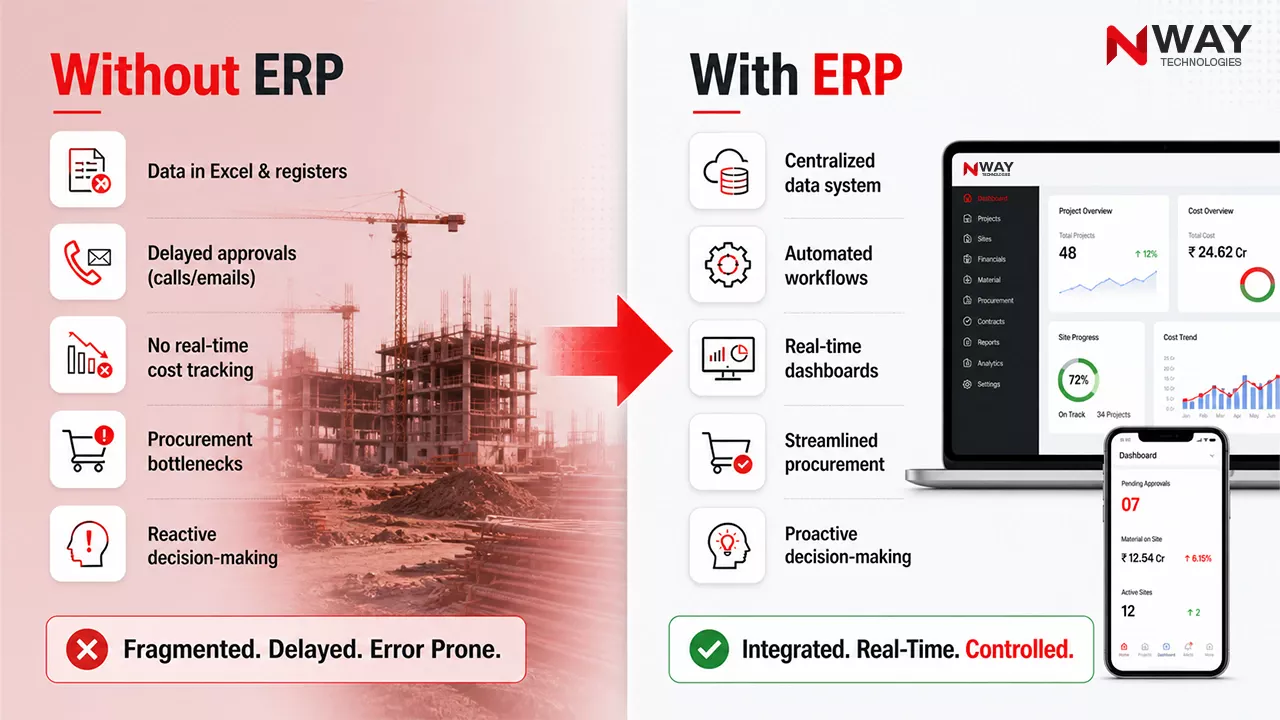
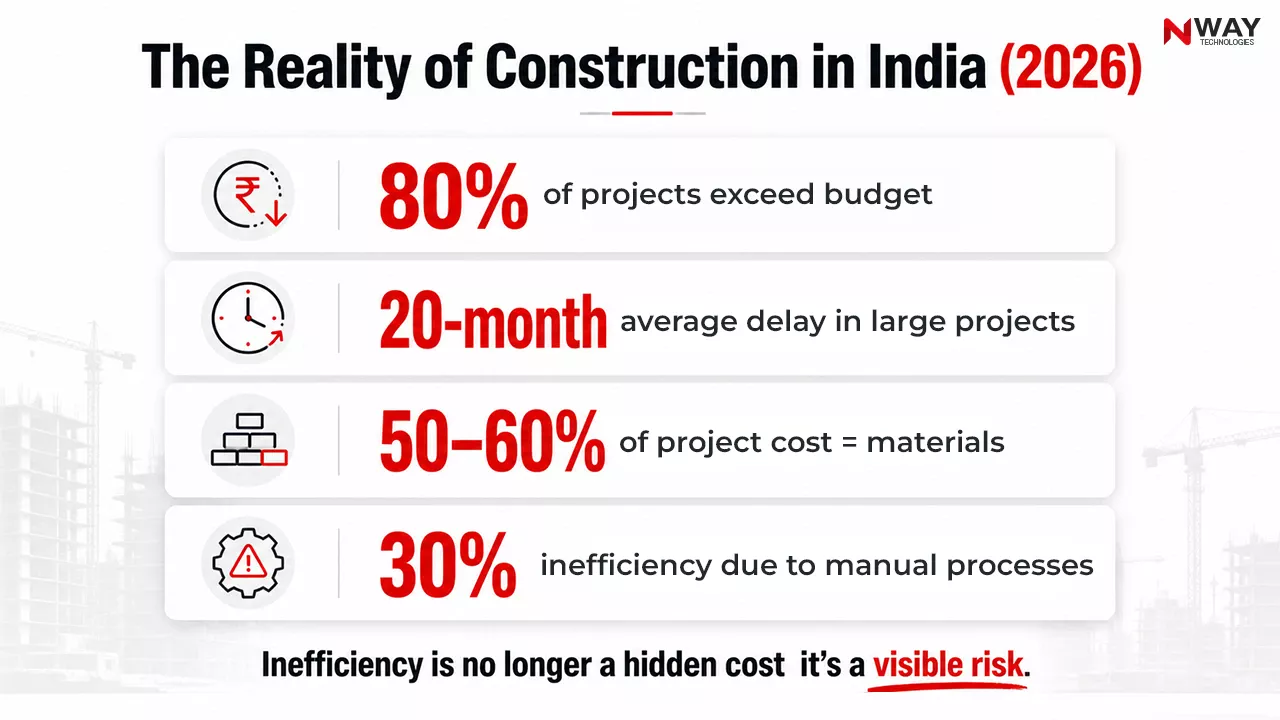
Imagine this: you are standing at a busy construction site. The sun is burning, machines are noisy, and workers are everywhere. You need updates – on material delivered, labour hours used, delays due to weather, cost overruns – all in real time. But right now, you rely on paper forms, phone calls, spreadsheets. It feels chaotic. Mistakes happen. Decisions are delayed. And profit margins shrink.
Construction project management software helps builders and contractors plan, track and control every site from one platform—replacing paper forms, WhatsApp updates, and scattered Excel sheets
That’s the story of many construction firms today. But it doesn’t have to be this way. With good construction project management software, chaos becomes control.
This blog explains how Nway ERP, a strong ERP for construction, makes project management smoother. You will learn how our construction ERP software uses construction workflow automation and thoughtfully designed features to reduce waste, speed-up decisions, and bring clarity to every site.
Table of Contents:
What Is Construction Project Management Software?
Let’s break it down simply:
- It’s a tool that helps you plan, execute, monitor, and close construction projects.
- It tracks labour, materials, machines, timelines, costs.
- It automates routine tasks. It ensures everyone (site, office, suppliers) sees the same info at same time.
When done well, construction project management software saves time, cuts costs, and keeps all your projects on time, everytime.
Why Construction Firms Desperately Need Better Tools in 2025
Between rising costs, labour shortages, supply delays, and climate‑impacts – managing projects has never been tougher.
Here are the trends forcing change:
- Real‑time data matters. Managers want to see project status now, not at month end.
- Cloud & mobile access are essential. Field work demands tools that work on phones or tablets.
- Automation of workflows. Approvals, safety checks, material requests – all need to move without human delays.
- Integration with IoT, BIM, analytics are becoming important so that decisions are data‑backed, not guesswork.
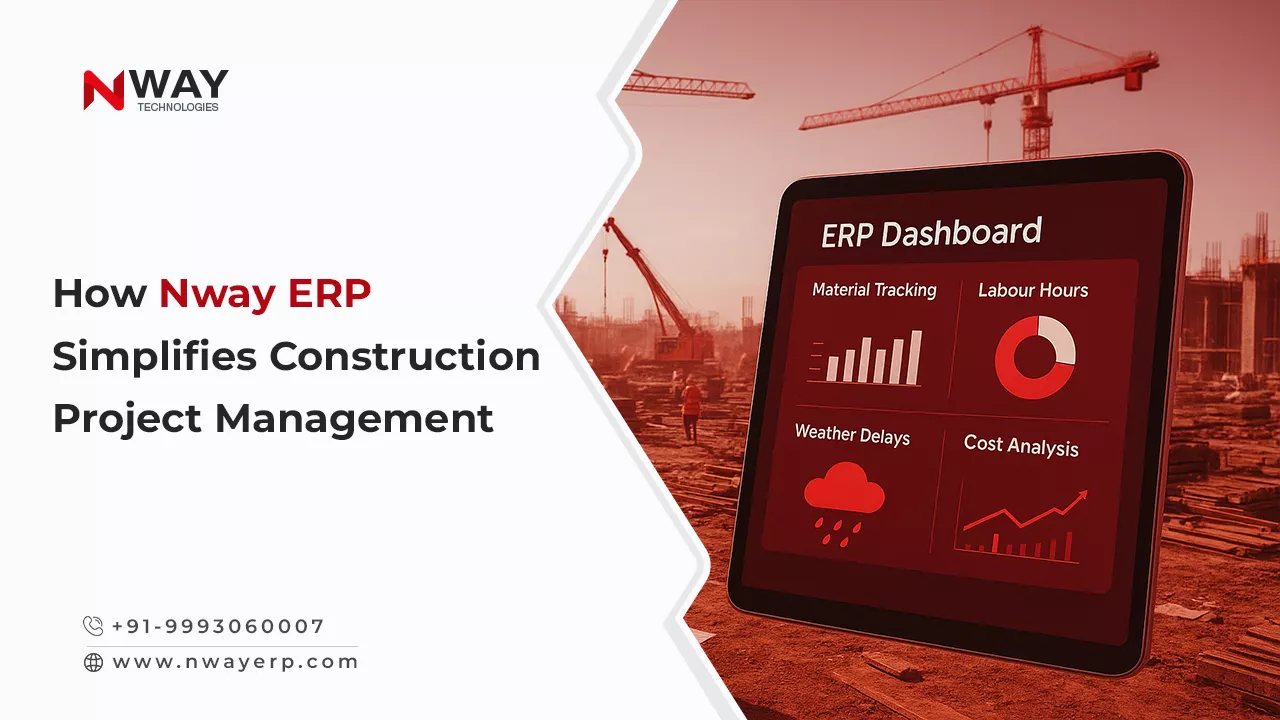
How Nway ERP Makes Construction Project Management Simple
Managing construction projects is complex. It involves many people, tasks, and tools. A small mistake or delay can lead to big losses. This is where Nway ERP helps. It brings everything into one smart system.
Below are the features that make Nway ERP a strong construction ERP software designed to simplify and improve daily operations.
1. Unified Data and a Single Source of Truth
With Nway ERP, all teams work on one platform. Site workers, procurement teams, finance staff, and managers use the same data.
- No more scattered spreadsheets
- No missing updates
- No duplicate entries
This keeps your project data clean, updated, and visible in real time. Everyone sees the same numbers. This is the core of good construction project management software.
2. Smart Planning and Accurate Estimation
Planning is key in construction. You need to know how much material, labour, and equipment is required.
Nway ERP, the most trusted ERP for construction, helps teams:
- Forecast costs
- Plan work schedules
- Estimate labour and machine needs
When things change, it’s easy to adjust. You can re‑estimate in minutes. This prevents delays and keeps budgets under control.
3. Real-Time Field Reporting from Anywhere
Field teams often face delays when sending updates to the office. With Nway ERP, this problem is solved.
Using our mobile app, workers can:
- Log work hours
- Request materials
- Report issues or delays
Everything updates instantly in the system. Office staff and managers can see real-time progress. This is a must-have feature in modern construction project management software.
Want to learn how ERP software can shape the future of your construction business and ensure long-term success? Check out our blog: The Future of Construction: Leveraging ERP Software for Long-Term Success
4. Automated Workflows and Approvals
Construction work includes many approval steps. Delays in approvals can stop the entire project.
Nway ERP uses construction workflow automation to make this faster. You can set rules for:
- Purchase order approvals
- Budget limits
- Safety checks
- Quality control forms
The system sends alerts. Approvals move forward automatically. No need to chase signatures. This saves time and reduces project delays.
5. Inventory and Equipment Management
Keeping track of materials and machines is hard without the right system. Many projects lose money due to:
- Wasted materials
- Idle equipment
- Missing tools
Nway ERP, as a reliable construction ERP software, helps track:
- Stock levels
- Material usage
- Equipment movement
- Maintenance schedules
It ensures you use resources better and avoid extra costs.
6. Finance, Billing, and Cost Control
Construction businesses must manage money carefully. Without clear numbers, budgets can fail.
Nway ERP connects all financial activities:
- Procurement
- Payroll
- Vendor payments
- Budget tracking
- Invoice approvals
You can compare planned vs actual costs. This helps spot overspending early. That’s why it’s one of the top features in a smart ERP for construction.
7. Role-Based Dashboards and Easy Reporting
Different people need different data. Site engineers, project managers, finance heads—they all have unique needs.
Nway ERP offers:
- Custom dashboards
- Role-based access
- Clear charts and reports
- Automated alerts
This makes reporting fast and useful. Everyone sees only what they need – no clutter, no confusion.
These features make Nway ERP more than just software. It’s a complete construction project management software that simplifies daily tasks, cuts errors, and improves decision-making. With built-in construction workflow automation, it helps construction companies save time, reduce costs, and grow faster.
Know Exactly What’s Happening on Every Site. In Real Time.
No more chasing updates. No more costly surprises. Nway ERP gives you instant clarity – anytime, anywhere.
What Makes Nway ERP Different from Other Construction ERP Software
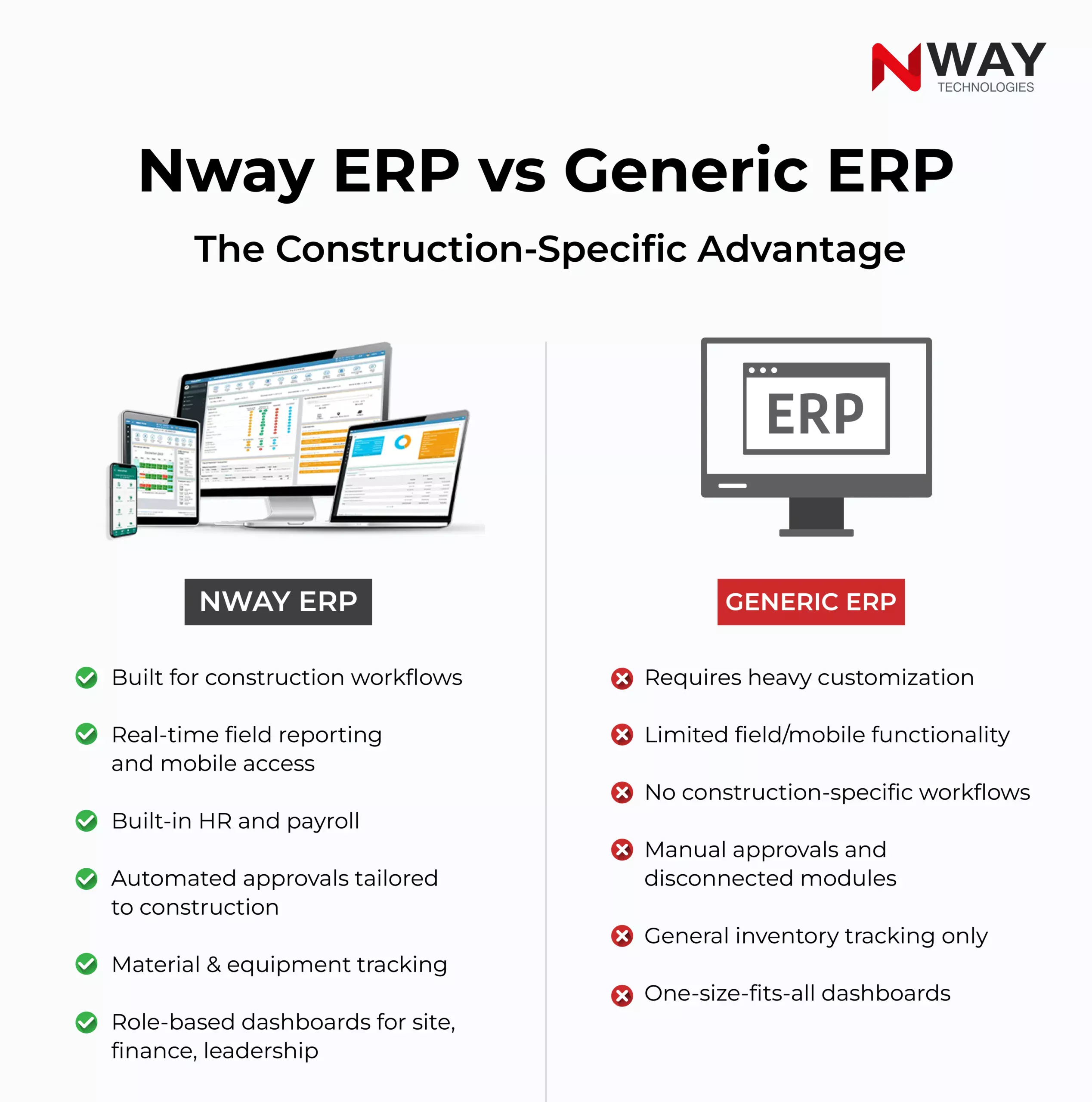
Let’s compare. Many tools try to serve many industries. But Nway ERP is built for construction. It knows your pain points.
Tailored for construction workflows: material procurement, equipment tracking, labour hours, safety audits etc. Not generic features that you then adapt.
Strong automation: approvals, workflows, mobile updates, safety checks automated so you don’t chase paperwork.
Mobile‑first and cloud-first: field teams need it on devices, remote sites need sync. Nway ERP delivers everytime!
Local compliance built in: including Indian rules (GST, contract norms, etc.), so you don’t need to integrate external tools.
Ease of use & support: good training, simple UI, strong customer support. Because a feature‑rich tool doesn’t help if no one uses it.
What can you expect after adopting strong construction project management software like Nway ERP?
Here are the benefits of opting for an ERP built especially for the construction industry:
| Benefit |
What Changes You’ll Notice |
| Faster decisions |
You’ll see delay, cost overspend, material shortages earlier so that you can act sooner. |
| Lower costs & less waste |
Better inventory control, less over‑ordering, fewer idle machines. |
| Boosted field productivity |
Site staff send updates live. Less rework, fewer lost documents. |
| Better accountability |
Everyone’s role, tasks, approvals are traceable. No finger‑pointing. |
| Improved safety & compliance |
Safety checklists, compliance forms submitted, tracked, audited. |
| Scalable growth |
When you add a new site or new project, you don’t double your chaos. Our system scales with you. |
Common Pitfalls & How Nway ERP Helps You Avoid Them
Even good tools can fail if not used well. Here’s what construction firms often mess up and how Nway ERP avoids them.
Resistance to change: Nway ERP offers intuitive interface + training. So workers and managers adapt more easily.
Poor internet/mobile access on site: Nway ERP works well in low bandwidth, offline where needed; mobile access is strong.
Over‑customization → complexity: Nway ERP balances flexible workflows with simplicity so you can customize but not get lost.
Data scattered in different systems: Nway ERP keeps finance, operations, inventory together. No jumping between tools.
Ignoring metrics: System gives real‑time dashboards. You track KPI’s: budget variance, schedule delay, machine idle time, etc.
Why Construction Workflow Automation Matters
Let’s zoom in: construction workflow automation is the hidden gear that keeps everything moving smoothly.
Approvals: Manual approvals slow everything. Automate so that cost estimates, vendor invoices, safety forms, etc. all go through predefined steps.
Notifications: If something is pending, people get alerts on mobile, email, and other channels that you choose.
Safety & Compliance: Digital safety checks, forms, audits. No paper forms lost, no compliance risk.
Material / Equipment Request: Field requests auto routed. Inventory updated live.
Role based permissions: Only authorised people approve cost items, handle finances, change estimates, etc.
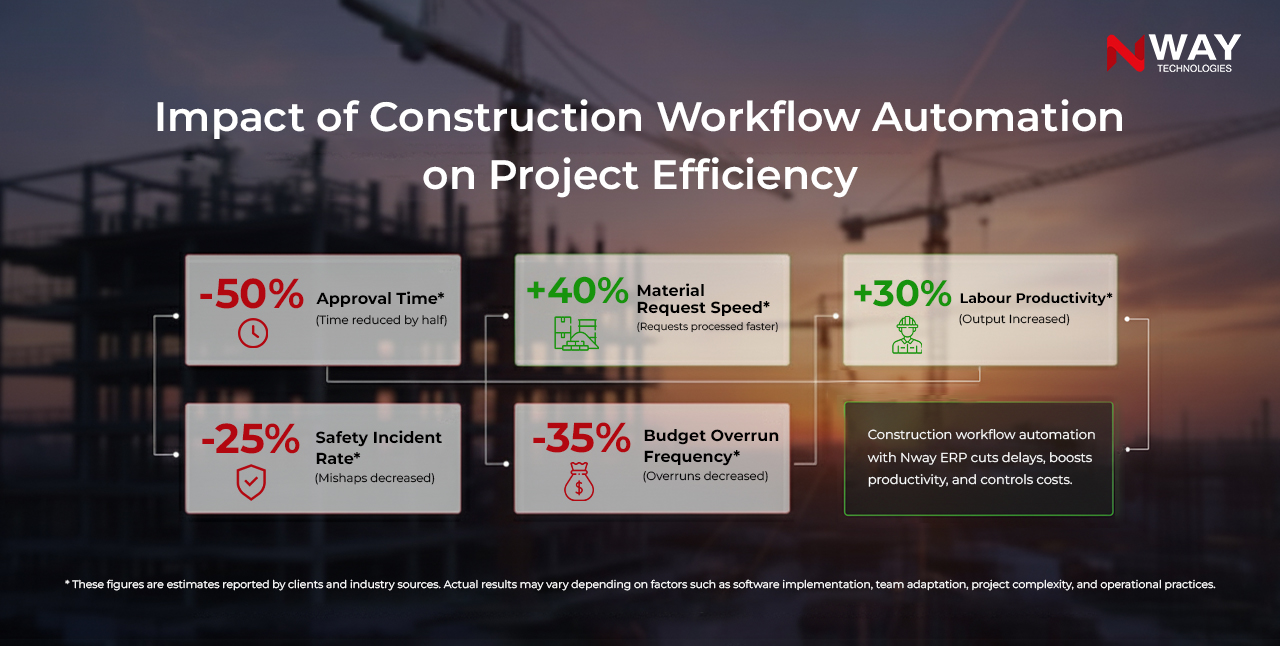
When automation works, your project doesn’t pause. No more delays because someone forgot to sign. No more cost surprises. Nway ERP is redefining construction workflow automation for 250+ active clients as of 2025.
Having trouble migrating construction data during software upgrades? See how companies overcome these challenges: Data Migration Challenges Faced by Construction Companies
How To Get the Most Out of Your Construction Project Management Software
Maximizing the benefits of construction project management software like Nway ERP requires a clear plan and careful steps. When used correctly, this powerful ERP for construction transforms project workflows, improves team coordination, and boosts overall efficiency. Here’s how to get the best results:
1. Map Your Current Construction Processes in Detail
Start by documenting all key workflows: approvals, material ordering, safety inspections, labour tracking, and more. Understanding where delays, bottlenecks, or rework occur helps tailor the construction ERP software to your exact needs. A clear map ensures smooth implementation of construction workflow automation features that save time and reduce errors.
2. Define Roles and Permissions Clearly
Assign specific roles within the system. Decide who approves purchase orders, who inputs data, and who views reports, etc. Clear role definition minimizes confusion and ensures accountability.
3. Leverage Mobile Access and Train Field Teams
Equip your site teams with the mobile app. This allows real-time updates from anywhere – logging work hours, material requests, or safety checks. Training is critical. When workers and managers understand how to use the mobile features, it drives adoption and maximizes the power of construction workflow automation embedded in the software.
4. Pilot the Software on a Single Project First
Start small. Implement the software on one project to test workflows and gather insights. Use this pilot to identify challenges, adjust settings, and optimize automation rules. This phased approach minimizes risk and builds confidence before a full rollout across all sites.
5. Track Key Metrics that Matter to Your Business
Select and monitor critical metrics like cost overruns, schedule delays, equipment downtime, and labour productivity. The right construction project management software provides dashboards and reports to track these in real time. Continuous monitoring helps catch issues early and keeps projects on track.
6. Collect Regular Feedback from Your Team on Site
Your team’s experience is vital. Regularly ask if forms are easy to use, if the app functions well offline, and whether the workflows are efficient. Feedback helps fine-tune the system to fit real-world conditions. This ongoing improvement ensures the software truly supports daily construction operations.
Following these steps will unlock the full potential of your construction project management software. With Nway ERP, the power of specialized construction ERP software and construction workflow automation turns project challenges into smooth, manageable tasks – delivering stronger results on every site.
If you are reading this, you probably want to stop fighting delays, cost overruns, missing data, frustrated workers. You want control. You want predictability. You want your construction projects to finish stronger and more profitable.
That’s exactly what construction project management software is for. And Nway ERP is a powerful choice because it offers ERP for construction with strong construction workflow automation, built‑in mobile/cloud, real-time data, safety, compliance, and cost control.
Make the change. Move from reacting to being in control. Your next project doesn’t have to be harder. It can be better.
Key Features to Look for in Construction Project Management Software
Not every project management tool is built for construction. Generic software can track tasks, but construction sites run on BOQs, daily reports, running bills and tight schedules. When you evaluate construction project management software, check for these core features first.
Gantt Charts and Project Scheduling
A Gantt chart shows your whole project on one timeline: every activity, its start and end dates, and how tasks depend on each other. Good construction project management software lets you break a project into phases, layers, tasks and sub-tasks, assign each one to a team, and adjust the schedule when things change on site. With Nway ERP, project managers can plan and inspect work layer-wise through Gantt charts. This makes it easy to spot slippage before it becomes a delay.
BOQ and SOR (Schedule of Rates)
The Bill of Quantities (BOQ) is the backbone of construction costing. It itemises materials, labour and work quantities for every activity. The Schedule of Rates (SOR) fixes the rate for each item of work. Your software should let you create a BOQ for each task, apply the SOR directly to it, and keep costs consistent across the project. In Nway ERP, SOR can be applied to tasks and layers, and a BOQ is generated for each task and layer for future reference and cost control.
DPR (Daily Progress Report)
The Daily Progress Report records what happened on site each day: work completed, labour deployed, materials consumed and machinery used. Paper DPRs arrive late and often get lost. Construction project management software should let site engineers submit DPRs from a mobile app so managers see progress the same day. Nway ERP’s mobile app captures DPRs from the field and sends alerts to project managers for instant review and action.
RA Billing (Running Account Bills)
Contractors in India get paid through RA bills raised against work completed at each stage. Manual RA billing is slow and error-prone, which delays cash flow. The right software links billing to measured work and BOQ quantities. That way bills are accurate, easy to verify and quick to raise. Integrated finance also keeps RA bills, vendor payments and GST records in one place.
Planned vs Actual Progress
The most useful report for any project manager compares what was planned with what actually happened: in time, quantity and cost. Construction project management software should compare planned schedules and budgets with actual site data from DPRs, purchases and labour records. Nway ERP’s dashboards show this variance in real time, so you can catch cost overruns and delays early and correct course while there is still time.
Critical Path and Milestone Tracking
In every project, some activities decide the final completion date. This sequence is the critical path. If an activity on the critical path slips, the whole project slips. Look for software that highlights dependent tasks, tracks key milestones such as foundation, structure and finishing, and alerts you when a critical activity falls behind. This helps you move resources to where they matter most instead of reacting after deadlines are missed.
Stop Chasing Problems and Start Leading with Confidence
Nway ERP is the steady hand that guides your projects safely to completion, on time and on budget.
FAQs
What are the latest trends in construction project management software for 2025?
In 2025, modern construction project management software focuses on real-time data, mobile-first access, automation of routine tasks, and integration with AI and IoT. Companies are now choosing platforms that offer predictive insights, risk alerts, and streamlined collaboration between field and office teams.
Is construction ERP software suitable for infrastructure and road projects?
Yes, modern construction ERP software like Nway ERP is fully capable of handling large-scale infrastructure, road, and government projects. It supports multi-site operations,
contract management, quality control, and compliance – all critical for infrastructure works.
What is construction workflow automation, and why is it important?
Construction workflow automation refers to using software to manage and streamline repetitive tasks like approvals, form submissions, scheduling, and alerts. It improves speed, reduces manual errors, and ensures every process follows the right steps, saving time and money on projects.
Can Nway ERP be integrated with other accounting or HR software?
Yes, Nway ERP supports seamless integration with popular accounting, HR, and payroll systems. This makes it easy for construction companies to sync financial data, streamline HR processes, and reduce manual data entry across different platforms.
Additionally, Nway ERP comes with built-in HR and payroll modules, allowing businesses to manage employee records, attendance, salary processing, and compliance – all within the same system. This eliminates the need for separate software and creates a fully connected construction management environment.
Does construction ERP software help with vendor and subcontractor management?
Absolutely. A good ERP for construction helps manage subcontractor agreements, monitor performance, track payments, and maintain compliance. Nway ERP includes features for vendor registration, RFQs, contracts, and billing, offering full visibility and control over external partners.
How does construction project management software improve client reporting?
Construction project management software offers real-time dashboards and automated reports that can be shared with clients. This builds trust by showing transparent updates on progress, costs, timelines, and risks without needing to manually compile reports every week.
Can construction ERP software help reduce project delays?
Yes. By centralizing data and automating workflows, construction ERP software like Nway ERP helps spot delays early, alerts teams in real time, and ensures faster decision-making. This proactive approach is key to delivering projects on time.
Is there a difference between general ERP and ERP for construction?
Yes. General ERP systems are built for multiple industries and often need heavy customization. An ERP for construction is built specifically for construction workflows like job costing, material tracking, site reporting, and subcontractor management. Nway ERP is designed with these exact needs in mind.
How do I choose the best construction project management software for my company?
Look for a platform that is built specifically for construction, offers real-time data access, includes construction workflow automation, supports mobile users, and allows easy integration with your existing tools. Consider scalability, local support, and ease of use as key decision factors.
Can Nway ERP be used by developers, contractors, and builders alike?
Yes, Nway ERP is flexible and built for all types of construction professionals – whether you’re a real estate developer, a general contractor, a subcontractor, or a government contractor. It supports project planning, budgeting, billing, labour management, and more – all in one platform.