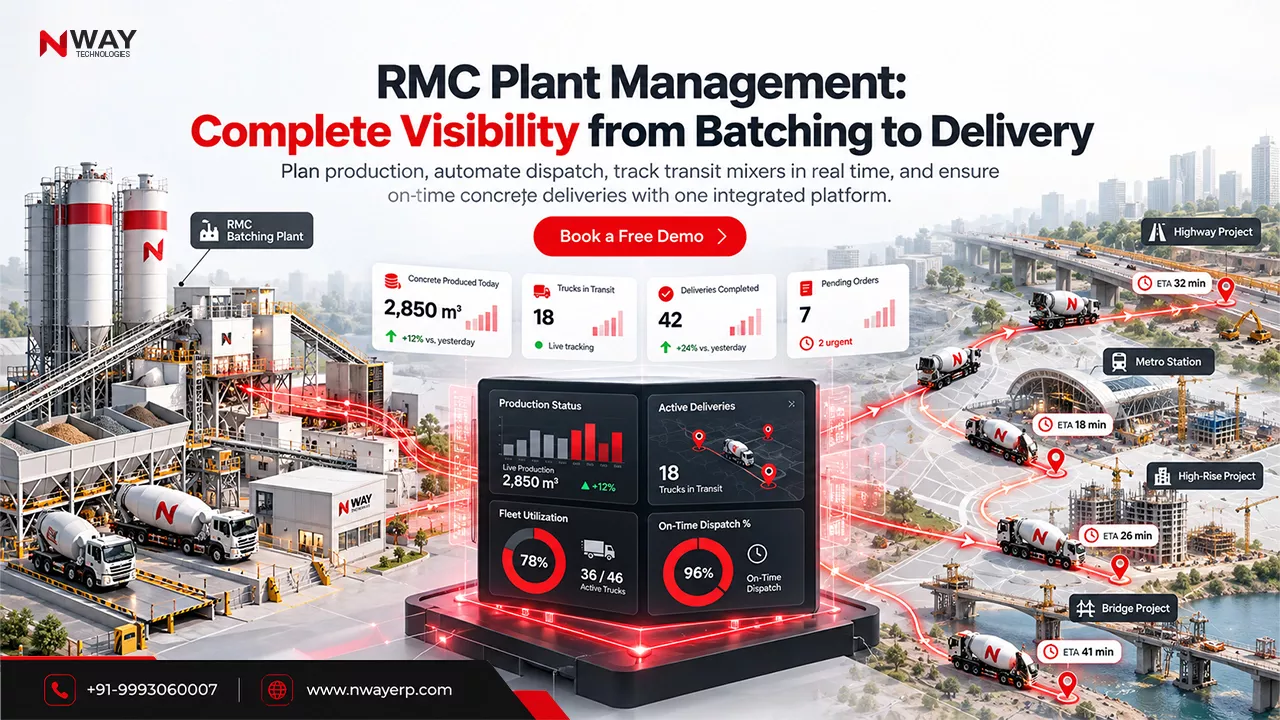
RMC Plant Management: Batching, Dispatch & Delivery Tracking in One System
Table of Contents:
- Introduction
- Why Traditional RMC Operations Struggle to Scale
- What Is RMC Plant Management Software?
- The Ideal Digital Workflow for Modern RMC Plants
- Before vs After Digital Transformation
- Why Dispatch Management Is the Key Profitability Driver
- How Real-Time Fleet Visibility Changes Operations
- The Strategic Value for Contractors and Infrastructure Companies
- KPI Framework for High-Performing RMC Plants
- Why One Integrated System Is Better Than Multiple Applications
- Conclusion
Introduction
It’s 8:30 AM.
An infrastructure contractor is pouring concrete for a critical bridge pier. The site team expects six transit mixers before noon. The RMC plant has already produced the concrete. Dispatch believes the trucks have left. The customer assumes everything is on track.
But reality looks different.
Two transit mixers are stuck in traffic. One vehicle was reassigned to another project. The plant has already started preparing the next batch. The site is waiting, labor is idle, and the concrete pouring schedule is at risk.
This scenario plays out every day across India’s construction, infrastructure, metro, highway, industrial, and real-estate projects.
The challenge isn’t simply producing ready-mix concrete.
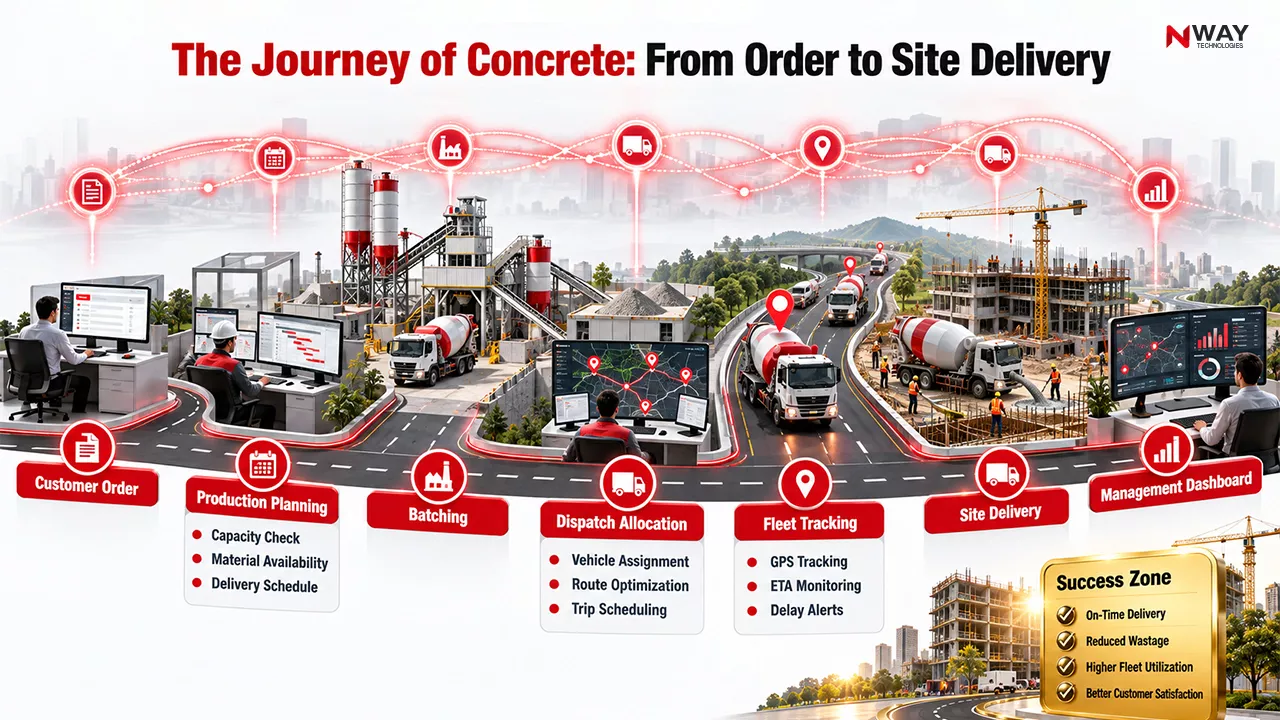
The challenge is coordinating the entire journey from:
Batching → Dispatch → Fleet Movement → Site Delivery → Customer Confirmation
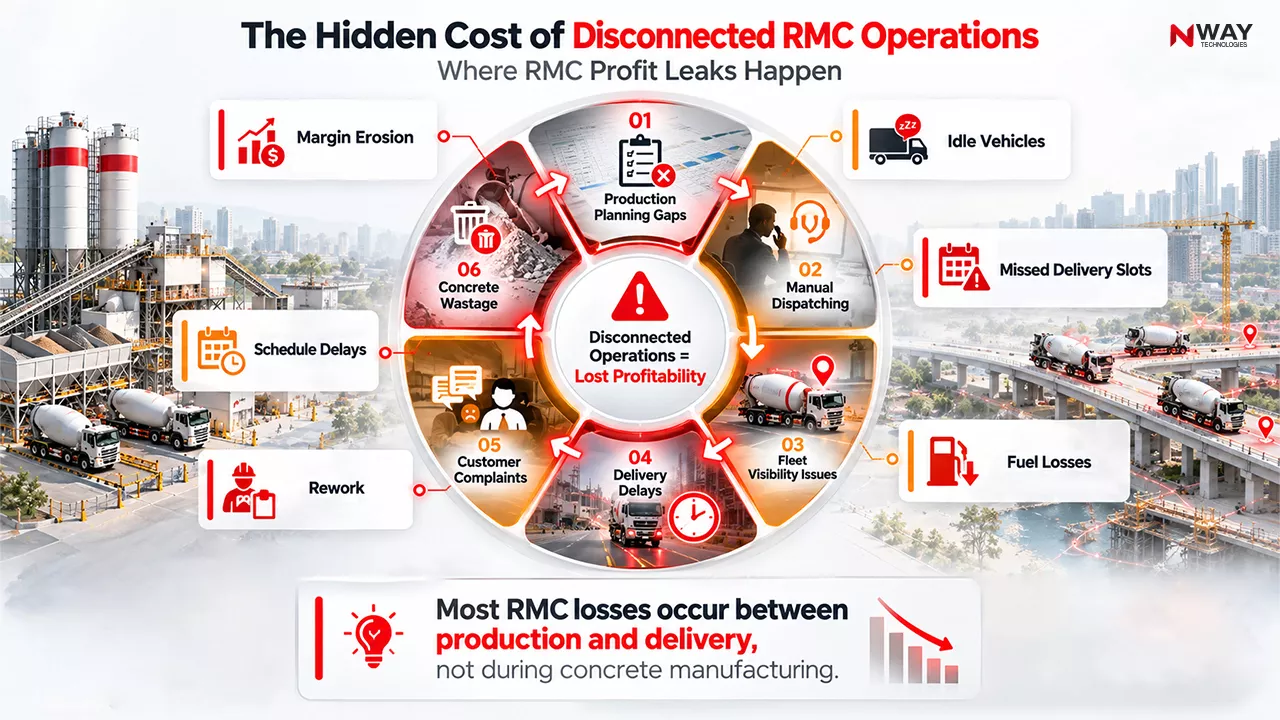
When these processes operate independently, businesses face:
- Delayed deliveries
- Idle fleets
- Concrete wastage
- Plant bottlenecks
- Customer disputes
- Reduced profitability
This is why leading RMC businesses are investing in ready mix concrete ERP software that connects the entire operation into one intelligent control system.
Instead of managing production, dispatch, and transportation separately, they create a single digital ecosystem where every stakeholder sees the same data in real time.
Why Traditional RMC Operations Struggle to Scale
As order volumes increase, operational complexity grows exponentially.
A typical RMC company must simultaneously manage:
- Multiple construction sites
- Multiple batching plants
- Transit mixer availability
- Pump allocation
- Production schedules
- Quality records
- Customer delivery commitments
- Fuel and vehicle utilization
Manual processes become unsustainable at this level.
Common Challenges
Production Teams Lack Delivery Visibility –
Operators may continue producing concrete without knowing whether enough vehicles are available for dispatch.
Dispatch Teams Depend on Phone Calls
Many dispatch coordinators still rely on:
- Calls
- Spreadsheet updates
- WhatsApp groups
- Manual registers
Information becomes outdated within minutes.
Fleet Teams Operate Independently
Vehicle status often remains unclear:
- Is the truck loading?
- Has it left the plant?
- Is it delayed?
- Has unloading started?
Without visibility, planning becomes guesswork.
Management Receives Information Too Late
By the time reports reach management:
- Service failures have occurred
- Profitability has been impacted
- Customers are already dissatisfied
Quick Insight
Most RMC delivery problems originate from communication gaps rather than production limitations.
The plant may have enough capacity, but disconnected processes prevent efficient execution.
What Is RMC Plant Management Software?
RMC plant management software is an integrated platform that manages every operational activity involved in ready-mix concrete production and delivery.
Instead of using separate systems for production, dispatch, transportation, and reporting, all activities are connected to a single digital platform.
Core Functional Areas
Production Planning
- Order scheduling
- Batch planning
- Plant capacity optimization
- Raw material availability checks
Plant Operations
- Batch execution
- Mix design management
- Production monitoring
- Quality control records
Dispatch Management
- Vehicle allocation
- Trip scheduling
- Dispatch prioritization
- Load sequencing
Fleet Management
Using RMC fleet management software, organizations can:
- Track transit mixers in real time
- Monitor vehicle utilization
- Improve turnaround time
- Reduce idle hours
Delivery Tracking
- GPS monitoring
- ETA visibility
- Delivery confirmation
- Site status updates
Management Analytics
- Production dashboards
- Fleet performance dashboards
- Dispatch KPIs
- Customer fulfillment reports
The Ideal Digital Workflow for Modern RMC Plants
Step 1: Customer Order Creation
The order enters the system with:
- Grade requirements
- Quantity
- Site location
- Delivery schedule
- Customer specifications
The platform immediately validates capacity availability.
Step 2: Production Planning
An advanced RMC plant and production module automatically evaluates:
- Plant capacity
- Existing workload
- Material stock
- Vehicle availability
This eliminates last-minute scheduling conflicts.
Step 3: Automated Batching
Production teams receive:
- Batch sequences
- Quantity requirements
- Mix specifications
All production data becomes digitally recorded.
Step 4: Dispatch Scheduling
The software allocates:
- Available transit mixers
- Delivery sequence
- Route assignments
- Loading schedules
Dispatch becomes proactive rather than reactive.
Step 5: Live Fleet Tracking
Vehicles can be monitored throughout their journey.
Operations teams know:
- Current location
- Route progress
- Expected arrival time
- Delays and exceptions
Step 6: Site Delivery Confirmation
Project sites can confirm:
- Receipt
- Quantity delivered
- Delivery time
- Completion status
Information instantly updates across the system.
Before vs After Digital Transformation
| Process Area | Traditional Method | Using RMC Software |
|---|---|---|
| Production Planning | Manual | Automated |
| Dispatch Scheduling | Phone-based | System-generated |
| Fleet Visibility | Unknown | GPS-enabled |
| Delivery Status | Reactive | Real-time |
| Resource Allocation | Trial-and-error | Demand-based |
| Reporting | End-of-day | Live Dashboard |
| Customer Updates | Manual calls | Instant visibility |
| Decision Making | Historical data | Real-time intelligence |
Why Dispatch Management Is the Key Profitability Driver
Many RMC companies focus heavily on plant operations while overlooking dispatch efficiency.
However, dispatch is where profitability is often won or lost.
Hidden Risks of Poor Dispatch Planning
- Trucks waiting at plants
- Sites waiting for concrete
- Traffic-related disruptions
- Higher fuel consumption
- Missed delivery slots
- Customer penalties
Even a highly efficient plant can lose money if dispatch operations remain disorganized.
Expert Tip
Measure fleet turnaround time, not just production output.
A plant may produce concrete efficiently, but delayed vehicle cycles significantly reduce daily delivery capacity and profitability.
How Real-Time Fleet Visibility Changes Operations
Modern RMC fleet and machinery management software provides much more than simple GPS tracking.
It creates operational intelligence.
Management Can Instantly Monitor
- Truck loading status
- Departure times
- Journey progression
- Delivery completion
- Return cycle duration
Business Benefits
- Better Asset Utilization – Higher vehicle productivity without increasing fleet size.
- Improved Customer Experience – Accurate ETA communication reduces uncertainty.
- Faster Decision-Making – Dispatchers can immediately respond to disruptions.
- Lower Transportation Costs – Optimized routing improves fuel efficiency.
Common Mistake
Many companies invest in vehicle tracking systems but fail to integrate them with plant and dispatch operations.
Without integration, GPS becomes a monitoring tool rather than a decision-making system.
The Strategic Value for Contractors and Infrastructure Companies
RMC digital transformation doesn’t benefit suppliers alone.
It provides significant value to contractors and EPC organizations.
Why Contractors Prefer Digitally Managed RMC Suppliers
- Predictable Deliveries – Project teams can plan labor and equipment resources more accurately.
- Reduced Pouring Interruptions – Continuous supply improves construction productivity.
- Better Coordination – Site engineers receive real-time delivery updates.
- Fewer Disputes – Digital records improve accountability.
Industry Example
Consider a highway contractor managing:
- Multiple bridge structures
- Simultaneous concrete pours
- Tight project timelines
Without delivery visibility, planners build schedules based on assumptions.
With integrated RMC software, they can:
- Monitor dispatch progress
- View estimated arrival times
- Adjust site resources accordingly
- Minimize project disruption
KPI Framework for High-Performing RMC Plants
Operational KPIs
Production Metrics
- Plant utilization rate
- Batch accuracy
- Output per shift
Dispatch Metrics
- Dispatch cycle time
- Order fulfillment rate
- On-time dispatch percentage
Fleet Metrics
- Transit mixer utilization
- Average turnaround time
- Fuel consumption
Customer Service Metrics
- On-time delivery rate
- Customer complaints
- Delivery deviations
Financial Metrics
- Delivery cost per cubic meter
- Fleet operating cost
- Revenue per vehicle
Did You Know?
Even small improvements in fleet turnaround times can increase daily delivery capacity without purchasing additional vehicles, making dispatch optimization one of the highest-ROI digital initiatives in the RMC business.
Why One Integrated System Is Better Than Multiple Applications
Many companies use:
- One system for batching
- Another for fleet tracking
- Spreadsheets for planning
- Calls for coordination
This creates operational silos.
Problems with Multiple Systems
- Duplicate data entry
- Reporting inconsistencies
- Communication delays
- Lack of accountability
- Higher administrative effort
Benefits of an Integrated RMC Software Platform
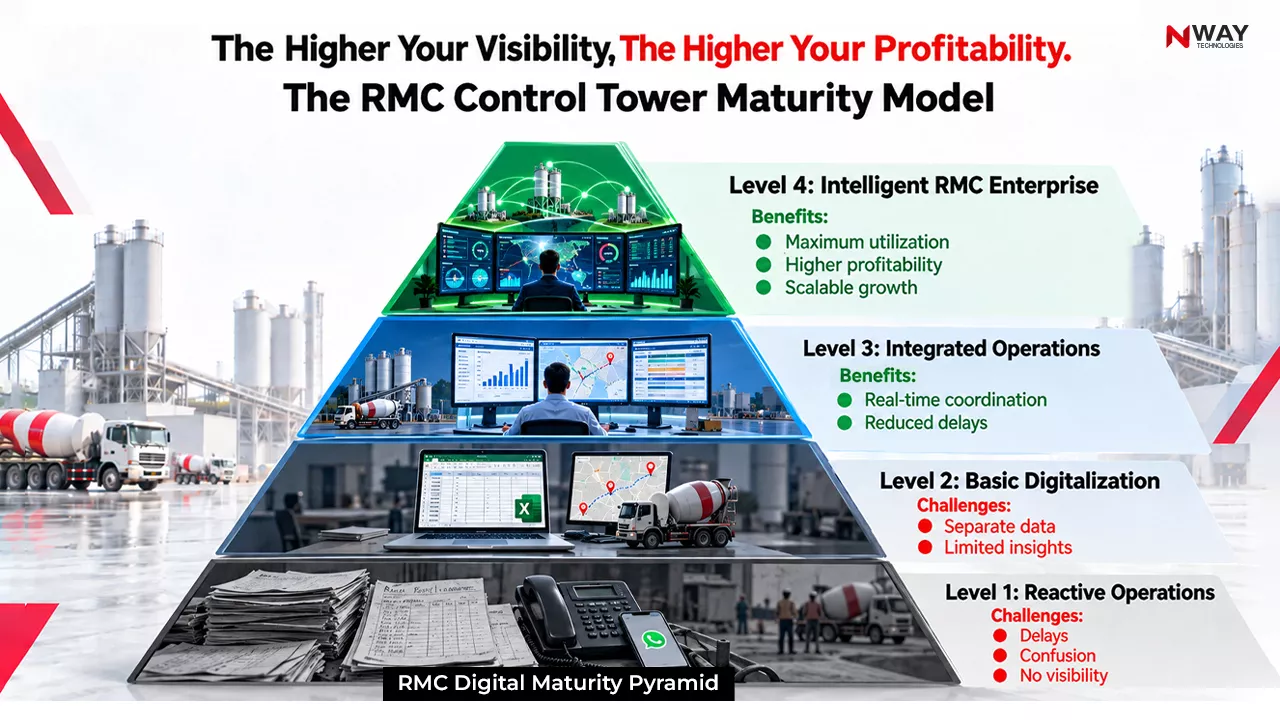
- Single Source of Truth – Everyone works from the same information.
- Faster Decisions – Real-time operational visibility.
- Better Resource Utilization – Production and fleet planning become synchronized.
- Improved Customer Service – Accurate and proactive communication.
- Scalability – Easier expansion across multiple plants and regions.
Conclusion
The future of ready-mix concrete operations will not be defined by plant capacity alone. It will be defined by visibility, coordination, and execution.
As project schedules become tighter and customer expectations rise, disconnected systems create operational risks that directly impact profitability. Companies that continue managing batching, dispatch, fleet movement, and delivery through separate tools will increasingly struggle to maintain efficiency and service levels.
A modern RMC plant management software platform brings every operational function into one connected ecosystem. By integrating production planning, dispatch automation, fleet visibility, and delivery tracking, organizations gain the control needed to improve utilization, reduce delays, and deliver a superior customer experience.
For RMC businesses serving contractors, EPC firms, and infrastructure projects, the question is no longer whether digital transformation is necessary. The real question is how quickly operations can move from fragmented coordination to a unified, data-driven command center powered by solutions such as NWAY ERP.
Read More: The Future of Concrete: Innovating with RMC ERP Software