Table of Contents:
- Introduction
- Why Real Estate Companies Need More Than Basic Software
- The 7 Factors Every Real Estate Company Should Evaluate Before Choosing an ERP
- Cloud ERP vs Traditional ERP Systems
- ERP Selection Roadmap for Mumbai Developers
- The Business Impact of Modern Real Estate ERP Solutions
- Conclusion
Introduction
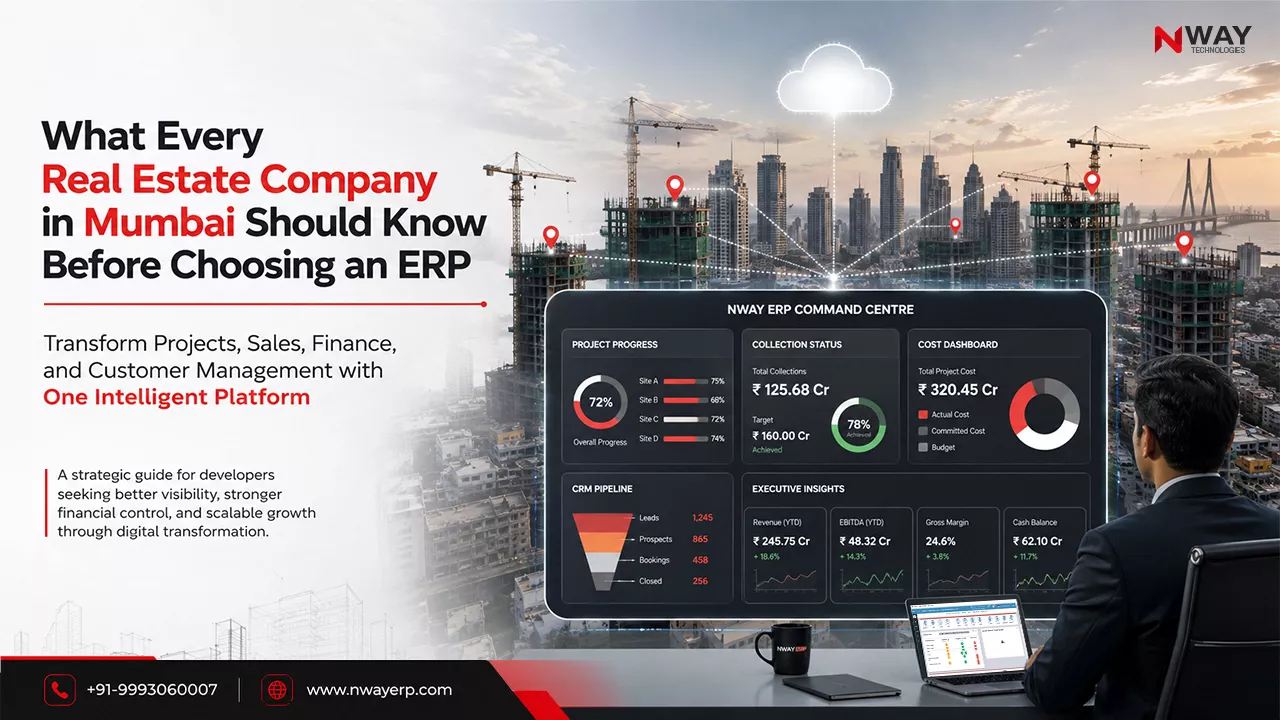
Real estate ERP software in Mumbai must do more than handle accounting. It must connect land and approvals, construction costs, bookings, customer collections, and MahaRERA reporting in one system because Mumbai developers run multiple towers, redevelopment projects, and contractor networks at once. This checklist covers the seven features to evaluate, the compliance your ERP must handle, typical costs, and implementation timelines so that you can shortlist the right ERP for your projects.
Mumbai remains one of India’s most competitive real estate markets. Developers today manage multiple projects, large contractor networks, evolving regulations, and increasingly demanding customers.
Yet many organizations still operate through disconnected systems where project data, accounting information, procurement records, and customer details are stored in separate applications.
This lack of visibility creates delays, reporting gaps, and decision-making challenges.
As projects become larger and more complex, companies are shifting toward ERP for Real Estate platforms that integrate project management, finance, procurement, sales, and customer service into a single ecosystem.
The question is no longer whether digital transformation is necessary.
The real question is:
Which ERP for Property Developers can support sustainable growth while improving operational control?
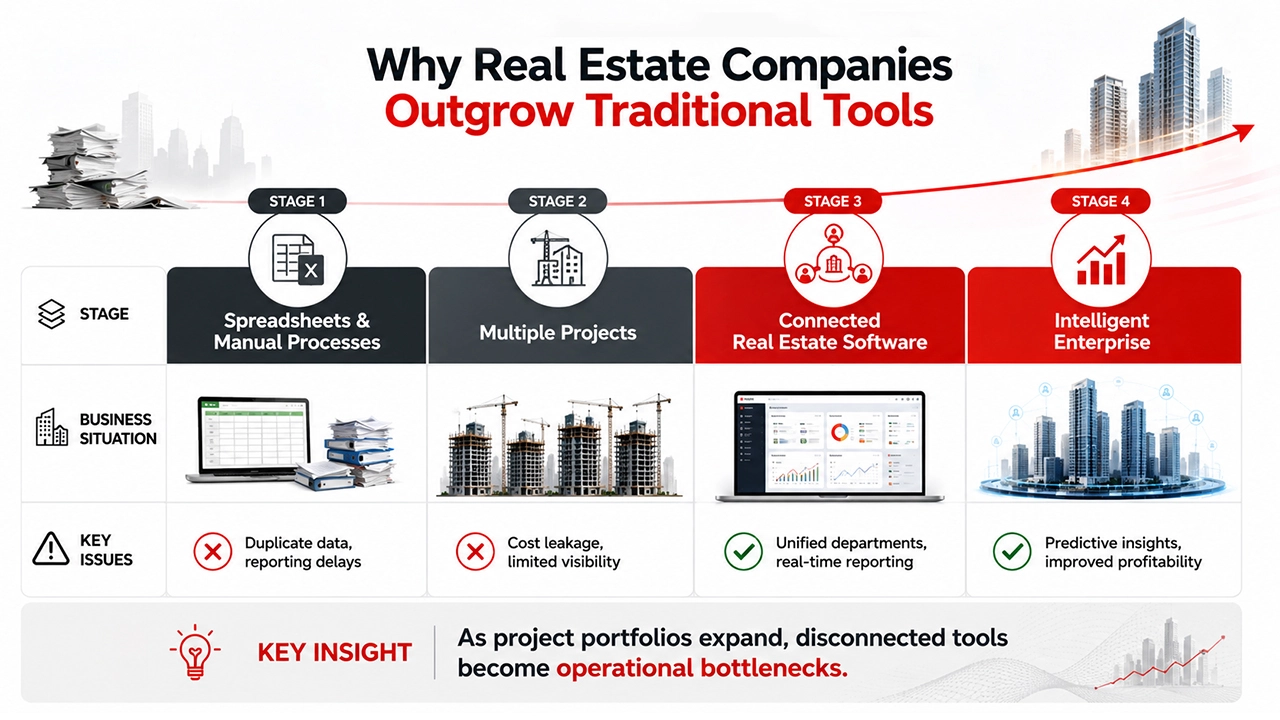
Are Your Teams Working on Different Systems?
Disconnected project, sales, and finance data can make growth difficult.
Why Real Estate Companies Need More Than Basic Software
Mumbai developers face several operational challenges:
- Multiple active project sites
- Large contractor ecosystems
- Complex billing structures
- Customer lifecycle management
- Regulatory compliance requirements
- Tight cash flow monitoring
Traditional software applications often address individual functions but fail to connect departments. Here’s how builders solve these with construction management software.
This creates:
- Cost overruns
- Delayed collections
- Fragmented customer information
- Manual reporting
- Poor forecasting accuracy
A modern real estate business management software platform solves these issues by creating a single source of truth across the organization.
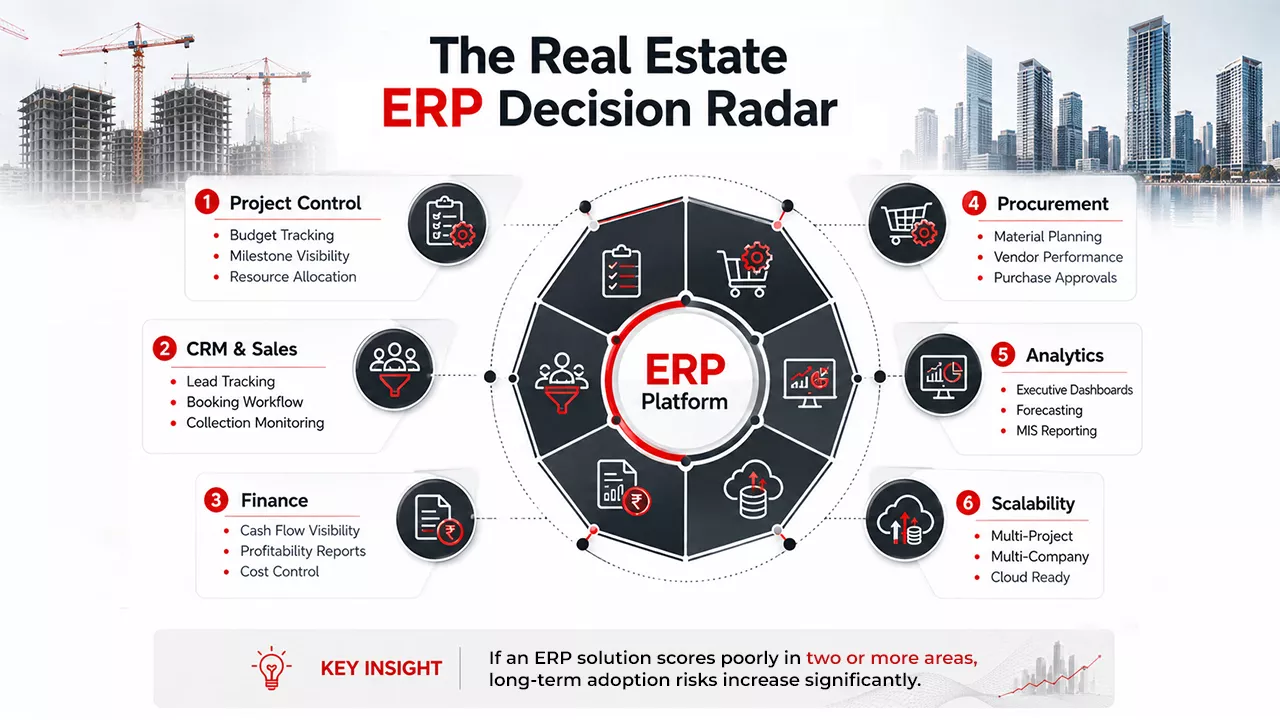
The 7 Factors Every Real Estate Company Should Evaluate Before Choosing an ERP
1. End-to-End Project Lifecycle Management
The best ERP for Real Estate should support:
- Land acquisition
- Budget planning
- Resource allocation
- Construction monitoring
- Milestone tracking
- Project handover
Expert Tip
If project teams continue relying on spreadsheets after implementation, the system may not be fully aligned with business processes.
2. Real Estate CRM and ERP Integration
Sales and execution teams should operate on the same platform.
A strong Real Estate CRM and ERP system enables:
- Lead tracking
- Sales follow-ups
- Booking management
- Collections monitoring
- Customer communications
- Possession management
Why It Matters
Customer information should flow seamlessly from enquiry to handover without switching between multiple applications.
3. Financial Visibility and Cash Flow Control
Financial control remains one of the most important reasons developers invest in Real Estate ERP Solutions.
Look for:
- Budget vs Actual analysis
- Collection tracking
- Vendor payment management
- Cost center reporting
- Profitability dashboards
- Cash flow forecasting
4. Procurement & Vendor Management
Construction delays often begin with procurement inefficiencies.
Your Real Estate Business Management Software should provide:
- Material planning
- Rate comparisons
- Purchase workflows
- Vendor evaluation
- Inventory tracking
Expected outcomes:
- Reduced delays
- Better purchasing control
- Improved material utilization
- Lower project costs
5. Scalability
The system should support future business growth.
Ask:
- Can it manage multiple companies?
- Can it handle multiple projects?
- Can it scale across regions?
- Can it support hundreds of users?
Growth should not require changing ERP systems.
6. Cloud Readiness
Construction businesses in Mumbai require access from office locations as well as project sites.
A modern Cloud ERP for Real Estate provides:
- Anywhere accessibility
- Faster deployment
- Mobile access
- Automatic updates
- Better collaboration
7. Analytics & Executive Dashboards
Leadership teams need visibility beyond transactions.
Look for:
- Executive MIS dashboards
- Project performance reports
- Collection analytics
- Forecasting tools
- Profitability analysis
Cloud ERP vs Traditional ERP Systems
| Evaluation Area | Cloud ERP for Real Estate | Traditional ERP |
|---|---|---|
| Accessibility | Anywhere | Limited |
| Deployment | Faster | Slower |
| Maintenance | Vendor Managed | Internal |
| Scalability | High | Moderate |
| Updates | Automatic | Manual |
| Multi-Site Operations | Excellent | Limited |
ERP Selection Roadmap for Mumbai Developers
Step 1: Identify Current Bottlenecks
Evaluate:
- Sales
- Finance
- Procurement
- Project Operations
- Customer Management
Step 2: Define Business Goals
Consider:
- Future project expansion
- Operational automation
- Reporting requirements
- Customer experience improvements
Step 3: Evaluate Vendors
Assess:
- Industry expertise
- Product maturity
- Support quality
- Implementation methodology
Step 4: Request Process-Based Demonstrations
Ensure workflows reflect actual business processes.
Step 5: Estimate Long-Term ROI
Measure:
- Efficiency gains
- Cost control improvements
- Faster collections
- Better resource utilization
See: The Complete Guide to ERP Software for Business Operations
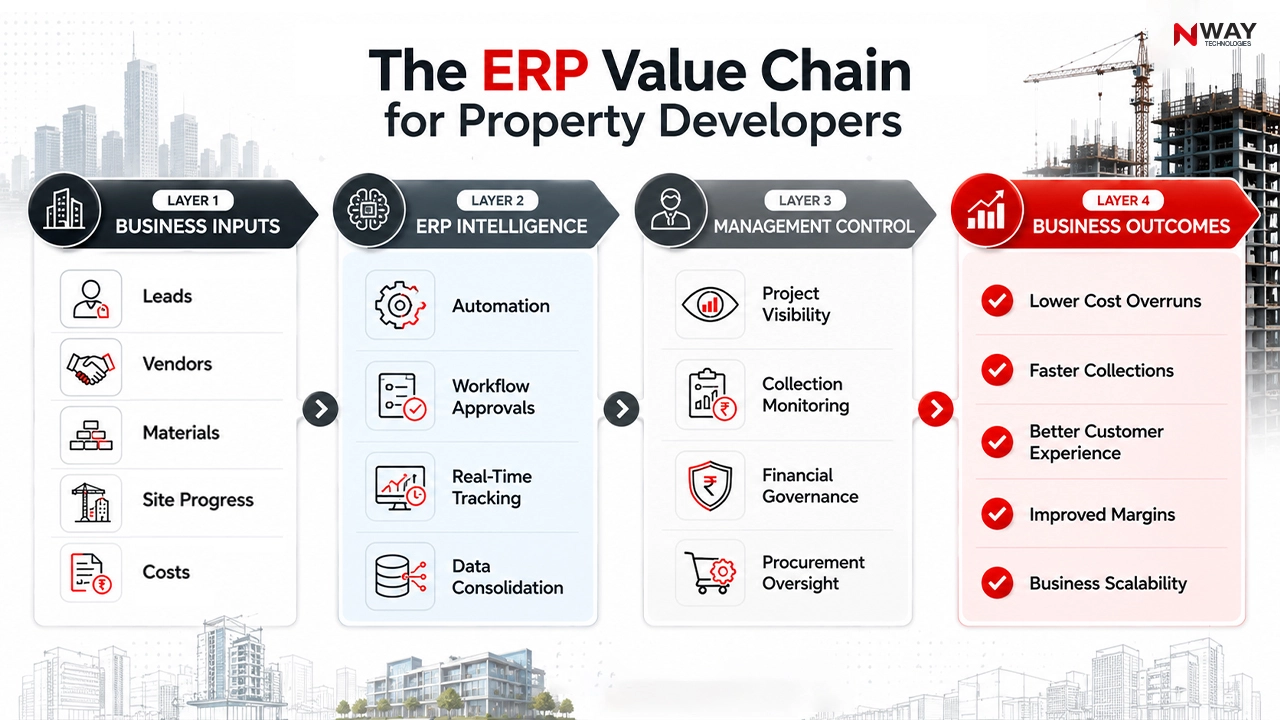
The Business Impact of Modern Real Estate ERP Solutions
The most successful developers no longer see ERP as a back-office tool.
Modern real estate software functions as a central operating platform connecting:
- Sales
- Finance
- Procurement
- Projects
- Customers
- Leadership Teams
This creates:
- Better visibility
- Faster decisions
- Improved governance
- Stronger profitability
- Scalable business growth
MahaRERA, GST, and escrow: compliance your ERP must handle
Mumbai developers face compliance that generic ERP software doesn’t cover. Before you sign, confirm the system can:
- Track the RERA designated account: 70% of customer collections must go into a separate project account and be withdrawn only against certified project cost.
- Support MahaRERA quarterly progress updates with construction, sales and finance data pulled from the ERP, not from spreadsheets.
- Handle GST on under-construction property (5% without ITC, 1% for affordable housing) and TDS under Section 194-IA on bookings above ₹50 lakh.
- Manage redevelopment and SRA projects, including tenant rehabilitation, rent payouts and carpet-area allotment.
- Keep an audit trail of approvals and cost changes project by project.
Conclusion
Choosing an ERP for Real Estate is not simply a technology decision. It is a business decision that influences profitability, project visibility, customer satisfaction, and future growth.
For real estate companies operating in Mumbai, the right Real Estate ERP Solution should provide:
- Project control
- Financial visibility
- CRM integration
- Procurement automation
- Analytics
- Scalability
Organizations that invest in connected platforms today will be better positioned to manage growth, improve operational efficiency, and compete effectively in the years ahead.
Ready to Build a More Efficient Real Estate Business?