How ERP for EPC Construction Improves Project Visibility and Control

EPC (Engineering, Procurement, and Construction) projects are among the most complex projects in the construction industry. They involve multiple stakeholders, large budgets, tight timelines, and coordination between engineering teams, procurement departments, and on-site construction crews.

Without a centralized system, managing these activities becomes extremely difficult. Many EPC companies still rely on spreadsheets, disconnected tools, and manual reporting, which leads to delays, cost overruns, and lack of transparency.

This is where ERP for EPC construction becomes essential

Modern EPC project management software provides centralized data, automated workflows, and real-time reporting that help project managers monitor performance, track resources, and maintain full control over project execution.

In this blog, we explore how ERP for EPC Construction improves project visibility, enhances operational control, and helps EPC companies deliver projects more efficiently.

Table of Contents:

ERP for EPC Construction enables real-time project visibility

One of the biggest challenges in EPC projects is the lack of real-time information. Project managers often receive updates from different departments at different times, making it difficult to understand the true status of a project.

With integrated ERP for construction projects, all project data is centralized into a single system. Engineering updates, procurement records, financial transactions, and construction progress are automatically captured and updated in real time.

How ERP for EPC Construction Improves Project Visibility

With real-time project tracking EPC, companies can:

  • Monitor project progress across multiple sites
  • Track procurement and material deliveries
  • Monitor labor productivity and equipment usage
  • Access accurate project reports instantly

This visibility enables faster decision-making and prevents small issues from turning into major project risks.

Why EPC projects struggle without integrated ERP systems

Traditional project management tools often fail to handle the complexity of EPC projects. Engineering teams, procurement departments, and finance teams frequently operate in separate systems.

This fragmentation creates major operational challenges such as:

  • Lack of coordination between project departments
  • Delays in procurement approvals
  • Difficulty tracking budgets and costs
  • Limited visibility into project progress

Common Challenges in EPC Projects Without ERP

Without project monitoring ERP for EPC, executives often rely on delayed reports and incomplete information. This reactive approach increases the risk of budget overruns and schedule delays.

An integrated ERP for construction projects connects all departments into one platform, ensuring data accuracy and operational transparency.

Real-time project tracking EPC improves project control

Beyond visibility, ERP for EPC Construction also strengthens operational control. Managers gain access to live dashboards that track project performance across engineering, procurement, and construction activities.

With EPC project management software, companies can monitor:

  • Project schedules and milestones
  • Procurement and inventory levels
  • Budget utilization and financial performance
  • Resource allocation across projects

Real-time dashboards provide decision-makers with actionable insights that help them maintain control over complex project workflows.

Organizations using project monitoring ERP for EPC often experience:

  • Faster reporting cycles
  • Reduced project delays
  • Better coordination between teams
  • Improved cost control

These benefits make ERP systems essential for modern EPC project management.

How Nway ERP improves visibility and control in EPC projects

Nway ERP is designed specifically for construction and infrastructure companies, including EPC contractors managing complex multi-site projects.

Its integrated ERP for construction projects connects engineering, procurement, finance, and site operations into a single intelligent platform.

Centralized project data management

All project information—from engineering drawings to procurement records and financial data—is stored in one centralized system.

This ensures that every department works with the same accurate information, reducing data inconsistencies and reporting delays.

Real-time project monitoring dashboards

Nway ERP provides live dashboards that allow project managers to monitor progress, budgets, and resource utilization across projects.

With real-time project tracking in EPC, executives gain immediate insights into project performance and can respond quickly to operational issues.

Procurement and material management integration

Procurement plays a critical role in EPC projects. Delays in material procurement can significantly impact project timelines.

Nway ERP integrates procurement workflows with project schedules, helping teams:

  • Track purchase orders and supplier deliveries
  • Monitor inventory availability
  • Prevent material shortages at project sites

This improves coordination between procurement and construction teams.

Financial tracking and budget control

Cost control is essential for EPC project success.

Nway ERP provides real-time financial tracking, allowing companies to monitor:

  • Project budgets and expenditures
  • Vendor payments and billing cycles
  • Cost variances across project phases

With better financial visibility, organizations can maintain strict budget control and improve profitability.

How Nway ERP strengthens project monitoring for EPC companies

Why Nway ERP is the Ideal ERP for EPC Construction

Unlike generic project management tools, Nway ERP provides domain-specific functionality for EPC contractors. Its integrated architecture ensures seamless data flow across all departments involved in project execution.

With project monitoring ERP for EPC, organizations gain:

  • Accurate project visibility across sites
  • Faster decision-making using real-time insights
  • Improved coordination between engineering, procurement, and construction teams
  • Greater control over budgets and project schedules

This level of operational transparency is critical for successful EPC project delivery.

The future of EPC project management with ERP

As EPC projects continue to grow in complexity, companies will increasingly rely on digital platforms to manage operations.

Future trends in EPC project management software include:

  • Real-time analytics for project performance
  • AI-powered project forecasting
  • Automated procurement and financial workflows
  • Mobile access for site teams
  • Integrated project monitoring dashboards

Companies adopting ERP for EPC construction today will gain a significant competitive advantage through better visibility, faster decision-making, and improved project control.

Conclusion

EPC projects involve complex coordination between engineering, procurement, and construction teams. Without centralized systems, managing these workflows becomes inefficient and error-prone.

ERP for EPC Construction provides the transparency and control needed to manage large-scale projects effectively. By enabling real-time project tracking EPC, integrating departments, and automating reporting, ERP systems help companies improve operational efficiency and deliver projects on time.

Nway ERP offers a powerful integrated ERP for construction projects, helping EPC contractors gain full visibility, maintain budget control, and ensure successful project execution.

FAQs ERP for EPC Construction

What is ERP for EPC Construction, and how is it different from general construction ERP?

ERP for EPC Construction is enterprise software built specifically for Engineering, Procurement, and Construction (EPC) companies, connecting engineering, procurement, execution, and finance on one platform. Unlike general construction ERP, which focuses mainly on site operations and billing, EPC ERP also manages multi-stage project workflows, vendor and subcontractor coordination, and cross-department budget tracking across engineering, procurement, and construction phases simultaneously.

How much does ERP for EPC Construction cost, and what factors affect the price?

Cost depends on the number of users, modules required (finance, procurement, HR, inventory, project tracking), deployment type (cloud vs. on-premise), and the scale of your projects. Nway ERP offers modular pricing, so EPC companies only pay for the functionality they need and can add modules as they grow. For an exact quote based on your project size and team, it’s best to book a demo.

How long does it take to implement an EPC ERP system like Nway ERP?

Implementation typically takes a few weeks to a few months, depending on the number of modules, data migration complexity, and how many sites/teams need onboarding. Nway ERP’s implementation and deployment team works with EPC companies to phase the rollout — starting with core modules like finance and project tracking — so operations aren’t disrupted during the transition.

Can ERP for EPC Construction integrate with existing accounting or compliance tools?

Yes. Nway ERP integrates with common accounting systems and supports statutory compliance requirements (GST, TDS, and other regulatory needs) relevant to Indian EPC contractors, so finance teams don’t need to maintain duplicate records across systems.

What ROI can EPC companies expect from real-time project tracking software?

EPC companies using real-time tracking typically see fewer cost overruns from early variance detection, faster decision-making due to live dashboards instead of delayed manual reports, and reduced time spent reconciling data across spreadsheets. The exact ROI varies by project size and how quickly teams adopt the live-reporting workflow, but the core gain is catching delays and budget deviations before they compound.

Is Nway ERP suitable for small and mid-sized EPC contractors, or only large firms?

Nway ERP is built to scale, making it suitable for small and mid-sized EPC contractors as well as large firms. Smaller contractors can start with core modules (project tracking, finance) and add procurement, HR, or inventory management as their project volume grows, without needing to switch systems later.

How does ERP reduce cost overruns and delays specifically in EPC projects?

Nway ERP is built to scale, making it suitable for small and mid-sized EPC contractors as well as large firms. Smaller contractors can start with core modules (project tracking, finance) and add procurement, HR, or inventory management as their project volume grows, without needing to switch systems later.

What EPC sub-sectors (road, infrastructure, RMC) does Nway ERP support?

NWAY ERP supports EPC companies across road construction, infrastructure development, and Ready Mix Concrete (RMC) operations, along with other construction sub-sectors — each with configurable workflows suited to that project type’s procurement, equipment, and reporting needs.

Top 10 Best Construction Management Software for 2026

Construction projects in 2026 will run on data, speed, and accuracy. Spreadsheets, manual reports, and disconnected tools are no longer enough. This is why construction management software has become a core requirement for contractors, developers, and infrastructure companies.

The right system helps teams control costs, track progress, manage documents, and make faster decisions. The wrong system creates delays, data gaps, and rework. This buyer’s guide explains the top construction management tools, how to evaluate them correctly, and why an end-to-end approach delivers the best long-term results for Indian and global construction businesses.

Table of Contents:

Top 10 Best Construction Management Software for 2026

This list is not ranked by popularity. Instead, it groups the most common and effective types of construction management software for 2026, based on how buyers actually use them.

Project-Only Construction Project Management Software

These tools focus on scheduling, task tracking, and site coordination. They work well for small teams but usually lack financial depth.

Field Collaboration Construction Management Systems

Designed for on-site execution. They support drawings, punch lists, and daily updates but often depend on separate accounting systems.

Document-Focused Construction Software Solutions

Strong in drawing control, approvals, and version management. Useful for compliance, but limited for cost control and forecasting.

Accounting-Centric Construction Software

These systems focus on billing, expenses, and ledgers. They help finance teams but provide limited real-time site visibility.

Scheduling-Focused Construction Management Software

Built mainly for timelines and dependencies. Good for planning, but weak in execution tracking and cost integration.

Modular Construction Software Solutions

Flexible tools that allow add-ons for procurement, HR, or reporting. However, integration gaps often appear as scale increases.

Legacy Construction Management Systems

Older ERP systems still used by large firms. They are stable but slow to adapt and often require heavy manual work.

Cloud-Based Construction Project Management Software

Accessible from anywhere and easier to deploy. Adoption is rising fast, especially for multi-location teams.

Global Enterprise Construction Management Software

Used by multinational firms. Powerful, but often complex, expensive, and not tailored for Indian workflows or compliance.

End-to-End Construction Management Software (Best Fit for 2026)

This category combines projects, finance, procurement, reporting, and compliance in one platform. For growing and large businesses, this delivers the highest operational control.

How Buyers Should Choose Construction Management Software in 2026

Choosing the right construction management system requires looking beyond features. Buyers should evaluate:

  • Can it show real-time cost vs budget?
  • Does it reduce manual data entry?
  • Are reports available instantly, not weekly?
  • Can site and office teams work on the same data?
  • Does it scale across multiple projects?

According to McKinsey, large construction projects typically take 20% longer than planned and go up to 80% over budget, mainly due to poor coordination and data gaps.

This is exactly what modern construction management software is designed to fix.

Common Mistakes When Selecting Construction Software

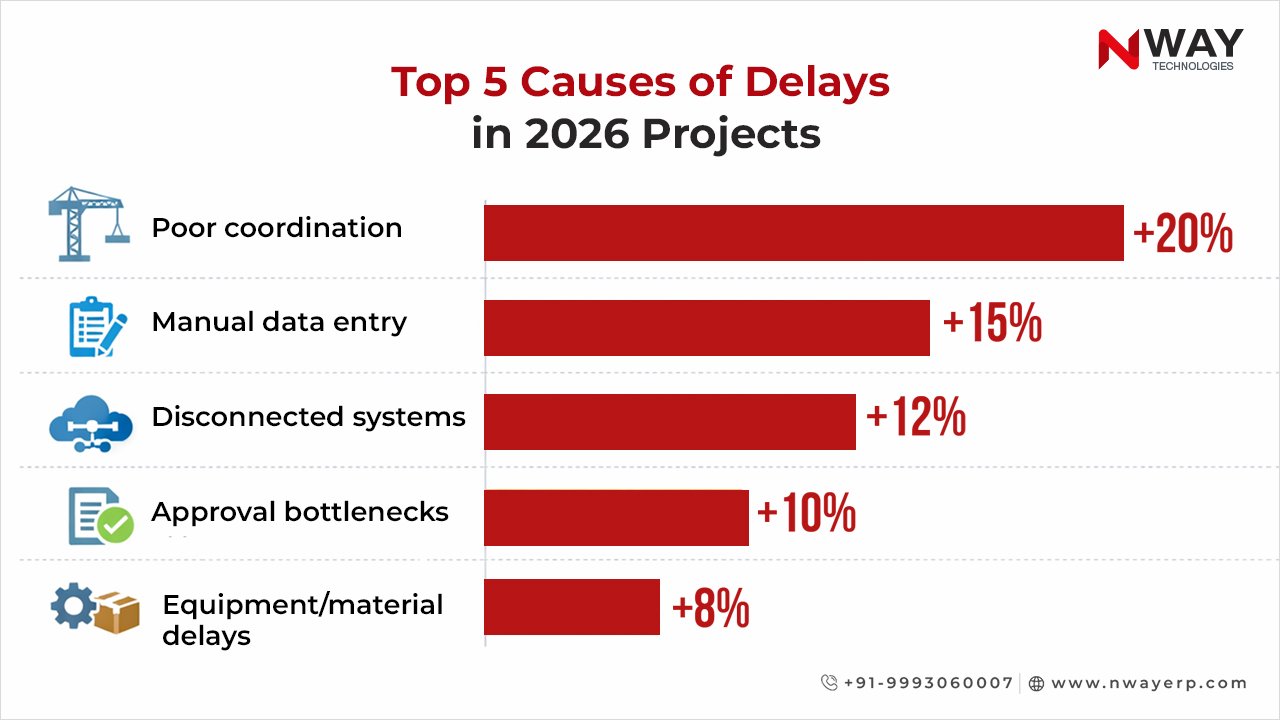
Top 5 Causes of Delays in 2026 Projects

Many companies struggle because they:

  • Choose tools that only solve one problem
  • Use different systems for projects and finance
  • Depend heavily on manual entries
  • Receive reports too late to act

Disconnected systems slow decision-making and increase risk.

What the Best Construction Management Software Delivers

The best construction management software 2026 must deliver:

  • Single source of truth for projects and costs
  • Faster reporting and approvals
  • Lower data errors through automation
  • Better forecasting and planning
  • AI-powered functionalities that help predict and forecast outcomes

The global construction software market is expected to grow steadily as firms digitize operations to improve productivity.

Why Nway ERP is the Best  Software for Construction Project Management for 2026

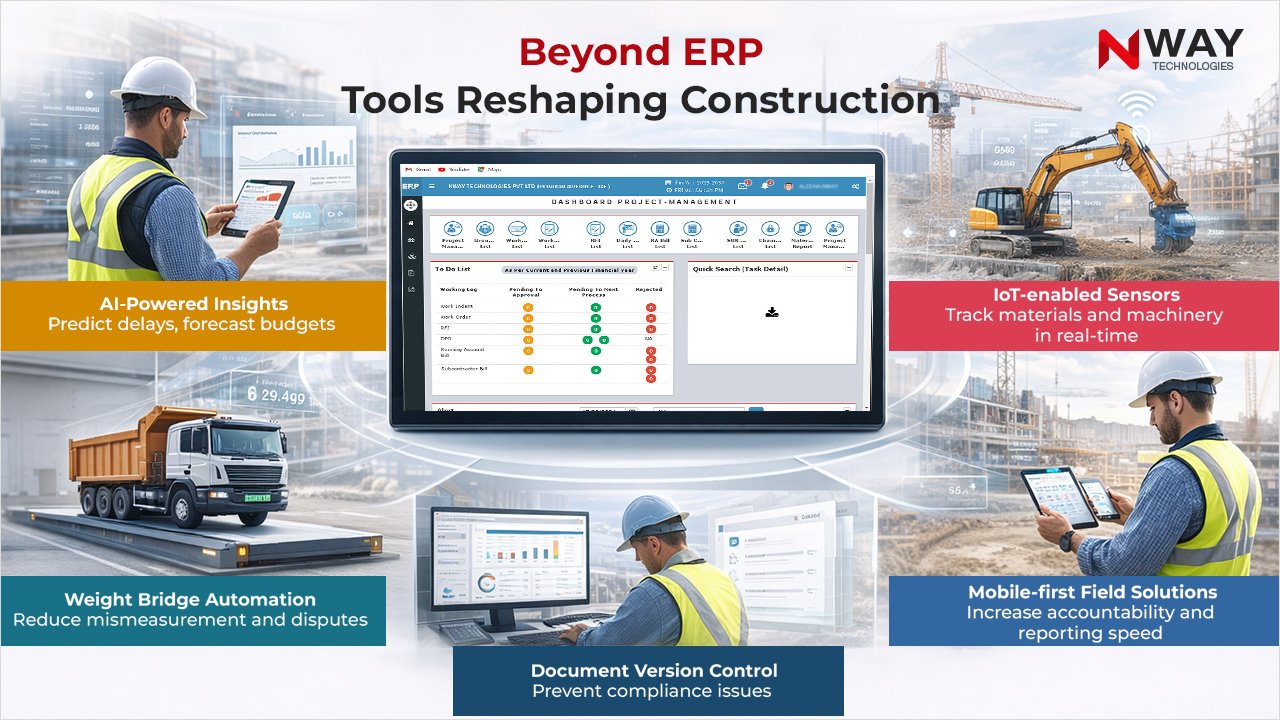
Beyond ERP - Tools Reshaping Construction

When buyers compare categories, a clear pattern appears. Project-only tools lack financial control. Accounting tools lack execution visibility. Enterprise platforms are complex and slow.

Nway ERP brings these pieces together.

Instead of managing projects, bills, materials, and reports in separate systems, Nway ERP connects them in one construction management system. This reduces reconciliation work and improves accuracy.

Faster Decisions, Not Just Data Storage

Teams can generate reports on demand, track KPIs instantly, and understand project health without waiting for manual updates. This supports better forecasting and timely corrective action.

Less Manual Work, Fewer Errors

Routine tasks like invoice entry, material records, and transaction capture are automated. This saves time and improves data quality across departments.

Better Control Across Projects

With consistent data from site to office, businesses gain clearer visibility into costs, timelines, and resources – essential for large and fast-moving construction portfolios.

Nway ERP fits Indian compliance needs while also supporting global project standards, making it a practical choice for companies operating at scale.

Real Business Impact

Instead of promoting AI, Nway ERP uses AI-driven capabilities to solve industry pain points: accurate forecasting, instant insights, and reliable operations. This helps mid-to-large Indian construction firms scale efficiently while maintaining compliance and financial control.

Who Should Use Nway ERP

Nway ERP is well-suited for:

  • EPC and infrastructure companies
  • Mid-to-large construction firms
  • Developers managing multiple sites
  • Businesses seeking tighter cost and project control

If your goal is to move from reactive management to proactive planning, an end-to-end system delivers the strongest results.

Conclusion

Choosing construction management software in 2026 is about outcomes, not buzzwords. The most effective systems reduce manual work, improve visibility, and support faster decisions.

While many tools address parts of the problem, end-to-end platforms offer the most value long term. For Indian and global construction businesses, Nway ERP delivers that balance of control, speed, and scalability.

FAQs

What features make the best construction management software in 2026?

The best construction management software in 2026 includes features that help teams plan, track, and finish projects smoothly. Look for tools that offer real‑time cost tracking, task scheduling, document storage, mobile access for field teams, and easy reports you can customize. These features help teams see project progress clearly and reduce manual work, especially on larger or multi‑site projects.

How do top construction management tools improve field and office teamwork?

Top construction management tools help office planners and field teams share the same information instantly. This means daily updates, task lists, and change alerts are available on mobile devices and desktop dashboards. When everyone sees the same project data, there are fewer mistakes, faster decisions, and clearer communication across the team — from site supervisors to finance.

What is the difference between construction project management software and a construction management system?

Construction project management software focuses mainly on planning, scheduling, and tracking tasks. A full construction management system includes these features plus budgeting, billing, documents, compliance, and reporting in one place. A system gives a more complete view of work across projects and helps larger teams avoid data gaps or duplicated work.

Can construction software solutions integrate with accounting and payroll systems?

Yes, many modern construction software solutions can connect with accounting, payroll, and other business tools. This makes billing, expense tracking, and payroll simpler because data is shared automatically rather than typed into separate spreadsheets. Integration saves time and reduces errors, which helps teams stay accurate and compliant as projects grow.

What should Indian construction companies consider when choosing construction management software in 2026?

Indian construction companies should consider tools that handle GST compliance, multi‑project cost tracking, and mobile access for field teams. They should also look for solutions with clear dashboards and easy reporting so decisions can be made quickly. Choosing software that supports both planning and financial control helps teams avoid delays and run projects more smoothly.