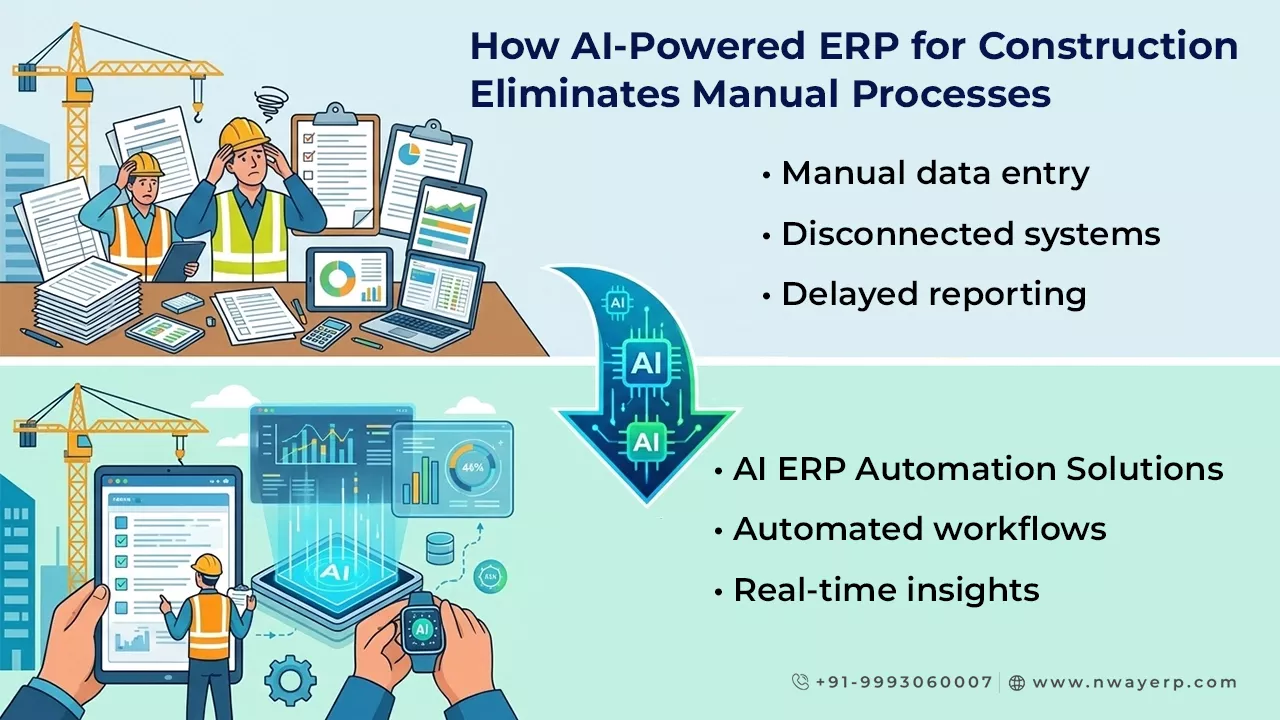
Construction and infrastructure companies today operate in a fast-moving environment with multiple projects, distributed teams, tight budgets, and strict timelines. Despite this complexity, many organizations still rely on manual data entry, disconnected systems, and delayed reporting.
This is where AI-powered ERP for construction transforms operations by automating workflows, improving accuracy, and enabling real-time decision-making.
With AI-driven ERP automation, companies can analyze project data in real time, reduce manual work, and gain predictive insights that help leaders make faster and smarter decisions.
Table of Contents:
- What is AI-powered ERP for construction?
- Key benefits of AI in construction ERP software
- How AI improves project planning & scheduling
- AI in cost control and financial management
- How Nway ERP delivers intelligent automation
- Future of AI-powered ERP in construction
What is AI-Powered ERP for Construction?
AI-powered ERP for construction is an advanced software solution that integrates artificial intelligence with ERP systems to automate project management, cost control, procurement, and resource planning.
Unlike traditional systems, AI-enabled ERP helps businesses predict delays, automate repetitive tasks, optimize resources, and provide real-time insights.
Contractors using construction ERP software gain better visibility and control over project performance.
Key Benefits of AI in Construction ERP Software
- Improved efficiency through automation.
- Real-time project tracking and reporting.
- Reduced manual errors in operations.
- Better decision-making using AI insights.
How Does AI Work Inside Construction ERP?
AI-powered construction ERP does more than display dashboards. It connects data generated across planning, procurement, inventory, project execution, labour, machinery, billing and finance and uses that information to identify patterns, automate repetitive work and surface exceptions that require management attention.
For example, project data may come from a BOQ, WBS, material requisition, purchase order, GRN, DPR, labour attendance, machinery logs, subcontractor bills and accounting transactions. Instead of reviewing each record independently, an AI-enabled ERP can analyze relationships between them.
This can help management answer questions such as:
Is material consumption higher than the BOQ quantity?
Which project is moving toward a budget variance?
Which purchase requirement could delay the construction schedule?
Which equipment is showing abnormal utilisation or maintenance patterns?
Which contractor bill does not match approved progress?
The objective is not to replace project managers or engineers. It is to reduce the time they spend collecting information and help them identify issues earlier.
How AI Improves Project Planning & Scheduling
AI analyzes historical project data, labor productivity, and resource availability to create accurate schedules and predict risks before they occur.
- Identify project delays early
- Allocate resources efficiently
- Improve overall project timelines
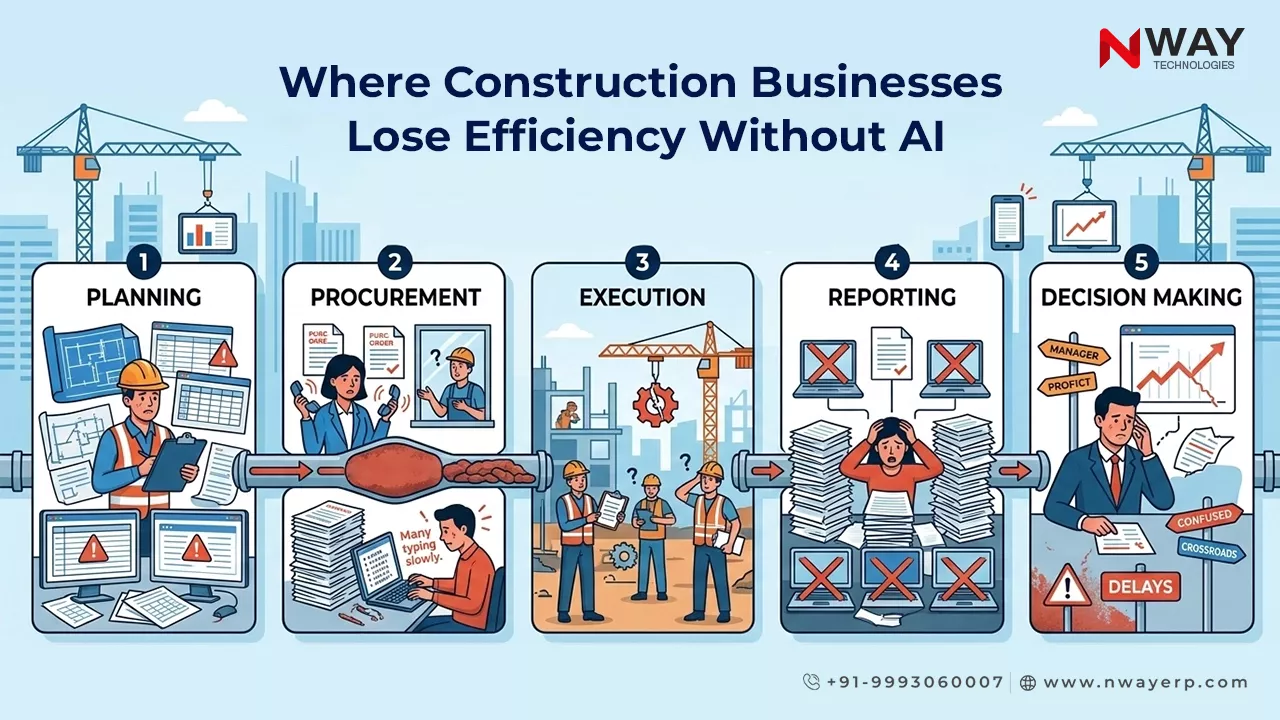
Where AI Creates Value Across the Construction Project Lifecycle
AI in Cost Control and Financial Management
Cost overruns are a major challenge in construction. AI-powered ERP systems track expenses in real time and compare planned vs actual costs.
Using construction cost management software, businesses can reduce financial risks and improve budget control.
AI also improves procurement efficiency through construction procurement management.
AI for BOQ and Construction Estimation
Construction estimation involves more than assigning rates to quantities. Estimators frequently work across tender documents, drawings, historical rates, material requirements, labour requirements and previous project data.
AI-assisted construction ERP can help extract structured information from project documents, analyse historical project data and identify quantities, clauses or cost patterns that would otherwise require substantial manual review.
AI for Construction Procurement and Vendor Management
AI becomes particularly valuable when procurement data is connected with BOQ quantities, inventory availability, project schedules and historical purchasing.
Instead of treating each purchase request separately, construction ERP can help management identify abnormal prices, duplicate purchasing patterns, material shortages, delayed procurement and discrepancies between purchase orders, GRNs and invoices.
Procurement teams can therefore move from reactive purchasing toward more controlled, data-driven material planning.
AI for RA Billing, GST and Construction Finance
AI-powered construction ERP becomes more valuable when project execution data flows directly into financial workflows.
Instead of treating project progress, contractor bills and finance as separate processes, an integrated ERP can connect approved quantities and project progress with billing and accounting. This reduces duplicate entry, billing delays, and reconciliation gaps while giving finance teams clearer visibility into project-level costs.
How Nway ERP Delivers Intelligent Automation
Nway ERP solution integrates AI capabilities across construction workflows to improve productivity and efficiency.
- AI-driven dashboards for real-time insights
- Automated document processing
- Predictive analytics for risk detection
- Smart workflow automation
AI ERP vs Traditional ERP Comparison
| Capability | Traditional Construction ERP | AI-Powered Construction ERP |
|---|---|---|
| Reporting | Shows recorded data | Highlights patterns and exceptions |
| Project Monitoring | Reviews current and historical status | Supports early risk identification |
| Cost Control | Planned vs actual reporting | Variance alerts and predictive analysis |
| BOQ & Estimation | Manual or system-assisted preparation | AI-assisted document and drawing analysis with estimation support |
| Procurement | PO and GRN workflows | Demand, anomaly and vendor intelligence |
| Documents | Storage and retrieval | Extraction, classification and intelligent analysis |
| Scheduling | WBS and planned timelines | Risk and potential delay identification |
| Machinery | Maintenance records | Predictive utilisation and maintenance insights |
| Management Reporting | Predefined MIS reports | Conversational and intelligent querying |
| Decision-Making | Users interpret reports manually | System surfaces issues that require management attention |
How Nway ERP Transforms ERP into an Intelligent Platform
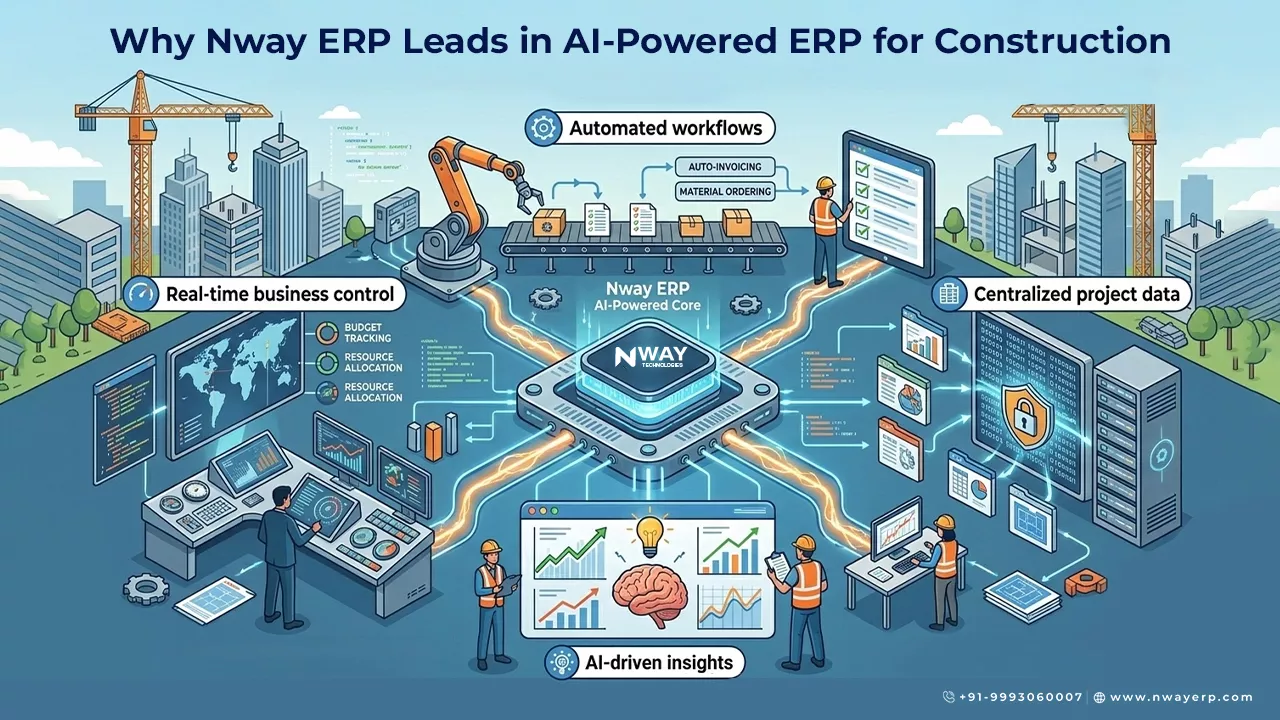
Nway ERP combines industry expertise with AI to deliver better visibility, faster reporting, and improved decision-making.
- Complete project visibility
- Reduced manual workload
- Faster reporting and analytics
- Data-driven decision-making
How NWAY Uses AI Across Construction ERP
| Intelligence Layer | Construction Use |
|---|---|
| Document Intelligence | Extract information from contracts, PDFs and project documents |
| Engineering Intelligence | Support BOQ, drawings, quantities and engineering workflows |
| Procurement Intelligence | Identify purchasing exceptions, material requirements and vendor-related insights |
| Project Intelligence | Monitor progress, schedule, cost and project risk |
| Financial Intelligence | Analyse cost, budget, billing and financial information |
| Conversational Intelligence | Allow users to ask operational questions using natural language |
Automate your construction operations with AI-powered ERP.
Improve efficiency, reduce costs, and gain real-time visibility.
Future of AI-Powered ERP in Construction
The future of ERP in construction is driven by artificial intelligence, automation, and real-time insights.
- Predictive analytics for project success
- Automated workflows and approvals
- AI-driven planning
- Real-time operational intelligence
How to Choose an AI-Powered Construction ERP
| Evaluation Factor | What the Buyer Should Check |
|---|---|
| Construction Specificity | BOQ, DPR, WBS, RA billing and subcontractor management |
| End-to-End Integration | Planning → procurement → execution → accounts |
| AI Depth | What the AI actually analyzes, predicts or automates |
| Data Sources | Documents, transactions, site information and ERP data |
| India Compliance | GST, TDS, RCM and e-invoicing where applicable |
| Multi-Site Capability | Central visibility across multiple projects and locations |
| Mobile & Site Adoption | Ease of use for site engineers, project teams and field users |
| Implementation | Data migration, system configuration, onboarding and training |
| Security | Role-based permissions, audit trails and data controls |
| Support | Implementation support and post-go-live assistance |
| Scalability | Ability to support more projects, users, companies and locations |
| ROI Measurement | Reporting time, cost variance, procurement efficiency and billing KPIs |
Conclusion
AI-powered ERP for construction is transforming how businesses manage projects, resources, and finances. By automating processes and providing real-time insights, it enables faster decisions and improved efficiency.
For construction companies aiming to scale operations and improve profitability, adopting AI-enabled ERP is essential for future growth.