GST e-invoicing is mandatory for eligible registered taxpayers whose aggregate annual turnover (AATO) is ₹5 crore or more in any applicable financial year from FY 2017-18 onwards. The ₹5 crore threshold came into effect on 1 August 2023. E-invoicing requires eligible B2B invoices and specified documents to be reported to an Invoice Registration Portal (IRP), where an Invoice Reference Number (IRN) and signed QR code are generated.
Businesses with AATO of ₹10 crore or more must also comply with the 30-day e-invoice reporting restriction introduced from 1 April 2025.
What Is E-Invoicing Under GST?
E-invoicing does not simply mean creating an invoice electronically or sending a PDF invoice to a customer.
Under the GST e-invoicing system, eligible businesses first prepare an invoice using their accounting, ERP or billing system. The required invoice information is then reported to an authorised Invoice Registration Portal (IRP).
After the information is successfully validated, the system generates an Invoice Reference Number (IRN) and a digitally signed QR code. These details become part of the valid e-invoice.
The IRP also passes relevant invoice information to the GST system, helping reduce duplicate data entry during GST reporting.
In simple terms, the process works like this:
Business Billing System → Invoice Registration Portal → Validation → IRN + QR Code → GST Reporting
This standardised process helps businesses maintain more consistent invoice information across their accounting and tax systems.
What Is the E-Invoice Turnover Limit in 2026?
The current GST e-invoice turnover threshold is ₹5 crore.
A taxpayer whose AATO meets the notified threshold in an applicable preceding financial year from FY 2017-18 onwards needs to check whether e-invoicing applies to the business.
The turnover is considered across GST registrations held under the same PAN across India rather than looking only at an individual GSTIN in isolation.
For example, imagine a company operates through several GST registrations in different states. When checking e-invoice applicability, the business should consider the aggregate turnover connected with the same PAN as required under the GST framework.
This becomes particularly important for construction, infrastructure and contracting companies that may operate through different branches, projects or state registrations.
E-Invoice Applicability Timeline in India
E-invoicing was not introduced for all businesses at once. The government gradually reduced the turnover threshold over several years.
| Effective Date | AATO Threshold |
|---|---|
| 1 October 2020 | ₹500 crore |
| 1 January 2021 | ₹100 crore |
| 1 April 2021 | ₹50 crore |
| 1 April 2022 | ₹20 crore |
| 1 October 2022 | ₹10 crore |
| 1 August 2023 | ₹5 crore |
The official IRP mandate records this phased reduction from ₹500 crore to the present ₹5 crore threshold.
Who Needs to Generate an E-Invoice?
E-invoicing mainly applies to notified registered taxpayers who meet the applicable turnover conditions and are not covered by a notified exemption.
It generally covers relevant B2B transactions, exports, supplies to government or PSUs where applicable, deemed exports, debit notes and credit notes.
The responsibility for generating the e-invoice normally rests with the supplier. The recipient does not generate an e-invoice for a supplier’s outward transaction.
Whether e-invoicing applies should therefore be checked using both the taxpayer’s turnover and the nature of the transaction.
Which Transactions Are Covered Under E-Invoicing?
For eligible taxpayers, e-invoicing can apply to transactions such as B2B supplies, export transactions, deemed supplies, deemed exports, supplies involving SEZ developers and applicable supplies to government entities.
Supplier-issued tax invoices, debit notes and credit notes are among the main documents covered by the system.
However, not every document created by a GST-registered business needs an IRN.
B2C supplies, bills of supply, imports, exempt supplies and certain other transactions are outside the standard e-invoicing mandate.
Businesses should therefore avoid treating e-invoicing as a rule that automatically applies to every invoice generated through their accounting system.
Who Is Exempt From E-Invoicing?
Meeting the turnover threshold does not automatically mean every organisation has to generate an e-invoice.
The GST framework provides exemptions for certain classes of registered persons. These include categories such as banking companies and financial institutions, including NBFCs; insurance companies; goods transport agencies for specified services; passenger transport service providers; certain suppliers providing admission to film exhibitions; and SEZ units. E-invoicing can still apply to SEZ developers, which are treated differently from SEZ units.
Government departments and local authorities have also been excluded from the e-invoicing requirement through Notification No. 23/2021-Central Tax.
Businesses falling into a special category should check the latest notification and their specific circumstances instead of relying only on turnover.
What Is the 30-Day E-Invoice Reporting Rule?
Businesses with AATO of ₹10 crore or more need to pay special attention to the reporting date.
From 1 April 2025, covered invoices, debit notes and credit notes must be reported to the IRP within 30 days from the document date for taxpayers falling within this turnover category.
If the business attempts to report such a document after the permitted period, the system restricts IRN generation.
For example, if an invoice covered by this rule is dated 1 June, the accounts team should not wait several weeks before sending it for IRN generation.
For businesses handling a large volume of project invoices, delays between site billing, head-office approval and final accounting can therefore create compliance problems.
This makes timely integration between billing, accounts and GST processes increasingly important.
How Does the E-Invoicing Process Work?
The basic process begins inside the company’s existing billing or ERP system.
The business prepares the invoice with the required supplier, customer, transaction, item, tax and document information. The relevant data is then sent to an authorised IRP.
The IRP validates key information and, after successful registration, generates the unique Invoice Reference Number and signed QR code.
The business then uses the registered information on the final invoice issued to the customer.
Relevant information can also flow from the IRP into the GST system and support other compliance processes, reducing the need to enter the same information repeatedly.
The purpose is not to replace a company’s billing or ERP software. Instead, the IRP acts as the registration and validation layer between the business invoice and the GST ecosystem.
What Is an IRN?
IRN stands for Invoice Reference Number.
It is the unique reference associated with invoice information successfully registered through the Invoice Registration Portal.
The IRN helps identify the registered document within the e-invoicing system. The IRP also provides a signed QR code containing key invoice information that can be used for verification.
Because the IRN is tied to the invoice data, businesses should make sure customer GSTIN, invoice number, document date, taxable values, tax information and other important details are accurate before reporting the transaction.
Can an E-Invoice Be Cancelled?
Yes, but the cancellation window is limited.
An active IRN can generally be cancelled through the IRP within 24 hours of its generation. If an active e-way bill is linked to the invoice, the e-way bill must first be dealt with before the IRN can be cancelled.
Once the 24-hour IRP cancellation period has passed, the taxpayer cannot simply cancel the IRN through the IRP. The required correction then needs to be handled through the appropriate GST reporting process, depending on the circumstances.
This is another reason businesses should check invoice information before generating the IRN.
Can an E-Invoice Be Edited After IRN Generation?
The IRP does not provide a normal editing function for an invoice after it has been registered.
If an error is identified within the allowed cancellation period, the IRN may be cancelled and the invoice process corrected as applicable.
If the problem is identified later, the correction needs to be handled through the appropriate GST return or adjustment process.
Companies generating hundreds or thousands of invoices can reduce these errors by maintaining accurate customer masters, GSTIN details, tax rates and billing workflows in their accounting or ERP system.
Why Is E-Invoicing Important for Businesses?
The main benefit of e-invoicing is better consistency between business invoices and GST reporting.
Because invoices follow a standard structure and are registered through the IRP, businesses can reduce manual entry across different systems.
It can also help with invoice tracking, data reconciliation and the transfer of relevant information to GST and e-way bill systems.
For finance teams, the practical benefit is fewer disconnected steps between invoice preparation, tax reporting and record keeping.
The real advantage becomes greater when invoicing is connected to the rest of the company’s operational data rather than handled as a separate activity.
E-Invoicing Challenges for Construction Companies
Construction companies often have a more complicated billing process than businesses operating from a single office.
Invoices may depend on project progress, RA bills, work completion, customer approvals, material movement or other project information. At the same time, the finance team may be working from a central office while projects operate across different cities or states.
This can create gaps between site activity, billing and GST compliance.
For example, a project team may prepare billing information at the site, while finance later checks quantities, rates, customer details and GST information. If these processes are managed through separate spreadsheets, emails and accounting entries, mistakes or reporting delays become more likely.
Companies working across several projects may also need to track different customers, GST registrations, invoice series, project costs and receivables at the same time.
A connected system can make this process easier to control.
How Construction ERP Can Help With E-Invoicing
Construction ERP connects project operations with finance and billing instead of treating invoicing as an isolated accounting activity.
A typical workflow can move from:
Project Execution → Billing → Finance & Accounts → GST Data → E-Invoice → Reporting
When project and accounting information is maintained in the same system, finance teams have better visibility into the source of the invoice and the project against which the transaction has been created.
NWAY ERP currently states that it supports e-invoicing and provides an integrated accounting environment covering accounting, billing, inventory and GST processes.
For construction and infrastructure companies, the broader advantage is connecting compliance with business operations. Instead of maintaining project information in one system, billing in another and GST records somewhere else, teams can work with a more connected flow of information.
This can help reduce repetitive data entry, improve invoice accuracy and provide better visibility across projects and accounts.
Process of the generation of e-Invoice
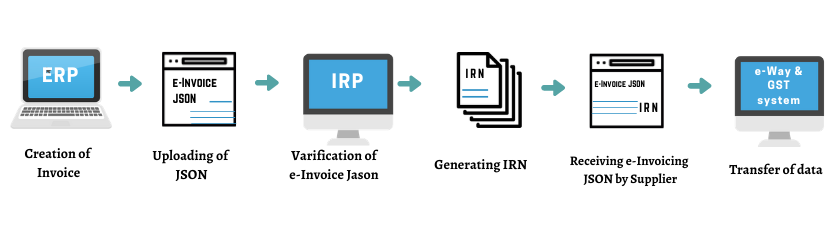
Nway ERP fully supports e-Invoicing for an automated digital solution without any hassle and offer different ways to connect to source ERP for invoice extraction. With Nway ERP you will get a fully integrated accounting system from Accounting to Billing to Inventory to GST, manage all your business data seamlessly.
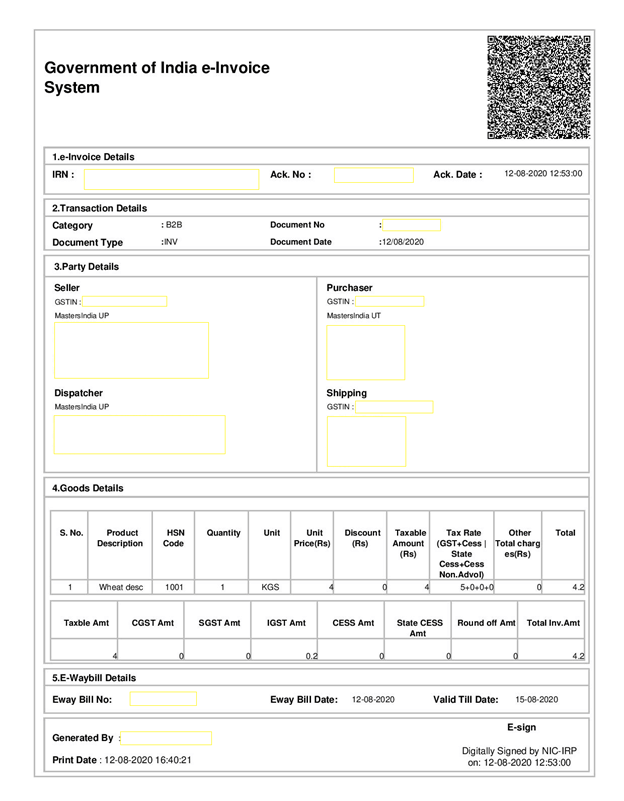
An e-Invoice format has been notified by CBIC is as follow (Example Invoice)
Make GST Billing Easier With Connected Construction ERP
For construction companies, GST compliance becomes easier when billing, accounts and project information work together.
NWAY Construction ERP helps connect project operations with finance, billing, inventory and GST-related processes so that teams can manage information through a more organised workflow.
Instead of depending on disconnected spreadsheets and repeated manual entries, project and finance teams can work with one connected system.
Want to see how NWAY ERP can support your construction billing and finance processes?