
Construction projects consume large volumes of cement, steel, sand, aggregates, blocks, pipes, and finishing materials across multiple sites and activities. When this usage is not tracked properly, contractors face one common problem — they know what they purchased, but they do not clearly know what was actually consumed, wasted, damaged, or left in stock.
This is where Material Reconciliation in Construction becomes essential.
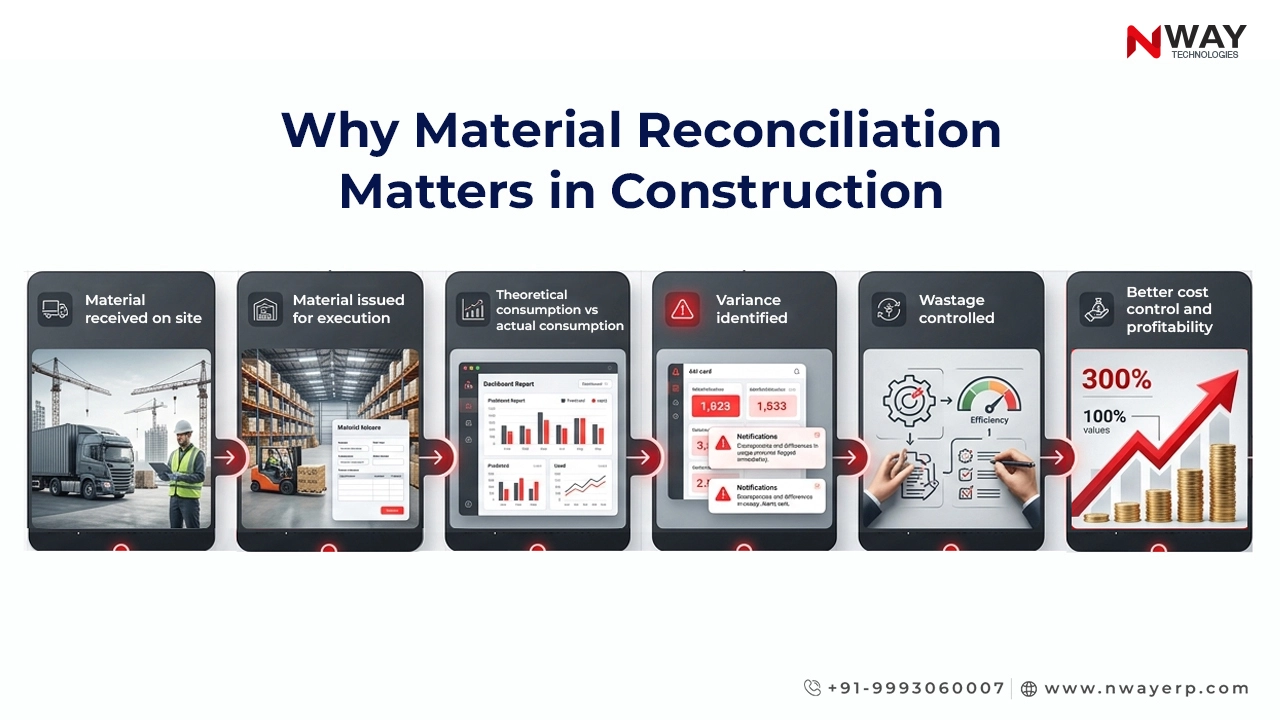
Material reconciliation helps contractors compare the theoretical quantity of materials required for executed work against the actual quantity issued or consumed on site. This gives project teams better control over wastage, pilferage, over-issuance, stock errors, and billing disputes.
Many contractors still manage this process through spreadsheets, manual stock registers, and delayed store reports. This often leads to inaccurate consumption records, higher material wastage, delayed project reviews, and reduced profitability.
With a structured Material Reconciliation Format, teams can monitor material movement more accurately, identify variances early, and take corrective action before costs escalate.
In this blog, we explain what material reconciliation in construction is, why it matters, the formula used, the reporting format, and a practical example. We also show how Nway ERP helps contractors track material consumption, stock, and project-wise usage more efficiently.
Table of Contents:
- What is Material Reconciliation in Construction?
- Why Material Reconciliation is Important for Contractors
- Key Components of a Material Reconciliation Statement
- Material Reconciliation Formula
- Material Reconciliation Format in Construction
- Example of Material Reconciliation in Construction
- Common Reasons for Material Variance
- Best Practices for Accurate Material Reconciliation
- How Nway ERP Simplifies Material Reconciliation
- The Future of Material Reconciliation in Construction
What is Material Reconciliation in Construction?
Material Reconciliation in Construction is the process of comparing:
- Material received on site
- Material issued or consumed for work
- Material remaining in closing stock
- Material theoretically required as per executed quantity
The purpose is to identify whether actual consumption is aligned with planned or standard consumption.
In simple terms, material reconciliation answers questions like:
- How much material was received?
- How much should have been consumed for the work done?
- How much was actually consumed?
- Is there any excess usage, shortage, wastage, or stock mismatch?
This process is especially important for high-value and high-volume materials such as:
- Cement
- Steel
- Sand
- Aggregate
- RMC
- Bricks / blocks
- Pipes and fittings
- Finishing materials
Without proper reconciliation, contractors may face hidden losses that directly affect project margins. This practical definition also aligns with broader industry guidance that material reconciliation means comparing planned, delivered, and consumed quantities to identify discrepancies and improve cost control.
Why Material Reconciliation is Important for Contractors
Material cost forms a major part of total project cost. Even a small variance in cement, steel, or aggregates can significantly affect profitability across large projects.
Without proper construction material reconciliation, contractors often face:
- Uncontrolled material wastage
- Stock shortages during execution
- Over-ordering of materials
- Delayed billing and cost reporting
- Difficulty in identifying theft or pilferage
- Inaccurate project cost analysis
- Disputes between stores, site, and accounts teams
Material reconciliation helps contractors:
- Track actual material consumption against work done
- Detect excess usage early
- Improve project-wise cost control
- Reduce material loss and wastage
- Support client billing and subcontractor verification
- Improve procurement planning
- Maintain accurate stock records
For multi-site contractors, this becomes even more important because material movement across projects can create major reporting gaps if not tracked systematically. These benefits are consistent with external guidance emphasizing cost control, waste reduction, schedule control, and better reporting through regular reconciliation.
Key Components of a Material Reconciliation Statement
A proper material reconciliation statement should include the following fields:
- Material name
- Unit of measurement
- Opening stock
- Quantity received during the period
- Total available quantity
- Quantity consumed as per site issue / actual usage
- Closing stock
- Theoretical consumption as per executed work
- Variance quantity
- Variance percentage
- Remarks or reason for variance
These fields help site engineers, quantity surveyors, project managers, and finance teams compare planned usage with actual usage in a structured way.
Typical documents used for reconciliation include:
- Purchase receipts / GRNs
- Stock register
- Material issue slips
- Daily progress reports
- BOQ and quantity calculations
- Bar bending schedule / mix design / consumption norms
- Physical stock verification report
A structured reporting format is a common best practice in reconciliation because clear documentation, regular physical counts, and prompt variance review improve accuracy and accountability.
Material Reconciliation Formula
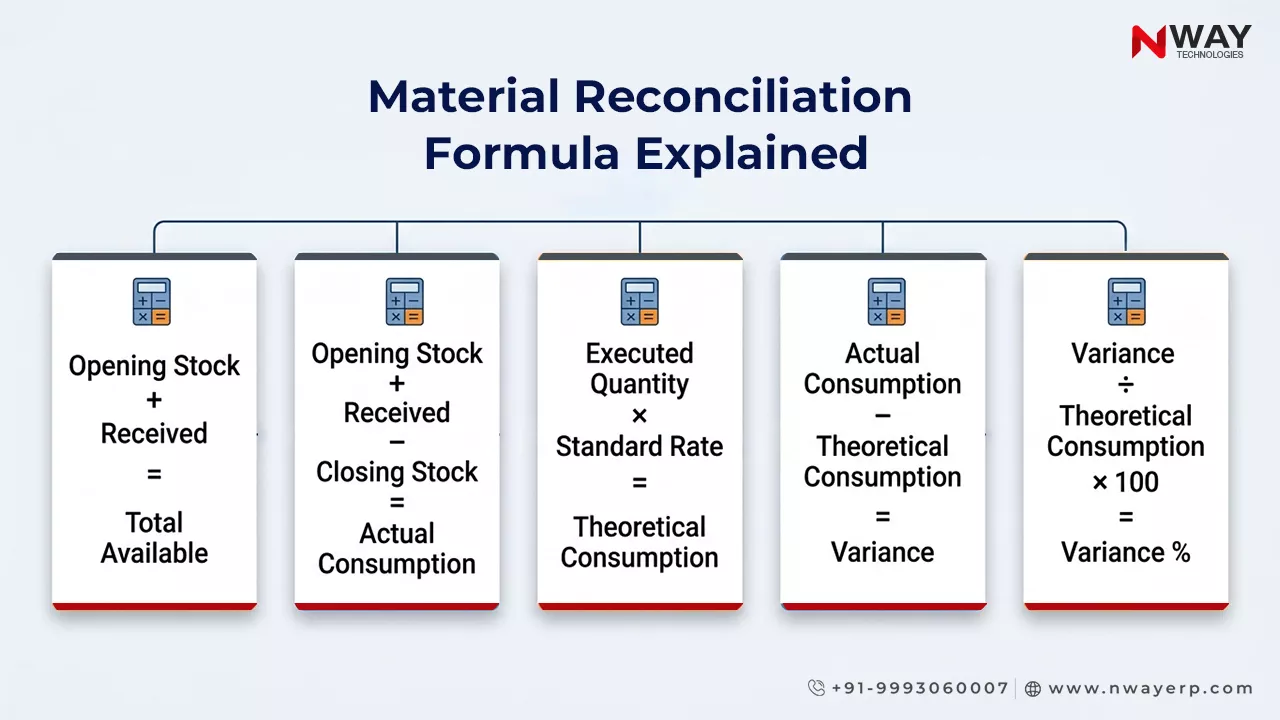
The exact formula can vary slightly by company and material type, but the most commonly used formulas are:
Total Available Quantity
Total Available = Opening Stock + Quantity Received
Actual Consumption
Actual Consumption = Opening Stock + Quantity Received − Closing Stock
Theoretical Consumption
Theoretical Consumption = Executed Work Quantity × Standard Consumption Rate
Variance
Variance = Actual Consumption − Theoretical Consumption
Variance Percentage
Variance % = (Variance ÷ Theoretical Consumption) × 100
Wastage Percentage
Wastage % = [(Actual Consumption − Theoretical Consumption) ÷ Theoretical Consumption] × 100
How to interpret variance:
Positive variance
= actual consumption is higher than theoretical consumption
This may indicate wastage, theft, breakage, poor planning, or inaccurate recording.
Negative variance = actual consumption is lower than theoretical consumption
This may indicate saving, stock recording error, under-reporting of work, or pending entries.
This formula-driven approach fits the SEO recommendation in your strategy report to publish process-led content built around “format, formula, and example” for high-intent construction searches.
Material Reconciliation Format in Construction
Below is a simple Material Reconciliation Format contractors can use for monthly or project-wise reporting:
| Material | Unit | Opening Stock | Received | Total Available | Actual Consumption | Closing Stock | Theoretical Consumption | Variance | Variance % | Remarks |
|---|---|---|---|---|---|---|---|---|---|---|
| Cement | Bags | 50 | 780 | 830 | 810 | 20 | 800 | 10 | 1.25% | Slight excess usage |
| Steel | MT | 5 | 42 | 47 | 44 | 3 | 43.2 | 0.8 | 1.85% | Cutting / rolling wastage |
| Sand | CFT | 2,000 | 15,000 | 17,000 | 15,800 | 1,200 | 15,500 | 300 | 1.94% | Handling loss |
Recommended reporting frequency:
- Daily for critical materials
- Weekly for fast-moving materials
- Monthly for project cost review
- Final reconciliation before project closure or billing stage
This format works best when it is maintained project-wise, site-wise, and material-wise.
Example of Material Reconciliation in Construction
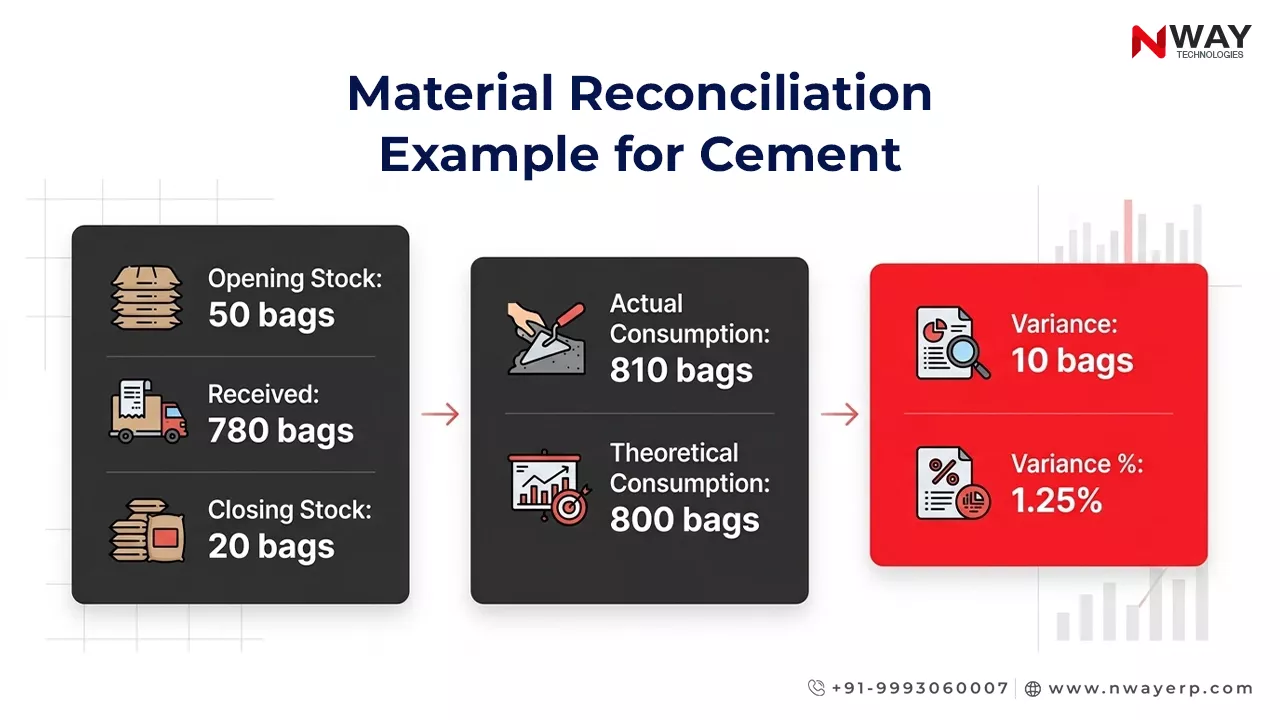
Let us take a simple cement reconciliation example for RCC work.
Project Data
- Material: Cement
- Opening stock: 50 bags
- Quantity received during month: 780 bags
- Closing stock after physical verification: 20 bags
- RCC work executed: 100 cubic meters
- Standard cement consumption: 8 bags per cubic meter
Step 1: Calculate Total Available Quantity
Total Available = Opening Stock + Received
= 50 + 780
= 830 bags
Step 2: Calculate Actual Consumption
Calculate Actual Consumption
Actual Consumption = Opening Stock + Received − Closing Stock
= 50 + 780 − 20
= 810 bags
Step 3: Calculate Theoretical Consumption
Theoretical Consumption = Executed Work Quantity × Standard Consumption Rate
= 100 × 8
= 800 bags
Step 4: Calculate Variance
Variance = Actual Consumption − Theoretical Consumption
= 810 − 800
= 10 bags
Step 5: Calculate Variance Percentage
Variance % = (10 ÷ 800) × 100
= 1.25%
Interpretation
This means the project consumed 10 bags more cement than the standard requirement. The excess consumption may be due to:
- Site wastage
- Improper storage
- Extra mortar usage
- Inaccurate batching
- Breakage of bags
- Record mismatch
This is exactly why regular material reconciliation reports in construction are critical. They help contractors identify small losses before they become large cost overruns.
Common Reasons for Material Variance
A variance in reconciliation does not always mean theft or mismanagement. However, it always requires review.
Common reasons include:
- Poor storage conditions
- Material damage during unloading or handling
- Unrecorded site issues
- Theft or pilferage
- Excess cutting or fabrication loss
- Rework due to quality issues
- Wrong standard consumption assumptions
- Inaccurate physical stock count
- Delayed posting of receipts or issues
- Material transfer between sites without entry
For steel, variance may happen due to cutting wastage, rolling margin, lapping, or unrecorded scrap recovery.
For cement, variance may happen due to moisture damage, torn bags, overmixing, or wastage in small pours.
For sand and aggregates, handling loss and measurement inconsistency are common.
Understanding the reason behind the variance is more important than simply recording the number.
Best Practices for Accurate Material Reconciliation
To make material reconciliation in construction more reliable, contractors should follow these practices:
Maintain site-wise and project-wise stock records
Do not mix records of multiple sites or projects in one register.
Update material receipts and issues daily
Delayed entries make reconciliation inaccurate.
Perform regular physical stock verification
System stock should always be validated with actual site stock.
Define standard consumption norms clearly
Theoretical consumption should be based on approved mix designs, BOQ, drawings, or internal norms.
Review high-value materials separately
Steel, cement, RMC, cables, pipes, and tiles should be tracked more closely.
Record wastage and scrap properly
Scrap recovery and damaged materials should not remain unaccounted.
Involve stores, site, QS, and accounts teams together
Material reconciliation works best when all teams review the same data.
Use software instead of disconnected spreadsheets
A centralized ERP system improves accuracy, traceability, and reporting speed.
These best practices closely reflect broader reconciliation guidance: clear process definition, regular physical counts, consistent documentation, discrepancy review, and use of technology for automation.
How Nway ERP Simplifies Material Reconciliation
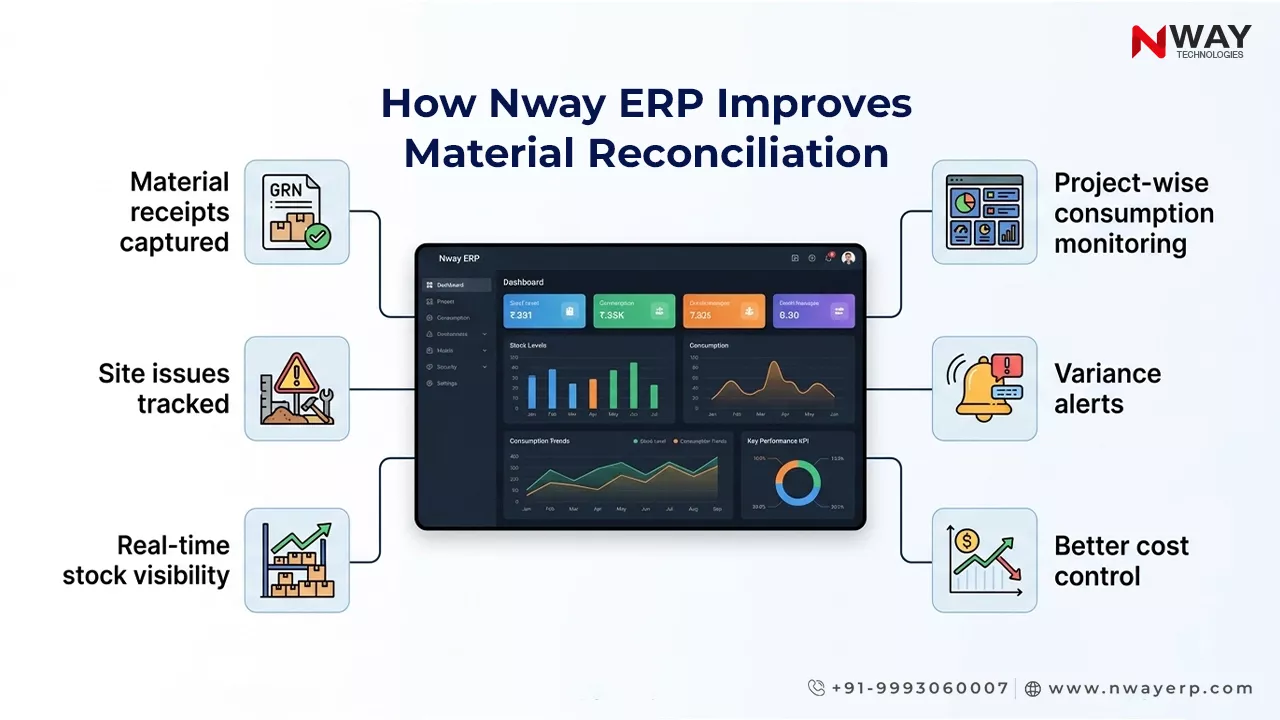
Nway ERP helps contractors move from delayed spreadsheet-based reconciliation to structured, real-time material control.
With Nway ERP, construction companies can manage:
Material receipt tracking
Record GRNs, supplier deliveries, and stock updates accurately.
Site-wise material issue management
Track how much material is issued to each project, activity, or site.
Real-time stock visibility
Monitor available stock, project consumption, and low-stock conditions without waiting for manual reports.
Project-wise material consumption analysis
Compare actual issue quantity with project execution and identify variances faster.
Better coordination between procurement, stores, and accounts
Material records stay connected across departments, reducing mismatches and reporting delays.
Faster reporting for management review
Generate material consumption and variance reports for faster decision-making.
This positioning is also consistent with the writing style of your recent NWAY ERP blogs, where the product section focuses on operational visibility, project-wise control, and real-time reporting rather than heavy product promotion.
The Future of Material Reconciliation in Construction
Construction companies are moving toward tighter cost control, live project dashboards, and faster field-to-office reporting.
In the coming years, construction material reconciliation will increasingly shift from manual monthly reporting to:
- Real-time stock tracking
- Integrated procurement and consumption records
- Mobile-based site entry
- Automated variance reports
- Project-wise material cost dashboards
- ERP-driven audit trails for every transaction
Contractors who digitize material reconciliation early will gain better visibility, reduce wastage, and improve project profitability.
Conclusion
Material Reconciliation in Construction is not just a store or billing activity. It is a critical cost-control process that helps contractors track material usage, reduce wastage, identify stock discrepancies, and improve profitability.
By using the right material reconciliation format, applying the correct formula, and reviewing variance through practical examples, project teams can make better decisions and maintain tighter control over project costs.
Manual spreadsheets may work for small records, but they often fail in multi-site, high-volume construction environments.
Nway ERP helps contractors bring material receipts, issues, stock, and project-wise reporting into one connected system — making material reconciliation faster, more accurate, and easier to manage.
Struggling to track material consumption across multiple construction sites?