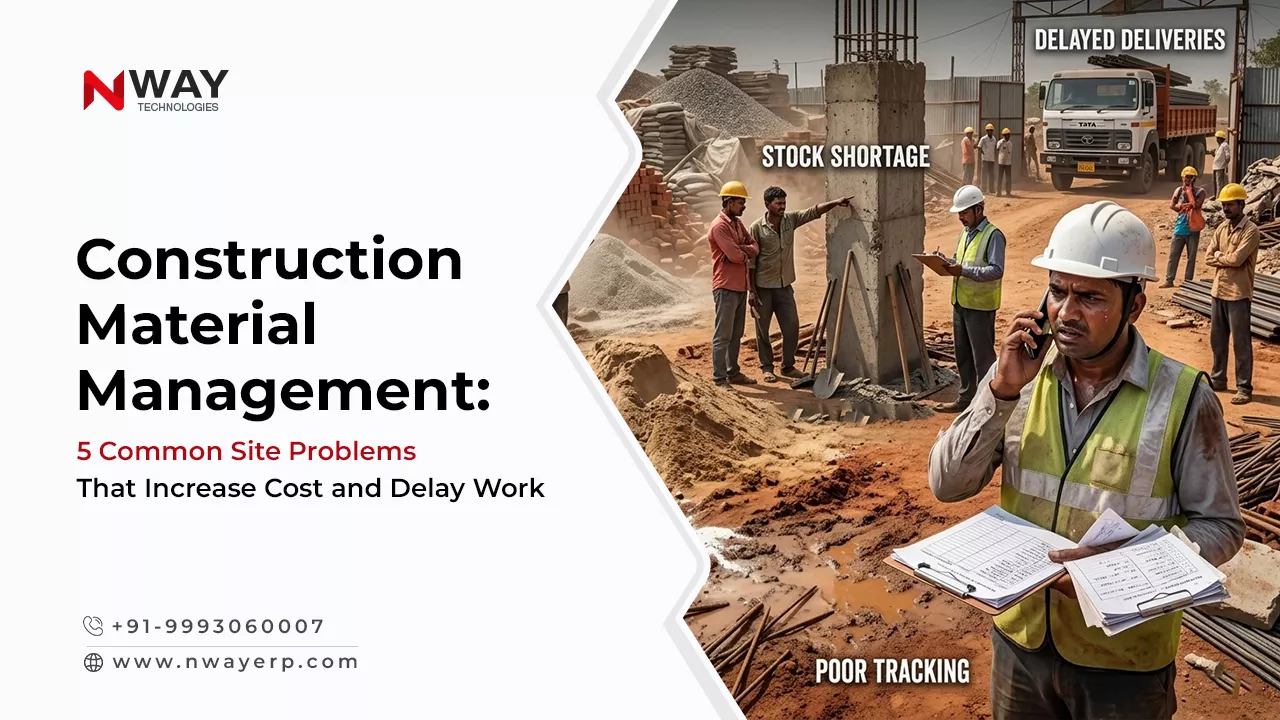
Construction projects live and die on materials. Cement, steel, sand, aggregates, pipes, bricks — every project depends on having the right material, in the right quantity, at the right time. Yet for most contractors, managing materials across multiple sites remains one of the most difficult and costly operational challenges.
In this guide, we cover the top 5 construction material management challenges, why they persist even in experienced companies, and how contractors can overcome them with smarter processes and construction ERP software.
Table of Contents:
- What is Material Management in Construction?
- Why Material Management Remains Difficult for Contractors
- Challenge 1: Inaccurate Material Forecasting and Estimation
- Challenge 2: Poor Stock Visibility and Inventory Control
- Challenge 3: Material Wastage and Excess Consumption
- Challenge 4: Supply Chain Disruptions and Procurement Delays
- Challenge 5: Disconnected Teams and Lack of Centralised Reporting
- How Construction ERP Software Addresses These Challenges
- How Nway ERP Helps Contractors Manage Materials Better
What is Material Management in Construction?
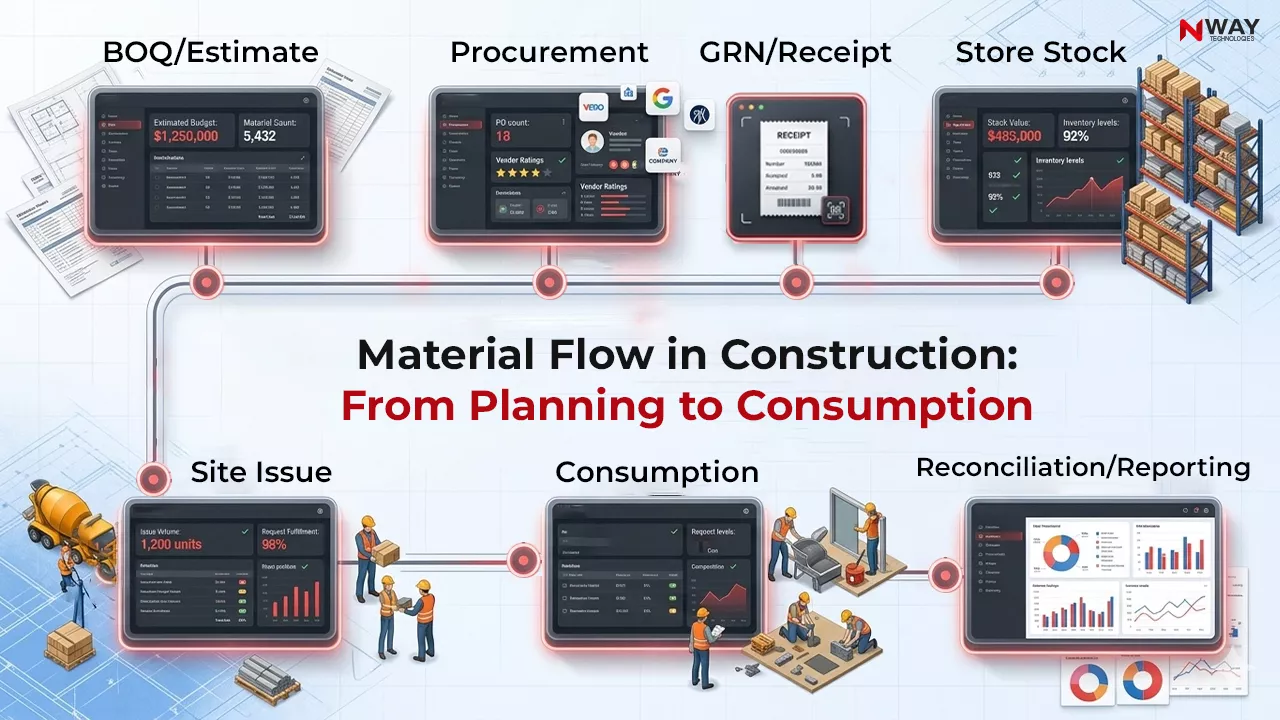
Material management in construction is the process of planning, buying, receiving, storing, issuing and reconciling materials so the right quantity reaches the right work front at the right time, at the right cost. It links four teams that often work apart: planning (or QS), procurement, stores and site execution, with accounts checking the money at the end.
Good material management answers three questions at any moment:
What do we need?
What do we have?
Where did the rest go?
Why Material Management Remains Difficult for Contractors
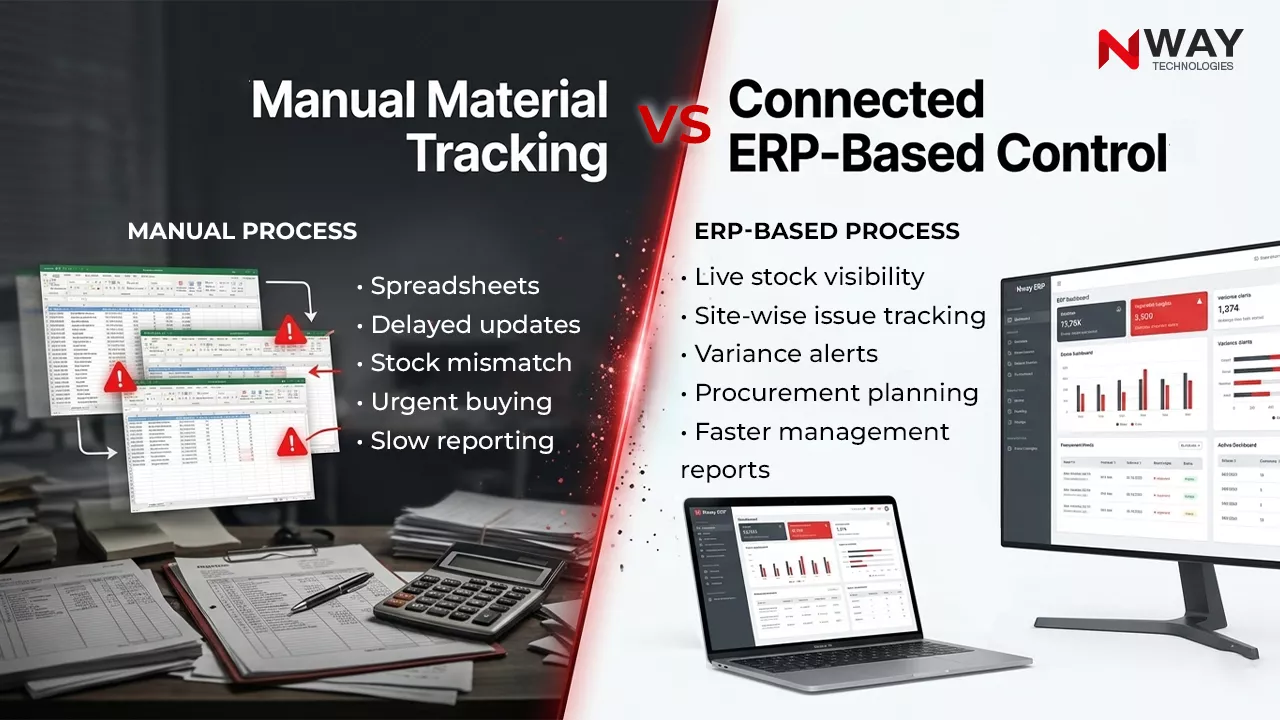
Despite the availability of digital tools, many construction companies still manage materials through spreadsheets, manual stock registers, and disconnected systems. This creates gaps between procurement, stores, site execution, and accounts — leading to errors, delays, and hidden losses.
The challenges are not just operational. They are structural. Material management in construction involves many moving parts: multiple vendors, multiple sites, multiple teams, varying consumption rates, and unpredictable site conditions. Without a centralised and real-time system, visibility breaks down quickly.
Let us look at the five most common challenges contractors face.
🔍 Want Real-Time Visibility Into Material Movement Across All Your Sites?
Challenge 1: Inaccurate Material Forecasting and Estimation
Inaccurate forecasting is one of the most persistent — and expensive — problems in construction material management. Getting quantities right before procurement begins is critical.
| Forecasting Error | What It Causes |
|---|---|
| Overestimate | Excess stock, increased storage costs, material degradation |
| Underestimate | Project delays, emergency procurement at premium prices, site disruption |
Why it happens:
- Estimations based on outdated standard rates or rough assumptions
- BOQ quantities not updated when design changes are made
- Poor coordination between the planning, procurement, and site teams
- No system to track actual consumption norms from past projects
How to Fix It:
- Maintain project-wise consumption norms updated with real data from completed work
- Integrate BOQ data directly with procurement so that scope changes automatically update material requirements
- Use historical project data to progressively improve forecasting accuracy
- Implement a construction ERP that connects estimation, planning, and procurement in one system
Accurate forecasting does not eliminate site uncertainty — but it significantly reduces unnecessary procurement and over-stocking.
Challenge 2: Poor Stock Visibility and Inventory Control
Most contractors know what they ordered. Very few know what’s actually in their store at any given moment. Discrepancies between system records and physical stock are common — and they grow worse as projects extend over months or years.
Poor inventory visibility leads to:
- Over-ordering because actual stock levels are unknown
- Under-issuing or over-issuing materials to the site
- Undetected theft, pilferage, or material loss
- Inability to transfer materials across sites when needed
- Billing disputes with clients and subcontractors
Why it happens:
- Stock registers maintained manually or in disconnected spreadsheets
- Delayed or unrecorded entries for material receipts and issues
- No process for physical stock verification
- Materials tracked at the project level but not at the activity or location level
How to overcome it:
- Conduct regular physical stock verification — weekly for high-value materials, monthly for all materials
- Record every GRN (Goods Receipt Note), material issue, and return in real time
- Use a centralised system where procurement, stores, and site are connected
- Track stock at the site level, store level, and project level simultaneously
Real-time inventory control is not about adding more reporting — it is about making sure every material movement is captured accurately and quickly.
Here’s a full checklist of what to look for in construction inventory software.
Challenge 3: Material Wastage and Excess Consumption
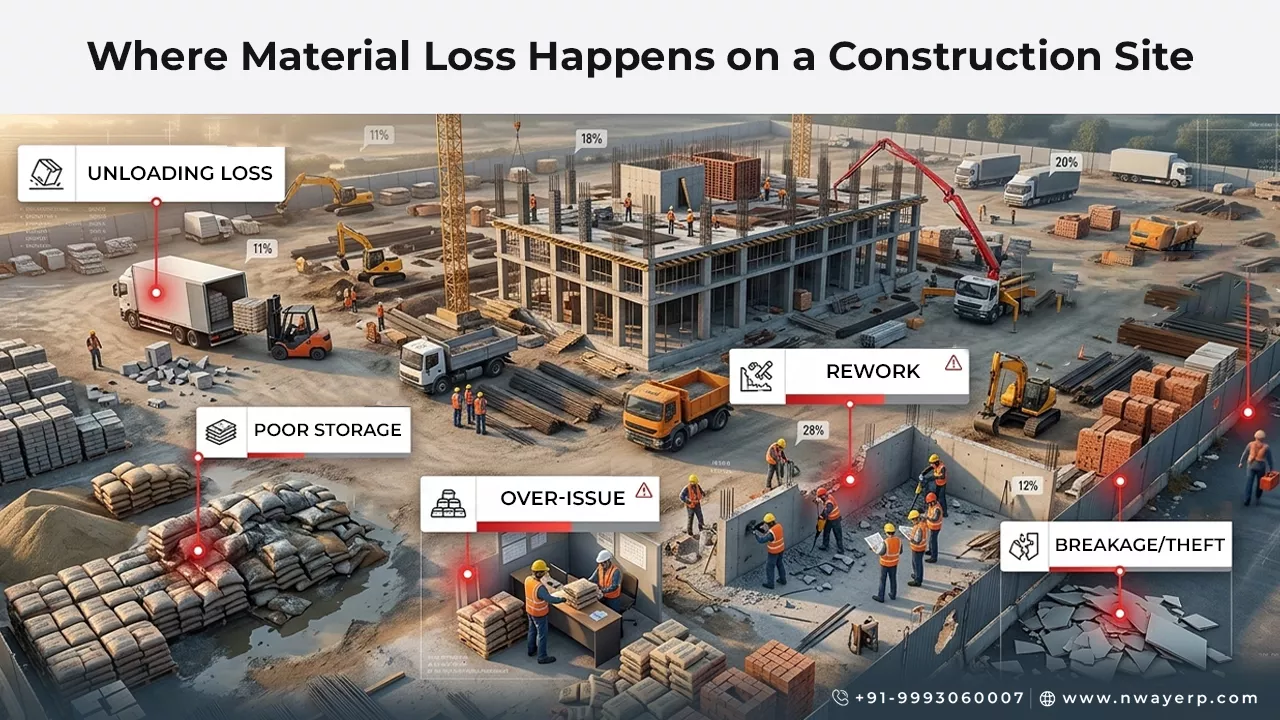
Material wastage is one of the most significant and under-monitored sources of cost leakage in construction. It appears in many forms: cement lost to moisture damage, steel wasted from excess cutting, sand lost during unloading, tiles broken from improper stacking.
Why it happens:
- No standard consumption norms defined at the activity level
- No comparison between actual consumption and theoretical requirement
- Poor site storage practices — materials left exposed, improperly stacked, or inadequately covered
- Lack of accountability for material usage at the field level
- Rework due to quality issues, design errors, or poor supervision
How to overcome it:
- Define standard consumption norms for all major materials (e.g., cement consumption per cubic meter of concrete, steel per ton of structural work)
- Perform regular material reconciliation — compare actual vs. theoretical consumption to surface variances early
- Train site teams on proper material handling, storage, and usage practices
- Track wastage, breakage, and scrap separately so they remain visible and accountable
- Review high-variance materials on a weekly basis and investigate root causes
The goal is not to eliminate all wastage — some is unavoidable. The goal is to measure it, understand it, and reduce it progressively across projects.
Losing Money Through Material Wastage or Stock Mismatch?
Challenge 4: Supply Chain Disruptions and Procurement Delays
Construction projects are directly dependent on timely material delivery. Delays in procurement — whether caused by vendor failures, price fluctuations, logistics issues, or sudden material shortages — can halt work on-site and push project timelines significantly.
Supply chain disruptions have become increasingly common in the construction industry. Geopolitical factors, rising raw material costs, logistics bottlenecks, and inconsistent supplier capacity all contribute to procurement uncertainty.
Why it happens:
- Over-reliance on single vendors without backup options
- Procurement triggered too late — ordered when needed rather than planned ahead
- Poor lead time visibility — contractors do not track how long specific materials take to arrive
- No early warning system when stock levels are running low
- Procurement handled in silos, disconnected from site progress and execution plans
How to overcome it:
- Maintain an approved vendor list with at least two to three alternatives for critical materials
- Build procurement lead times into project schedules — procure based on projected site requirement, not current stock
- Set minimum stock threshold alerts so low-stock situations are flagged before they become emergencies
- Integrate procurement planning with daily or weekly site progress reports
- Use an ERP system that connects site execution data with procurement workflows so reordering is triggered proactively
Procurement delays are often predictable — they tend to happen when planning is reactive rather than proactive.
Challenge 5: Disconnected Teams and Lack of Centralised Reporting
In most construction companies, material management involves multiple teams: procurement, stores, site engineers, project managers, quantity surveyors, and finance. When these teams work from different data sources — different spreadsheets, different registers, different formats — the result is inconsistency, miscommunication, and reporting delays.
The finance team may show one material cost figure. The site team may show another. The store records may not match either. Reconciling these differences consumes significant time and still often leaves gaps that affect billing, subcontractor payments, and project cost analysis.
Why it happens:
- Each team maintains its own records without integration
- Material data entered manually at multiple points — increasing errors and duplication
- No single source of truth for material receipts, issues, consumption, and stock
- Reports generated manually, often with delays of days or weeks
- Multi-site operations with no visibility across projects
How to overcome it:
- Implement a centralised material management system that connects procurement, store, site, and accounts
- Standardise data entry workflows across all projects and sites
- Generate daily or weekly consumption and stock reports automatically — not manually
- Give project managers, site engineers, and accounts teams access to the same real-time data
- Use dashboards to surface material variances, low-stock alerts, and project-wise consumption summaries
When all teams are working from the same data, material decisions become faster, disputes reduce, and project cost control improves significantly.
A worked example: cement on one slab
Figures below are illustrative. Use your own mix design and rates.
| Item | Value |
|---|---|
| Concrete poured (M25 slab) | 100 m³ |
| Cement norm as per mix design | 8 bags/m³ |
| Theoretical requirement | 800 bags |
| Allowed wastage (2%) | 16 bags → 816 bags |
| Actually issued from store | 860 bags |
| Excess over allowance | 44 bags |
| Cost at ₹380/bag | ₹16,720 on one slab |
Multiply that by every pour on every site and it becomes a real number. The point of the example isn’t the ₹16,720. It’s that you can only see it if issues are recorded against the activity, not just against the project.
How Construction ERP Software Addresses These Challenges
Manual processes and disconnected spreadsheets can manage material data for a single small project. They cannot scale to multi-site, multi-team operations where material volumes are large, timelines are tight, and margins are thin.
Construction ERP software brings all material management functions into a single, connected platform — linking estimation, procurement, store management, site issuance, and project cost reporting.
| Challenge | What ERP Solves |
|---|---|
| Inaccurate forecasting | BOQ integration with procurement; historical consumption norms |
| Poor stock visibility | Real-time inventory tracking across all sites and stores |
| Material wastage | Automated reconciliation against consumption norms; variance alerts |
| Procurement delays | Low-stock alerts; lead-time-aware procurement planning |
| Disconnected reporting | Single source of truth for all teams; automated dashboards |
Storage rules that prevent avoidable losses
- Cement: stack on raised wooden pallets, away from walls, no more than 10 bags high, and use first-in-first-out.
- Steel: keep it off the ground on sleepers, separated by diameter, and covered to limit rusting.
- Sand and aggregates: store on a hard, level base with side walls so material isn’t lost during unloading or in rain.
- Bricks, blocks and tiles: stack near the point of use to cut double handling and breakage.
Prioritise with ABC analysis
Not every item deserves the same attention. Classify materials by value:
- A items (about 70–80% of material spend, few in number): cement, steel, RMC, cable. Count them weekly and reconcile them every pour or month.
- B items: plumbing, fittings, formwork accessories. Count them monthly.
- C items (many in number, low value): consumables. Control them with min–max levels.
5 KPIs to review every week
| KPI | Formula | Watch for |
|---|---|---|
| Wastage % | (Issued − theoretical) ÷ theoretical × 100 | Anything above the allowance |
| Stock accuracy | Physical stock ÷ system stock × 100 | Below 98% on A items |
| Material cost variance | (Actual − budget) ÷ budget × 100 | Trends, not one-offs |
| Indent-to-GRN time | Days from indent to receipt | Rising lead times on critical items |
| Stock-outs | Number of times work stopped for material | Any repeat on the same item |
If you track only one, track wastage % on A items. It catches forecasting, storage and pilferage problems at once.
Where ERP fits in
Spreadsheets can manage materials on a single small job. They break once you have several sites, several stores and dozens of vendors, because nobody can see the whole picture without asking for it. A construction ERP connects the steps above:
- Indents that check the BOQ before they are approved
- POs, GRNs and bills that match each other automatically
- Issues recorded per activity, so reconciliation is a report rather than a project
- Stock and transfers visible across multiple sites
- Low-stock and over-consumption alerts before they become budget leakage
How Nway ERP Helps Contractors Manage Materials Better
NWAY ERP is built for Indian contractors running multi-site work. Its purchase and store modules handle indent, PO, GRN, issue, return and transfer in one flow. It tracks consumption by activity and flags variances against plan, and accounts can see the same figures as site.
With Nway ERP, construction teams can:
- Record and track all material receipts (GRNs) against purchase orders
- Manage site-wise material issuance and track consumption activity-by-activity
- Monitor real-time stock across all sites and store locations
- Identify and flag material variances against planned consumption
- Coordinate between procurement, stores, and accounts without manual reconciliation
- Generate project-wise material cost and consumption reports for faster review
Whether you are managing one project or twenty, Nway ERP gives you the visibility and control to reduce material waste, prevent stock shortages, and keep project costs on track.
Conclusion
Material management challenges in construction are not new — but they become more costly as project scale and complexity grow. Inaccurate forecasting, poor stock visibility, unchecked wastage, procurement delays, and disconnected teams all contribute to cost overruns that could have been avoided with better systems and processes.
The first step is identifying where the gaps are. The next step is putting the right processes and tools in place to close them.
Contractors who invest in structured material management — supported by a connected ERP system — consistently achieve better project outcomes, lower material costs, and improved profitability.
Ready to take control of material management across your construction projects?